
Pulp Fiction, 1922 · page 154 of 200
Adventure Magazine Cover, December 10, 1922 — page 154: what you’re looking at
A restored page from Pulp Fiction, 1922. Page through the whole issue in the reader above.
📄 Transcribed text from this page (OCR, searchable)
Machine-transcribed from the original scan — historical spelling and the odd misread are preserved.
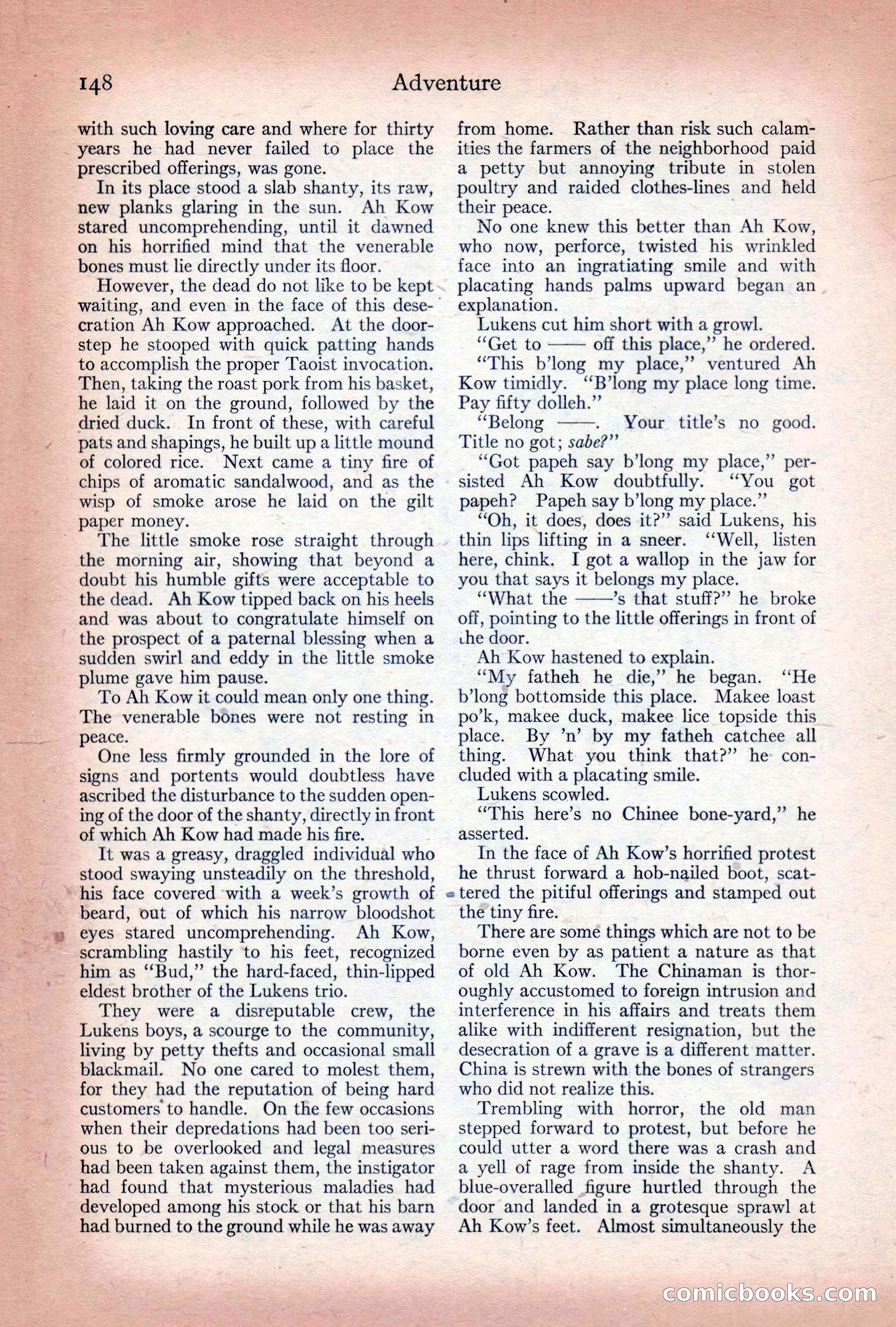
148 with such loving care and where for thirty _ years he had never failed to place the prescribed offerings, was gone. In its place stood a slab shanty, its raw, new planks glaring in the sun. Ah Kow stared uncomprehending, until it dawned on his horrified mind that the venerable bones must lie directly under its floor. However, the dead do not like to be kept waiting, and even in the face of this dese- cration Ah Kow approached. At the door- step he stooped with quick patting hands to accomplish the proper Taoist invocation. Then, taking the roast pork from his basket, he laid it on the ground, followed by the dried duck. In front of these, with careful pats and shapings, he built up a little mound of colored rice. Next came a tiny fire of chips of aromatic sandalwood, and as the wisp of smoke arose he laid on the gilt paper money. The little smoke rose straight through the morning air, showing that beyond a doubt his humble gifts were acceptable to the dead. Ah Kow tipped back on his heels and was about to congratulate himself on the prospect of a paternal blessing when a sudden swirl and eddy in the little smoke plume gave him pause. To Ah Kow it could mean only one thing. The venerable bones were not resting in peace. One less firmly grounded in the lore of signs and portents would doubtless have ascribed the disturbance to the sudden open- ing of the door of the shanty, directly in front of which Ah Kow had made his fire. It was a greasy, draggled individual who stood swaying unsteadily on the threshold, ' his face covered with a week’s growth of beard, out of which his narrow bloodshot eyes stared uncomprehending. Ah Kow, scrambling hastily to his feet, recognized him as “Bud,” the hard-faced, thin-lipped eldest brother of the Lukens trio. They were a disreputable crew, the Lukens boys, a scourge to the community, living by petty thefts and occasional small blackmail. No one cared to molest them, for they had the reputation of being hard customers to handle. On the few occasions when their depredations had been too seri- ous to be overlooked and legal measures had been taken against them, the instigator had found that mysterious maladies had developed among his stock or that his barn had burned to the ground while he was away Adventure from home. Rather than risk such calam- ities the farmers of the neighborhood paid a petty but annoying tribute in stolen poultry and raided clothes-lines and held their peace. No one knew this better than Ah Kow, who now, perforce, twisted his wrinkled face into an ingratiating smile and with placating hands palms upward began an explanation. Lukens cut him short with a growl. “Get to off this place,”’ he ordered. “This b’long my place,” ventured Ah Kow timidly. ‘“B’long my place long time. Pay fifty dolleh.” “Belong Title no got; sabe?” “Got papeh say b’long my place,”’ per- sisted Ah Kow doubtfully. “You got papeh? Papeh say b’long my place.” “Oh, it does, does it?” said Lukens, his thin lips lifting in a sneer. ‘Well, listen here, chink. I got a wallop in the jaw for you that says it belongs my place. “What the ’s that stuff?” he broke off, pointing to the little offerings in front of the door. Ah Kow hastened to explain. “My fatheh he die,” he began. “He b’long bottomside this place. Makee loast po’k, makee duck, makee lice topside this place. By ’n’ by my fatheh catchee all thing. What you think that?” he con- cluded with a placating smile. Lukens scowled. ‘This here’s no Chinee bone-yard,” he asserted. In the face of Ah Kow’s horrified protest he thrust forward a hob-nailed boot, scat- Your title’s no good. «tered the pitiful offermgs and stamped out the tiny fire. There are some things which are not to be borne even by as patient a nature as that of old Ah Kow. The Chinaman is thor- oughly accustomed to foreign intrusion and interference in his affairs and treats them alike with indifferent resignation, but the desecration of a grave is a different matter. China is strewn with the bones of strangers who did not realize this. Trembling with horror, the old man stepped forward to protest, but before he could utter a word there was a crash and a yell of rage from inside the shanty. A blue-overalled figure hurtled through the door and landed in a grotesque sprawl at Ah Kow’s feet. Almost simultaneously the Gomichoo “S' (E)