
Pulp Fiction, 1922 · page 103 of 200
Adventure Magazine Cover, December 10, 1922 — page 103: what you’re looking at
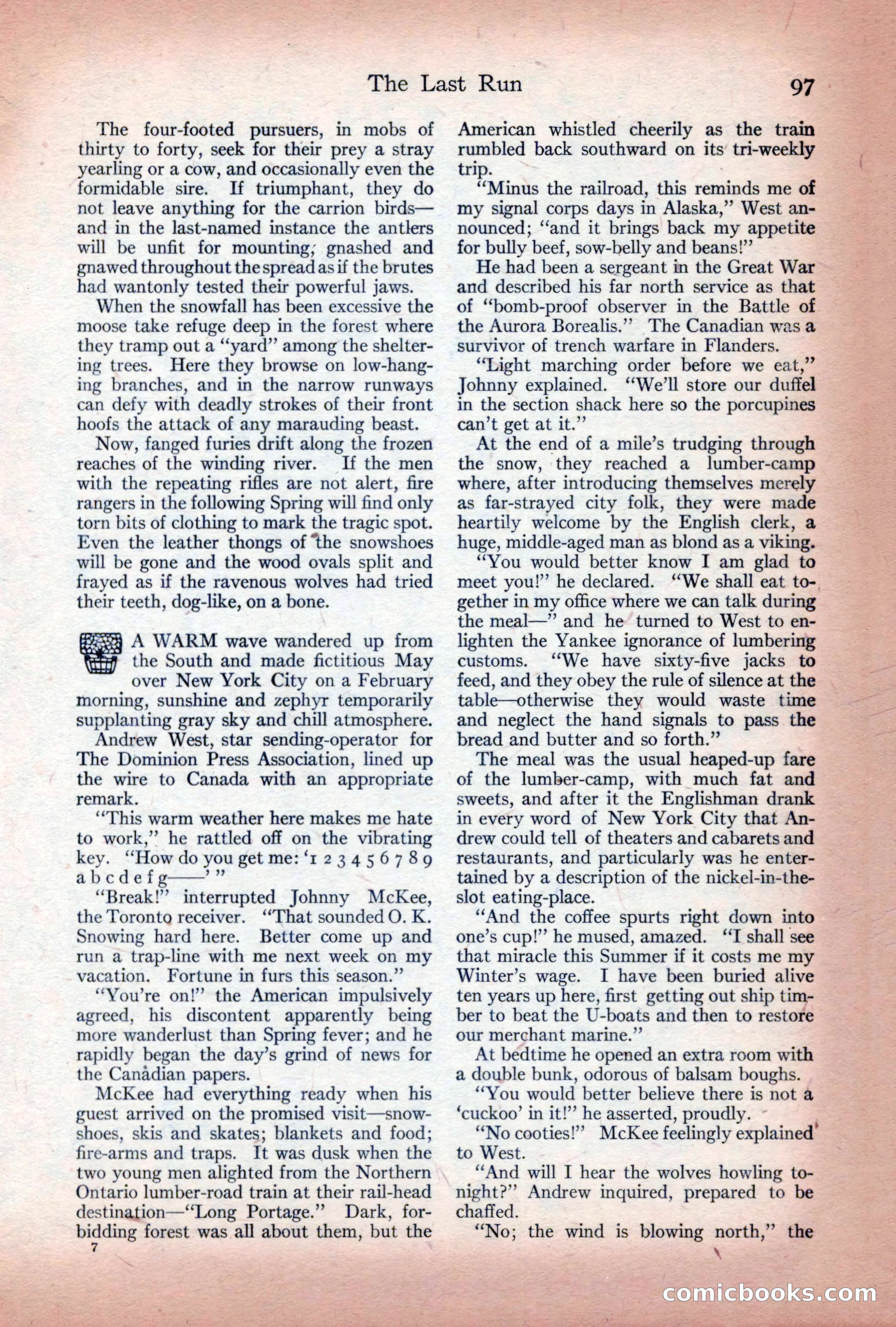
A restored page from Pulp Fiction, 1922. Page through the whole issue in the reader above.
📄 Transcribed text from this page (OCR, searchable)
Machine-transcribed from the original scan — historical spelling and the odd misread are preserved.
The Last Run The four-footed pursuers, in mobs of thirty to forty, seek for their prey a stray yearling or a cow, and occasionally even the formidable sire. If triumphant, they do not leave anything for the carrion birds— and in the last-named instance the antlers will be unfit for mounting; gnashed and gnawed throughout the spread asif the brutes had wantonly tested their powerful jaws. When the snowfall has been excessive the moose take refuge deep in the forest where they tramp out a “‘yard’’ among the shelter- ing trees. Here they browse on low-hang- ing branches, and in the narrow runways can defy with deadly strokes of their front hoofs the attack of any marauding beast. Now, fanged furies drift along the frozen reaches of the winding river. If the men with the repeating rifles are not alert, fire rangers in the following Spring will find only torn bits of clothing to mark the tragic spot. Even the leather thongs of ‘the snowshoes will be gone and the wood ovals split and frayed as if the ravenous wolves had tried their teeth, dog-like, on a bone. A WARM wave wandered up from the South and made fictitious May over New York City on a February morning, sunshine and zephyr temporarily supplanting gray sky and chill atmosphere. Andrew West, star sending-operator for The Dominion Press Association, lined up the wire to Canada with an appropriate remark. ‘“‘This warm weather here makes me hate to work,” he rattled off on the vibrating key. ‘How do you get me: ‘1 23456789 abcdefg— ” “Break!” interrupted Johnny McKee, the Toronto receiver. ‘That sounded O. K. Snowing hard here. Better come up and run a trap-line with me next week on my vacation. Fortune in furs this season.” “Vou’re on!” the American impulsively agreed, his discontent apparently being more wanderlust than Spring fever; and he rapidly began the day’s grind of news for the Canadian papers. McKee had everything ready when his guest arrived on the promised visit—snow- shoes, skis and skates; blankets and food; fire-arms and traps. It was dusk when the two young men alighted from the Northern Ontario lumber-road train at their rail-head destination—‘‘Long Portage.” Dark, for- bidding forest was all about them, but the American whistled cheerily as the train rumbled back southward on its’ tri-weekly trip. “Minus the railroad, this reminds me of my signal corps days in Alaska,” West an- nounced; “and it brings back my appetite for bully beef, sow-belly and beans!” He had been a sergeant in the Great War and described his far north service as that of “bomb-proof observer in the Battle of the Aurora Borealis.”” The Canadian was a survivor of trench warfare in Flanders. “Light marching order before we eat,” Johnny explained. ‘‘We’ll store our duffel in the section shack here so the porcupines can’t get at it.” At the end of a mile’s trudging through the snow, they reached a_ lumber-camp where, after introducing themselves merely as far-strayed city folk, they were made heartily welcome by the English clerk, a huge, middle-aged man as blond as a viking. “You would better know I am glad to meet you!” he declared. ‘We shall eat to-. gether in my office where we can talk during the meal—” and he turned to West to en- lighten the Yankee ignorance of lumbering customs. ‘‘We have sixty-five jacks to feed, and they obey the rule of silence at the table—otherwise they would waste time and neglect the hand signals to pass the bread and butter and so forth.” The meal was the usual heaped-up fare of the lumber-camp, with much fat and sweets, and after it the Englishman drank in every word of New York City that An- drew could tell of theaters and cabarets and restaurants, and particularly was he enter- tained by a description of the nickel-in-the- slot eating-place. “And the coffee spurts right down into one’s cup!’”’ he mused, amazed. “I shall see that miracle this Summer if it costs me my Winter’s wage. I have been buried alive ten years up here, first getting out ship tim- ber to beat the U-boats and then to restore our merchant marine.” At bedtime he opened an extra room with a double bunk, odorous of balsam boughs. “You would better believe there is not a ‘cuckoo’ in it!”’ he asserted, proudly. ~ “No cooties!”” McKee feelingly explained’ to West. ‘“‘And will I hear the wolves howling to- night?”’? Andrew inquired, prepared to be chaffed. “No; the wind is blowing north,” the \ ; Eomicbooks 97 2 (E(0) te ae ee ee