
Pulp Fiction, 1922 · page 86 of 200
Adventure Magazine Cover — page 86: what you’re looking at
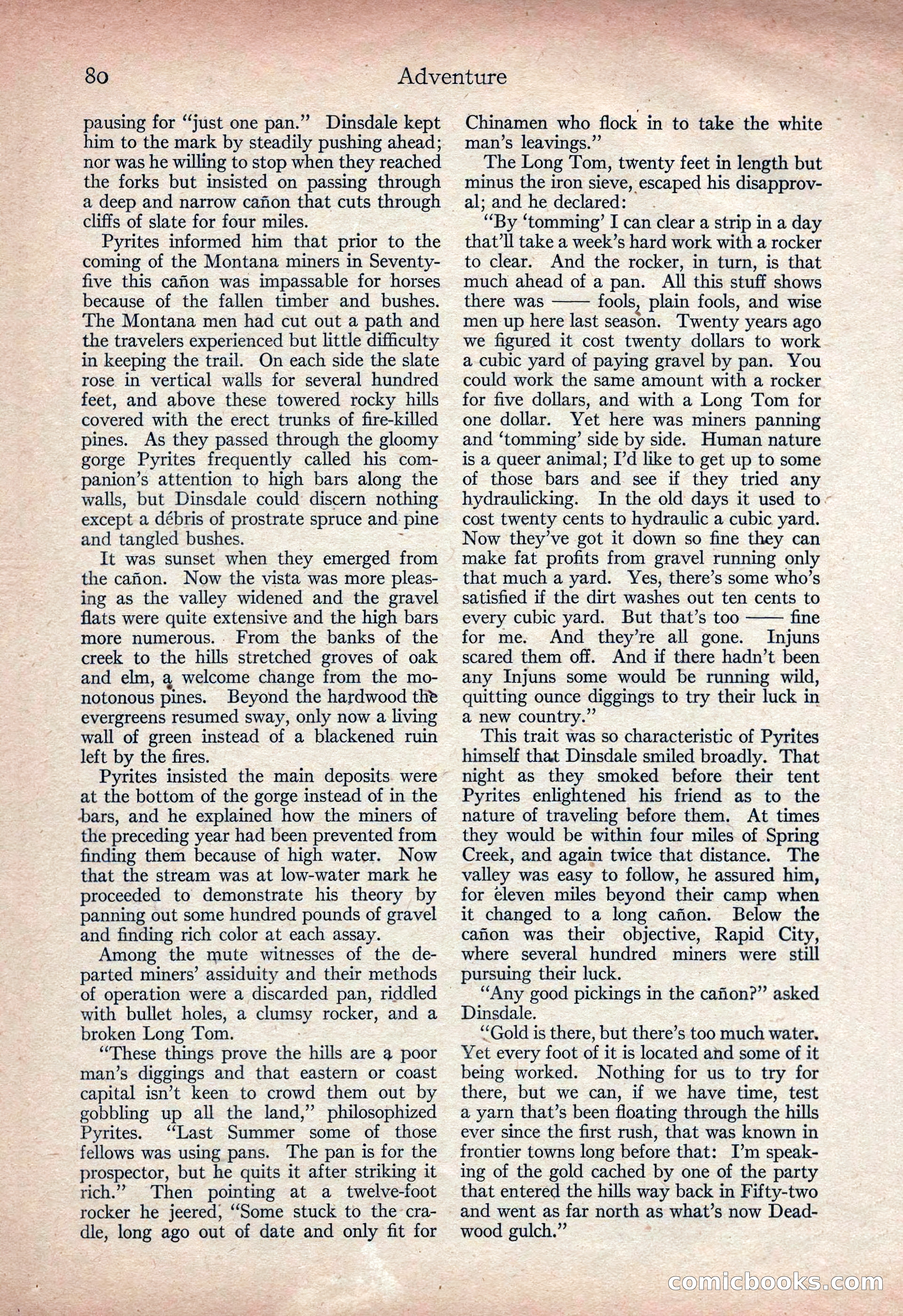
A restored page from Pulp Fiction, 1922. Page through the whole issue in the reader above.
📄 Transcribed text from this page (OCR, searchable)
Machine-transcribed from the original scan — historical spelling and the odd misread are preserved.
Ga So ry 80 pausing for “just one pan.” Dinsdale kept him to the mark by steadily pushing ahead; nor was he willing to stop when they reached the forks but insisted on passing through a deep and narrow cafion that cuts through cliffs of slate for four miles. Pyrites informed him that prior to the coming of the Montana miners in Seventy- five this cafion was impassable for horses because of the fallen timber and bushes. The Montana men had cut out a path and the travelers experienced but little difficulty in keeping the trail. On each side the slate rose in vertical walls for several hundred feet, and above these towered rocky hills covered with the erect trunks of fire-killed pines. As they passed through the gloomy gorge Pyrites frequently called his com- panion’s attention to high bars along the walls, but Dinsdale could discern nothing except a débris of prostrate spruce and ‘pine and tangled bushes. It was sunset when they emerged from the cafion. Now the vista was more pleas- ing as the valley widened and the gravel flats were quite extensive and the high bars more numerous. From the banks of the creek to the hills stretched groves of oak and elm, a welcome change from the mo- notonous pines. Beyond the hardwood the evergreens resumed sway, only now a living wall of green instead of a blackened ruin left by the fires. Pyrites insisted the main deposits. were at the bottom of the gorge instead of in the bars, and he explained how the miners of the preceding year had been prevented from finding them because of high water. Now that the stream was at low-water mark he proceeded to demonstrate his theory by panning out some hundred pounds of gravel and finding rich color at each assay. Among the mute witnesses of the de- parted miners’ assiduity and their methods of operation were a discarded pan, riddled — with bullet holes, a clumsy rocker, and a broken Long Tom. “These things prove the hills are 4 poor man’s diggings and that eastern or coast capital isn’t keen to crowd them out by gobbling up all the land,” philosophized Pyrites. ‘Last Summer some of those fellows was using pans. The pan is for the prospector, but he quits it after striking it rich.” Then pointing at a_twelve-foot rocker he jeered, “Some stuck to the cra- dle, long ago out of date and only fit for Adventure Chinamen who flock in to take the white — man’s leavings.”’ The Long Tom, twenty feet in length but minus the iron sieve, escaped his disapprov- al; and he declared: “By “‘tomming’ I can clear a strip in a day that’ll take a week’s hard work with a rocker to clear. And the rocker, in turn, is that much ahead of a pan. All this stuff shows there was fools, plain fools, and wise men up here last season. Twenty years ago we figured it cost twenty dollars to work a cubic yard of paying gravel by pan. You could work the same amount with a rocker for five dollars, and with a Long Tom for one dollar. Yet here was miners panning and ‘tomming’ side by side. Human nature is a queer animal; I’d like to get up to some of those bars and see if they tried any hydraulicking. In the old days it used to~ cost twenty cents to hydraulic a cubic yard. Now they’ve got it down so fine they can make fat profits from gravel running only that much a yard. Yes, there’s some who’s satisfied if the dirt washes out ten cents to every cubic yard. But that’s too fine for me. And they’re all gone. Injuns scared them off. And if there hadn’t been any Injuns some would be running wild, quitting ounce diggings to try their luck in a new country.” This trait was so characteristic of Pyrites himself that Dinsdale smiled broadly. That night as they smoked before their tent Pyrites enlightened his friend as to the nature of traveling before them. At times they would be within four miles of Spring Creek, and again twice that distance. The valley was easy to follow, he assured him, for eleven miles beyond their camp when it changed to a long cafion. Below the cafion was their objective, Rapid City, where several hundred miners were still pursuing their luck. “Any good pickings in the cafion?” asked Dinsdale. “Gold is there, but there’s too much water. Yet every foot of it is located and some of it being worked. Nothing for us to try for there, but we can, if we have time, test a yarn that’s been floating through the hills ever since the first rush, that was known in frontier towns long before that: I’m speak- ing of the gold cached by one of the party that entered the hills way back in Fifty-two and went as far north as what’s now Dead- wood gulch.” Eomichbooks (E@) |