
Pulp Fiction, 1922 · page 79 of 200
Adventure Magazine Cover — page 79: what you’re looking at
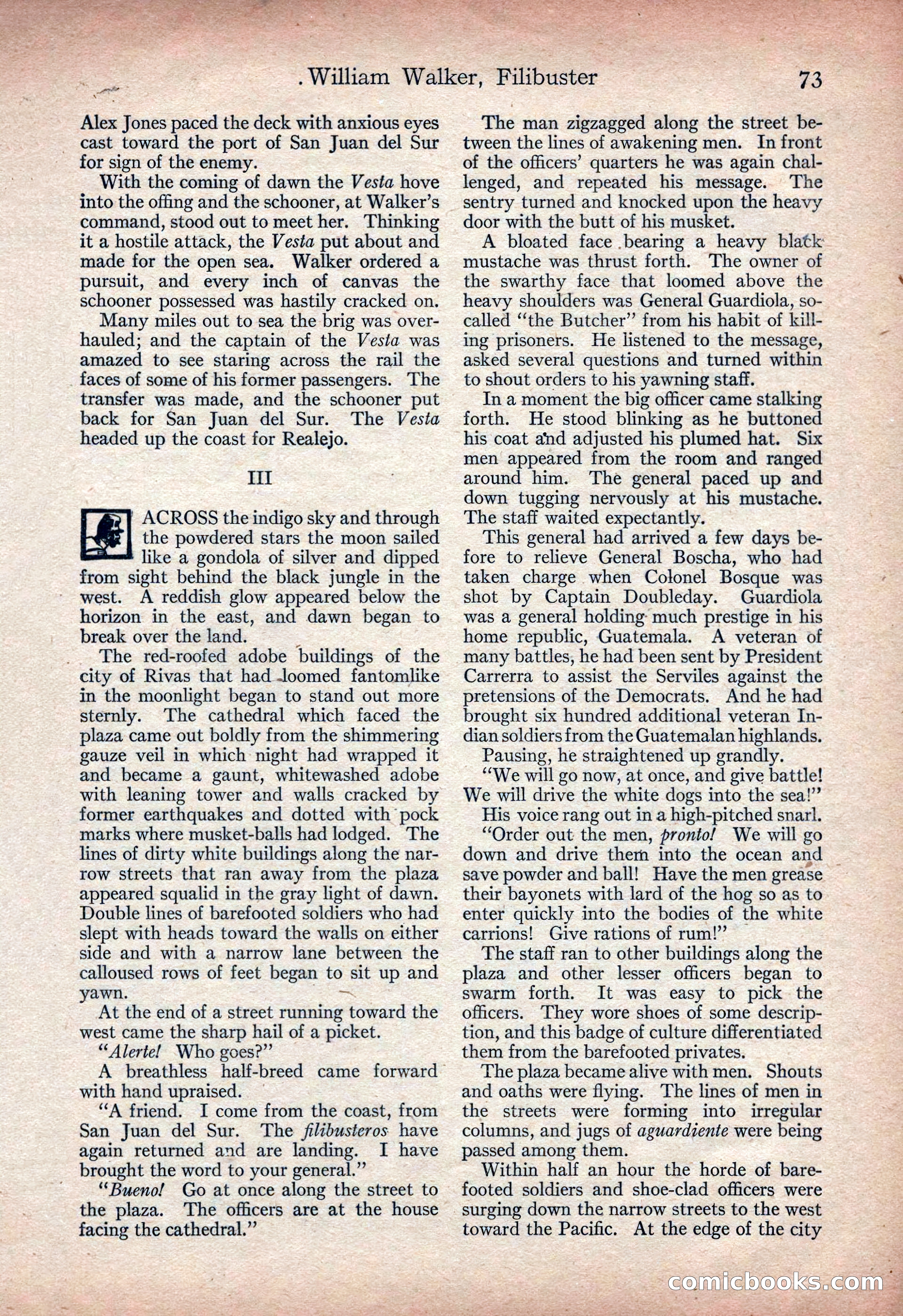
A restored page from Pulp Fiction, 1922. Page through the whole issue in the reader above.
📄 Transcribed text from this page (OCR, searchable)
Machine-transcribed from the original scan — historical spelling and the odd misread are preserved.
William Walker “Filibuster Alex Jones paced the deck with anxious eyes _ cast toward the port of San Juan del Sur for sign of the enemy. With the coming of dawn the Vesta hove into the offing and the schooner, at Walker’s command, stood out to meet her. Thinking it a hostile attack, the Vesta put about and made for the open sea. Walker ordered a pursuit, and every inch of canvas the schooner possessed was hastily cracked on. Many miles out to sea the brig was over- hauled; and the captain of the Vesta was amazed to see staring across the rail the faces of some of his former passengers. The transfer was made, and the schooner put back for San Juan del Sur. The Vesia headed up the coast for Realejo. Ill ACROSS the indigo sky and through the powdered stars the moon sailed like a gondola of silver and dipped from sight behind the black jungle in the west. A reddish glow appeared below the horizon in the east, and dawn began to break over the land. 2 _ The red-roofed adobe buildings of the city of Rivas that had loomed fantomlike in the moonlight began to stand out more sternly. The cathedral which faced the plaza came out boldly from the shimmering gauze veil in which night had wrapped it and became a gaunt, whitewashed adobe with leaning tower and walls cracked by former earthquakes and dotted with pock marks where musket-balls had lodged. The lines of dirty white buildings along the nar- row streets that ran away from the plaza appeared squalid in the gray light of dawn. Double lines of barefooted soldiers who had slept with heads toward the walls on either side and with a narrow lane between the calloused rows of feet began to sit up and yawn. | At the end of a street running toward the west came the sharp hail of a picket. ““Alerte! Who goes?” ™~ A. breathless half-breed came forward with hand upraised. ‘“‘A friend. I come from the coast, from San Juan del Sur. The filibusteros have again returned and are landing. I have brought the word to your general.” “Bueno! Go at once along the street to the plaza. The officers are at the house facing the cathedral.” 73 The man zigzagged along the street be- tween the lines of awakening men. In front of the officers’ quarters he was again chal- lenged, and repeated his message. The sentry turned and knocked upon the heavy door with the butt of his musket. A bloated face bearing a heavy blatk mustache was thrust forth. The owner of the swarthy face that loomed above the heavy shoulders was General Guardiola, so- called ‘the Butcher” from his habit of kill- ing prisoners. He listened to the message, asked several questions and turned within to shout orders to his yawning staff. In a moment the big officer came stalking forth. He stood blinking as he buttoned his coat and adjusted his plumed hat. Six men appeared from the room and ranged around him. ‘The general paced up and down tugging nervously at his mustache. The staff waited expectantly. This general had arrived a few days be- fore to relieve General Boscha, who had taken charge when Colonel Bosque was shot by Captain Doubleday. Guardiola was a general holding: much prestige in his home republic, Guatemala. A veteran of many battles, he had been sent by President Carrerra to assist the Serviles against the pretensions of the Democrats. And he had brought six hundred additional veteran In- dian soldiers from the Guatemalan highlands. Pausing, he straightened up grandly. “We will go now, at once, and give battle! We will drive the white dogs into the sea!” His voice rang out in a high-pitched snarl. “Order out the men, pronto! We will go per pit) down and drive thern into the ocean and _ save powder and ball! Have the men grease their bayonets with lard of the hog so as to enter quickly into the bodies of the white carrions! Give rations of rum!” The staff ran to other buildings along the plaza and other lesser officers began to swarm forth. It was easy to pick the officers. They wore shoes of some descrip- tion, and this badge of culture differentiated them from the barefooted privates. The plaza became alive with men. Shouts and oaths were flying. The lines of men in the streets were forming into irregular columns, and jugs of aguardzente were being passed among them. Within half an hour the horde of bare- footed soldiers and shoe-clad officers were surging down the narrow streets to the west toward the Pacific. At the edge of the city Eomicboo G cS ‘a4 - "i “a ee (EO) ait : ‘ A o> * a ee - .~ . = * a. ee es <tr.