
Pulp Fiction, 1922 · page 77 of 200
Adventure Magazine Cover — page 77: what you’re looking at
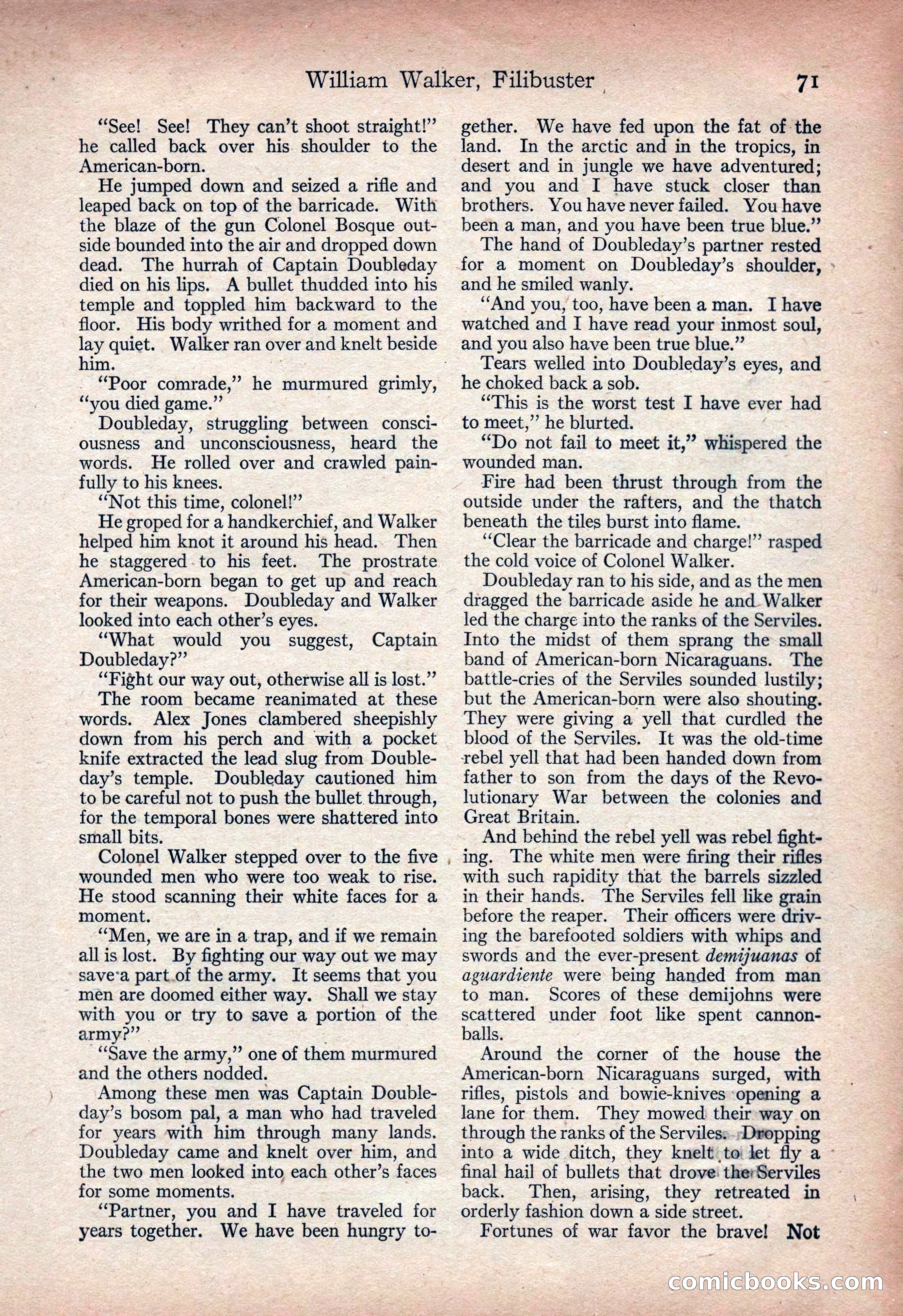
A restored page from Pulp Fiction, 1922. Page through the whole issue in the reader above.
📄 Transcribed text from this page (OCR, searchable)
Machine-transcribed from the original scan — historical spelling and the odd misread are preserved.
William Walker, Filibuster “See! See! They can’t shoot straight!” he called back over his shoulder to the American-born. He jumped down and seized a rifle and leaped back on top of the barricade. With the blaze of the gun Colonel Bosque out- side bounded into the air and dropped down dead. The hurrah of Captain Doubleday died on his lips. A bullet thudded into his temple and toppled him backward to the floor. His body writhed for a moment and lay quiet. Walker ran over and knelt beside him. - “Poor comrade,” “vou died game.” Doubleday, struggling between consci- he murmured grimly, ousness and unconsciousness, heard the words. He rolled over and crawled pain- fully to his knees. “Not this time, colonel!” He groped for a handkerchief, and Walker helped him knot it around his head. Then he staggered-.to his feet. The prostrate American-born began to get up and reach for their weapons. Doubleday and Walker looked into each other’s eyes. “What would you suggest, Doubleday?” “Fight our way out, otherwise all is lost.” The room became reanimated at these words. Alex Jones clambered sheepishly down from his perch and with a pocket knife extracted the lead slug from Double- day’s temple. Doubleday cautioned him to be careful not to push the bullet through, for the temporal bones were shattered into small bits. Captain Colonel Walker stepped over to the five , wounded men who were too weak to rise. He stood scanning their white faces for a moment. “Men, we are in a trap, and if we remain all is lost. By fighting our way out we may save’a part.of the army. It seems that you men are doomed either way. Shall we stay with you or try to save a portion of the army?” | “Save the army,” one of them murmured and the others nodded. Among these men was Captain Double- day’s bosom pal, a man who had traveled for years with him through many lands. Doubleday came and knelt over him, and the two men looked into each other’s faces for some moments. “Partner, you and I have traveled for years together. We have been hungry to- hie tie - vA _— - i Nig sete gether. We have fed upon the fat of the land. In the arctic and in the tropics, in desert and in jungle we have adventured; and you and I have stuck closer than brothers. You have never failed. You have been a man, and you have been true blue.” The hand of Doubleday’s partner rested 71 for a moment on Doubleday’s shoulder, > and he smiled wanly. ‘‘And you, too, have been a man. I have watched and I have read your inmost soul, and you also have been true blue.” Tears welled into Doubleday’s eyes, and he choked back a sob. “This is the worst test I have ever had to meet,” he blurted. “Do not fail to meet it,” eee the wounded man. Fire had been thrust through from the outside under the rafters, and the thatch beneath the tiles burst into flame. ‘Clear the barricade and charge!”’ rasped the cold voice of Colonel Walker. Doubleday ran to his side, and as the men dragged the barricade aside he and. Walker led the charge into the ranks of the Serviles. Into the midst of them sprang the small band of American-born Nicaraguans. The battle-cries of the Serviles sounded lustily; but the American-born were also shouting. They were giving a yell that curdled the blood of the Serviles. It was the old-time rebel yell that had been handed down from father to son from the days of the Revo- lutionary War between the colonies and Great Britain. And behind the rebel yell was rebel fight- ing. The white men were firing their rifles with such rapidity that the barrels sizzled in their hands. The Serviles fell like grain before the reaper. Their officers were driv- ing the barefooted soldiers with whips and swords and the ever-present demijuanas of aguardiente were being handed from man to man. Scores of these demijohns were scattered under foot like spent cannon- balls. Around the corner of the house the American-born Nicaraguans surged, with rifles, pistols and bowie-knives ‘opening a lane for them. They mowed their way on through the ranks of the Serviles:.;Dropping into a wide ditch, they knelt to let fly a - final hail of bullets that drove: therServiles back. Then, arising, they retreated in orderly fashion down a side street. Fortunes of war favor the brave! Not (6) MIE cS 0\(0 (0) (EO)