
Pulp Fiction, 1922 · page 73 of 200
Adventure Magazine Cover — page 73: what you’re looking at
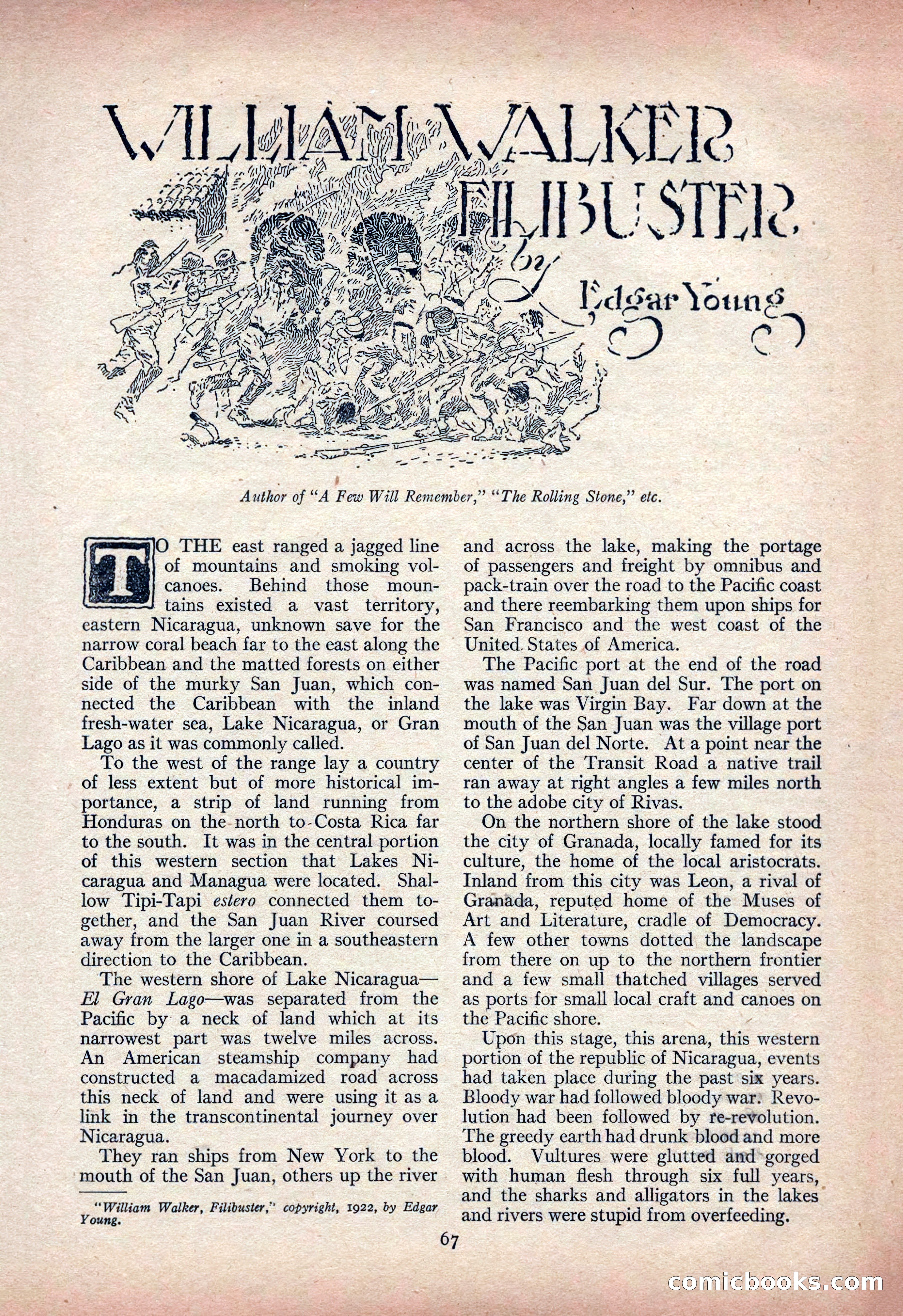
A restored page from Pulp Fiction, 1922. Page through the whole issue in the reader above.
📄 Transcribed text from this page (OCR, searchable)
Machine-transcribed from the original scan — historical spelling and the odd misread are preserved.
Y) NS ie Ww ~ oS AyAL AE Ie oy ey a pede, . a a, 49 oe ce @ ee Ora TO <p Peetu m6 hes Gy Ss ee , me oe ee “3 Nt : Zit er td Oa. of 2 i Dos es Mie hy gS age eX, ees. Ter WSO, Bs asl) CORLEY WZ ST a BAS Author of “A Few Will Remember,” ‘The Rolling Stone,” etc. j}O0 THE east ranged a jagged line of mountains and smoking vol- canoes. Behind those moun- tains existed a vast territory, eastern Nicaragua, unknown save for the narrow coral beach far to the east along the Caribbean and the matted forests on either side of the murky San Juan, which con- nected the Caribbean with the inland fresh-water sea, Lake Nicaragua, or Gran Lago as it was commonly called. To the west of the range lay a country of less extent but of more historical im- portance, a strip of land running from Honduras on the-north to-Costa Rica far to the south. It was in the central portion of this western section that Lakes Ni- caragua and Managua were located. Shal- low Tipi-Tapi estero connected them to- gether, and the San Juan River coursed away from the larger one in a southeastern direction to the Caribbean. The western shore of Lake Nicaragua— El Gran Lago—was separated from the Pacific by a neck of land which at its narrowest part was twelve miles across. An American steamship company had constructed a macadamized road across this neck of land and were using it as a link in the transcontinental journey over Nicaragua. They ran ships from New York to the mouth of the San Juan, others up the river “William Walker, Filibuster,” Young. copyright, 1922, by Edgar 07 and across the lake, making the portage of passengers and freight by omnibus and pack-train over the road to the Pacific coast and there reembarking them upon ships for San Francisco and the west coast of the United. States of America. The Pacific port at the end of the road was named San Juan del Sur. The port on the lake was Virgin Bay. Far down at the mouth of the San Juan was the village port of San Juan del Norte. At a point near the center of the Transit Road a native trail ran away at right angles a few miles north to the adobe city of Rivas. On the northern shore of the lake stood the city of Granada, locally famed for its culture, the home of the local aristocrats. Inland from this city was Leon, a rival of Granada, reputed home of the Muses of Art and Literature, cradle of Democracy. A few other towns dotted the landscape from there on up to the northern frontier and a few small thatched villages served as ports for small local craft and canoes on the Pacific shore. Upon this stage, this ; arena, tks western portion of the republic of Nicaragua, events had taken place during the past six years. Bloody war had followed bloody war: Revo- lution had been followed by re-revolution. The greedy earth had drunk blood and more blood. Vultures were glutted and -gorged with human flesh through six full years, and the sharks and alligators in the lakes” and rivers were stupid from overfeeding. com 5 0)(0\(6)