
Pulp Fiction, 1922 · page 64 of 200
Adventure Magazine Cover — page 64: what you’re looking at
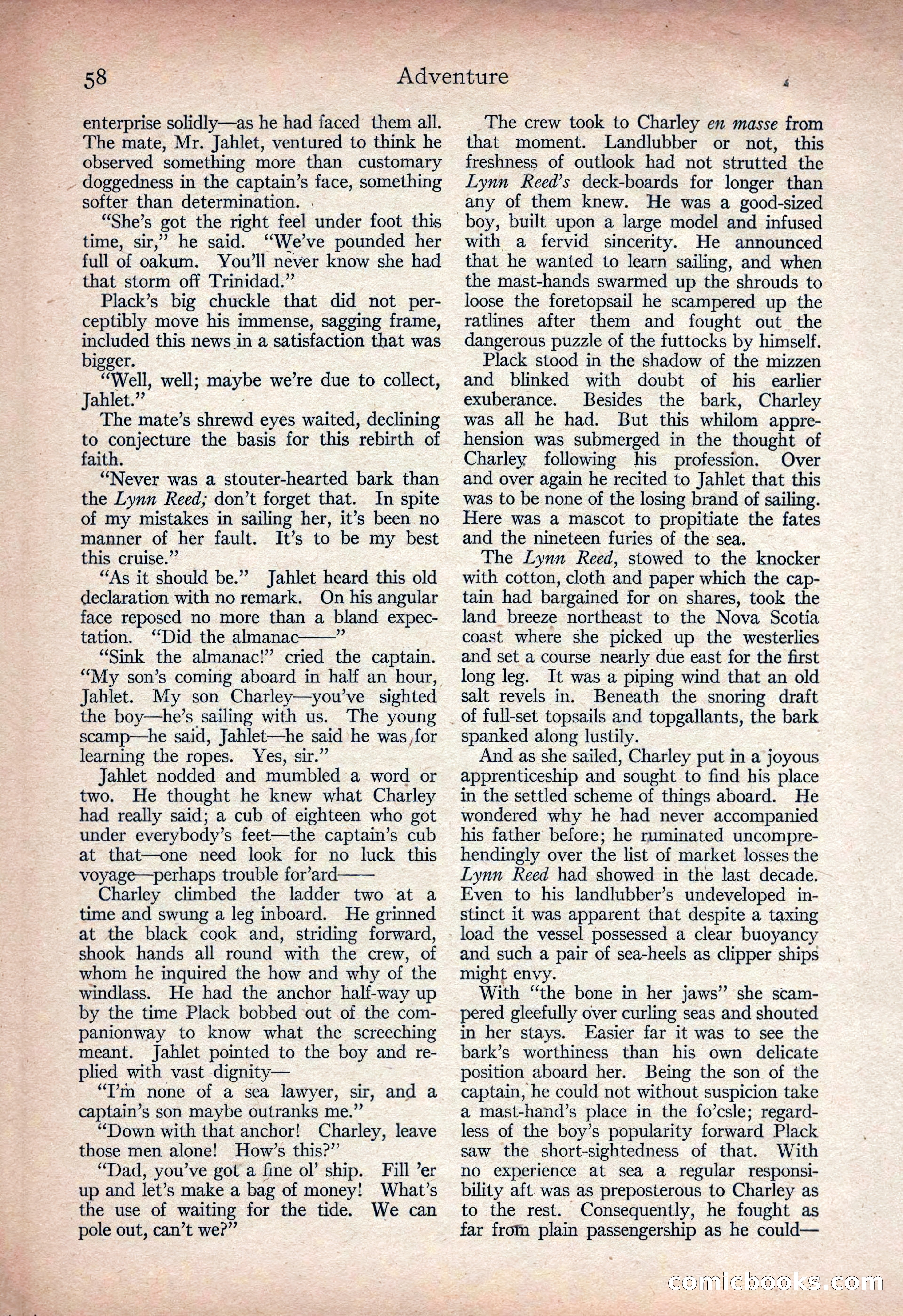
A restored page from Pulp Fiction, 1922. Page through the whole issue in the reader above.
📄 Transcribed text from this page (OCR, searchable)
Machine-transcribed from the original scan — historical spelling and the odd misread are preserved.
58 enterprise solidly—as he had faced them all. The mate, Mr. Jahlet, ventured to think he observed something more than customary _ doggedness in the captain’s face, something softer than determination. . “She’s got the right feel under foot this time, sir,” he said. ‘‘We’ve pounded her full of oakum. You'll never know she had that storm off Trinidad.” Plack’s big chuckle that did not per- ceptibly move his immense, sagging frame, included this news in a satisfaction that was bigger. “Well, well; maybe we're due to collect, Jahlet.” The mate’s shrewd eyes waited, declining to conjecture the basis for this rebirth of faith. “Never was a stouter-hearted bark than the Lynn Reed; don’t forget that. In spite of my mistakes in sailing her, it’s been no manner of her fault. It’s to be my best this cruise.” _ “As it should be.” Jahlet heard this old declaration with no remark. On his angular face reposed no more than a bland expec- tation. “Did the almanac——” “Sink the almanac!” cried the captain. “My son’s coming aboard in half an hour, Jahlet. My son Charley—you’ve sighted the boy—he’s sailing with us. The young scamp—he said, Jahlet—he said he was ,for learning the ropes. Yes, sir.’ Jahlet nodded and mumbled a word or two. He thought he knew what Charley had really said; a cub of eighteen who got under everybody’s feet—the captain’s cub at that—one need look for no luck this voyage—perhaps trouble for’ard Charley climbed the ladder two at a time and swung a leg inboard. He grinned at the black cook and, striding forward, shook hands all round with the crew, of whom he inquired the how and why of the windlass. He had the anchor half-way up by the time Plack bobbed out of the com- panionway to know what the screeching meant. Jahlet pointed to the boy and re- plied with vast dignity— “T’m none of a sea lawyer, sir, and a captain’s son maybe outranks me.” “Down with that anchor! Charley, leave those men alone! How’s this?”’ “Dad, you’ve got a fine ol’ ship. Fill ’er up and let’s make a bag of money! What’s the use of waiting for the tide. We can pole out, can’t we?” Adventure © eS i The crew took to Charley ex masse from that moment. Landlubber or not, this freshness of outlook had not strutted the Lynn Reed’s deck-boards for longer than any of them knew. He was a good-sized boy, built upon a large model and infused with a fervid sincerity. He announced that he wanted to learn sailing, and when the mast-hands swarmed up the shrouds to loose the foretopsail he scampered up the ratlines after them and fought out the dangerous puzzle of the futtocks by himself. Plack stood in the shadow of the mizzen and blinked with doubt of his earlier exuberance. Besides the bark, Charley was all he had. But this whilom appre- hension was submerged in the thought of Charley following his profession. Over and over again he recited to Jahlet that this was to be none of the losing brand of sailing. Here was a mascot to propitiate the fates and the nineteen furies of the sea. The Lynn Reed, stowed to the knocker with cotton, cloth and paper which the cap- tain had bargained for on shares, took the land breeze northeast to the Nova Scotia coast where she picked up the westerlies and set a course nearly due east for the first long leg. It was a piping wind that an old salt revels in. Beneath the snoring draft _ of full-set topsails and topgallants, the bark spanked along lustily. And as she sailed, Charley put in a joyous apprenticeship and sought to find his place in the settled scheme of things aboard. He wondered why he had never accompanied his father before; he ruminated uncompre- hendingly over the list of market losses the Lynn Reed had showed in the last decade. Even to his landlubber’s undeveloped in- stinct it was apparent that despite a taxing load the vessel possessed a clear buoyancy and such a pair of sea-heels as clipper ships might envy. With “the bone in her jaws” she scam- pered gleefully over curling seas and shouted in her stays. Easier far it was to see the bark’s worthiness than his own delicate position aboard her. Being the son of the captain, he could not without suspicion take a mast-hand’s place in the fo’csle; regard- less of the boy’s popularity forward Plack saw the short-sightedness of that. With no experience at sea a regular responsi- bility aft was as preposterous to Charley as to the rest. Consequently, he fought as far from plain passengership as he could— CORMICLOOKS (C (C@)