
Pulp Fiction, 1922 · page 43 of 200
Adventure Magazine Cover — page 43: what you’re looking at
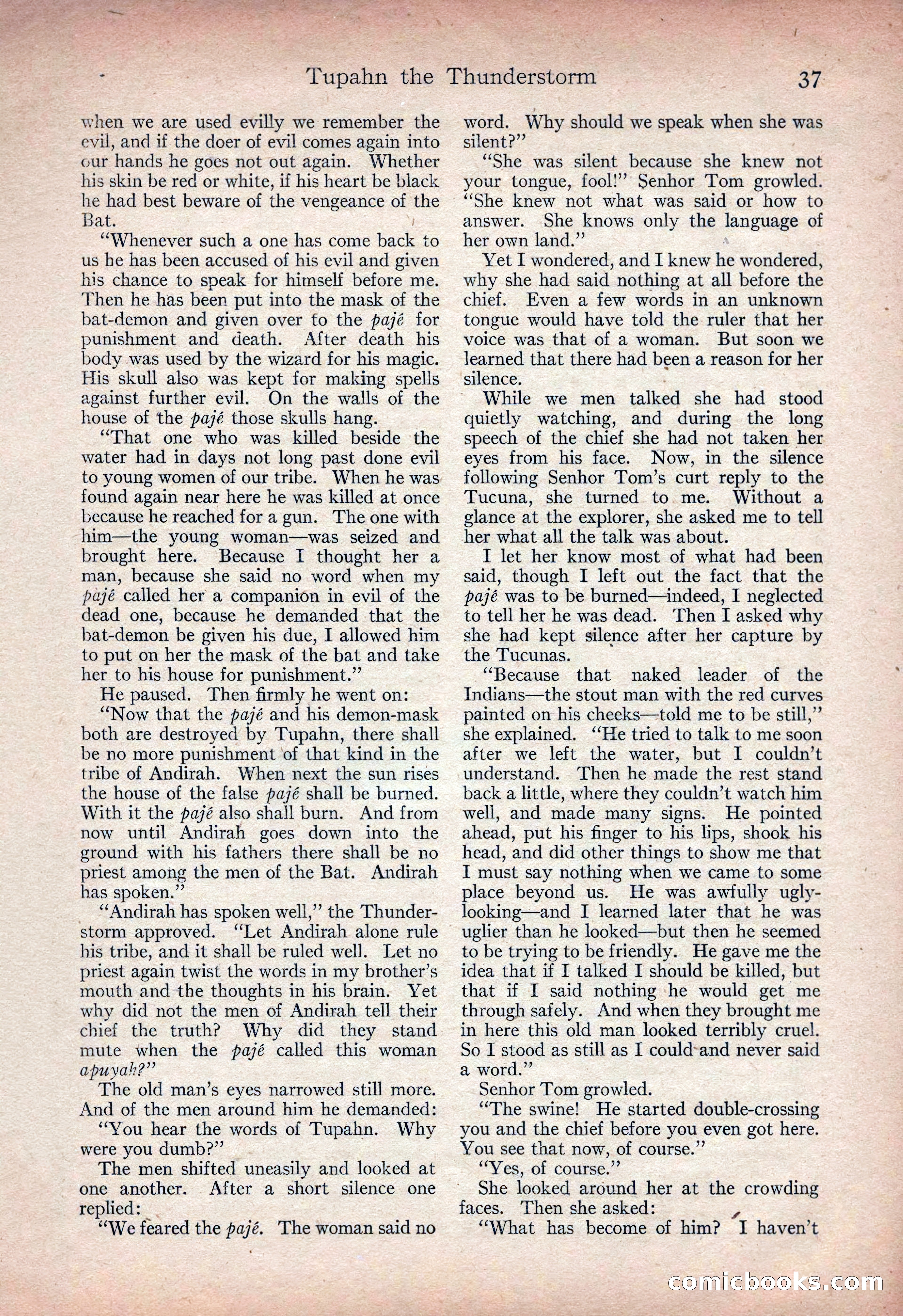
A restored page from Pulp Fiction, 1922. Page through the whole issue in the reader above.
📄 Transcribed text from this page (OCR, searchable)
Machine-transcribed from the original scan — historical spelling and the odd misread are preserved.
: Be 3 Tupahn the Thunderstorm when we are used evilly we remember the evil, and if the doer of evil comes again into our hands he goes not out again. Whether his skin be red or white, if his heart be black he had best beware of the vengeance of the Bat. “Whenever such a one has come back to us he has been accused of his evil and given his chance to speak for himself before me. Then he has been put into the mask of the bat-demon and given over fo the pajé for punishment and death. After death his body was used by the wizard for his magic. His skull also was kept for making spells against further evil. On the walls of the house of the pajé those skulls hang. “That one who was killed beside the water had in days not long past done evil to young women of our tribe. When he was found again near here he was killed at once because he reached for a gun. The one with him—the young woman—was seized and brought here. Because I thought her a man, because she said no word when my pajé called her a companion in evil of the dead one, because he demanded that the bat-demon be given his due, I allowed him to put on her the mask of the bat and take her to his house for punishment.”’ He paused. Then firmly he went on: “Now that the pazé and his demon-mask both are destroyed by Tupahn, there shall be no more punishment of that kind in the tribe of Andirah. When next the sun rises the house of the false pazé shall be burned. With it the pajyé also shall burn. And from now until Andirah goes down into the ground with his fathers there shall be no priest among the men of the Bat. Andirah has spoken.” _ “Andirah has spoken well,” the Thunder- storm approved. “Let Andirah alone rule his tribe, and it shall be ruled well. Let no priest again twist the words in my brother’s mouth and the thoughts in his brain. Yet why did not the men of Andirah tell their chief the truth? Why did they stand mute when the pajé called this woman apuyah?” The old man’s eyes narrowed still more. And of the men around him he demanded: “You hear the words of Tupahn. Why were you dumb?” The men shifted uneasily and looked at one another. . After a short silence one replied: . “We feared the pajé. The woman said no word. Why should we speak when she was silent?” “She was silent because she knew not your tongue, fool!” Senhor Tom growled. “She knew not what was said or how to answer. She knows only the language of her own land.” Yet I wondered, and I knew he wondered, why she had said nothing at all before the chief. Even a few words in an unknown tongue would have told the ruler that her voice was that of a woman. But soon we learned that there had been a reason for her silence. While we men talked she had stood quietly watching, and during the long speech of the chief she had not taken her eyes from his face. Now, in the silence following Senhor Tom’s curt reply to the Tucuna, she turned to me. Without a glance at the explorer, she asked me to tell her what all the talk was about. I let her know most of what had been said, though I left out the fact that the pajé was to be burned—indeed, I neglected to tell her he was dead. Then I asked why she had kept silence after her capture by the Tucunas. “Because that naked leader of the Indians—the stout man with the red curves painted on his cheeks—told me to be still,” she explained. “He tried to talk to me soon after we left the water, but I couldn’t understand. Then he made the rest stand back a little, where they couldn’t watch him well, and made many signs. He pointed ahead, put his finger to his lips, shook his head, and did other things to show me that I must say nothing when we came to some place beyond us. He was awfully ugly- looking—and I learned later that he was uglier than he looked—but then he seemed to be trying to be friendly. He gave me the idea that if I talked I should be killed, but that if I said nothing he would get me through safely. And when they brought me in here this old man looked terribly cruel. So I stood as still as I could-and never said a word.” Senhor Tom growled. “The swine! He started double-crossing you and the chief before you even got here. You see that now, of course.” “Yes, of course.” She looked around her at the crowding faces. Then she asked: “What has become of him? “I haven’t COME 37 (E(0) JOOKS