
Pulp Fiction, 1922 · page 25 of 200
Adventure Magazine Cover — page 25: what you’re looking at
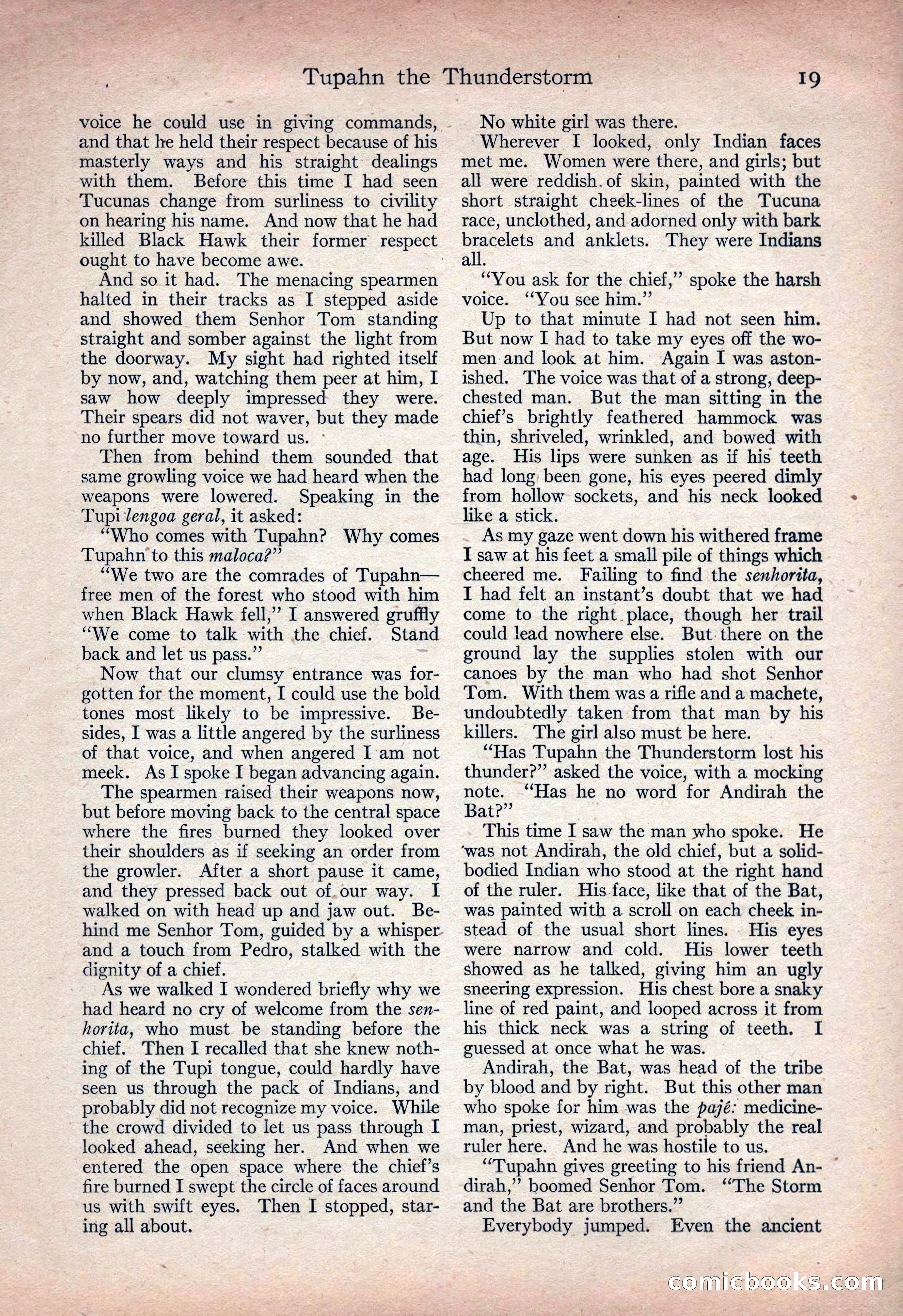
A restored page from Pulp Fiction, 1922. Page through the whole issue in the reader above.
📄 Transcribed text from this page (OCR, searchable)
Machine-transcribed from the original scan — historical spelling and the odd misread are preserved.
Tupahn the Thunderstorm - voice he could use in giving commands, - and that he held their respect because of his masterly ways and his straight dealings with them. Before this time I had seen Tucunas change from surliness to civility on hearing his name. And now that he had killed Black Hawk their former respect ought to have become awe. And so it had. The menacing spearmen halted in their tracks as I stepped aside and showed them Senhor Tom standing straight and somber against the light from the doorway. My sight had righted itself by now, and, watching them peer at him, I saw how deeply impressed they were. Their spears did not waver, but they made no further move toward us. Then from behind them sounded that _ same growling voice we had heard when the weapons were lowered. Speaking in the Tupi lengoa geral, it asked: “Who comes with Tupahn? Why comes Tupahn to this maloca?” ‘“‘We two are the comrades of Tupahn— free men of the forest who stood with him when Black Hawk fell,” I answered gruffly “We come to talk with the chief. Stand back and let us pass.” Now that our clumsy entrance was for- gotten for the moment, I could use the bold tones most likely to be impressive. Be- sides, I was a little angered by the surliness of that voice, and when angered I'am not meek. As I spoke I began advancing again. The spearmen raised their weapons now, but before moving back to the central space where the fires burned they looked over their shoulders as if seeking an order from the growler. After a short pause it came, and they pressed back out of.our way. I walked on with head up and jaw out. Be- hind me Senhor Tom, guided by a whisper. and a touch from Pedro, stalked with the dignity of a chief. As we walked I wondered briefly why we had heard no cry of welcome from the sen- horita, who must. be standing before the chief. Then I recalled that she knew noth- ing of the Tupi tongue, could hardly have seen us through the pack of Indians, and probably did not recognize my voice. While - the crowd divided to let us pass through I looked ahead, seeking her. And when we entered the open space where the chief’s fire burned I swept the circle of faces around us with swift eyes. Then I stopped, star- ing all about. 19 No white girl was there. Wherever I looked, only Indian faces met me. Women were there, and girls; but all were reddish. of skin, painted with the short straight cheek-lines of the Tucuna race, unclothed, and adorned only with bark bracelets and anklets. They were Indians all. “You ask for the chief,’ spoke the harsh voice. ‘You see him.” Up to that minute I had not seen him. But now I had to take my eyes off the wo- men and look at him. Again I was aston- ished. The voice was that of a strong, deep- chested man. But the man sitting in the chief’s brightly feathered hammock was thin, shriveled, wrinkled, and bowed with age. His lips were sunken as if his teeth had long: been gone, his eyes peered dimly from hollow sockets, and his neck looked like a stick. As my gaze went down his withered frame I saw at his feet a small pile of things which cheered me. Failing to find the senhorita, I had felt an instant’s doubt that we had come to the right place, though her trail could lead nowhere else. But: there on the ground lay the supplies stolen with our canoes by the man who had shot Senhor Tom. With them was a rifle and a machete, undoubtedly taken from that man by his killers. The girl also must be here. “Has Tupahn the Thunderstorm lost his thunder?”’ asked the voice, with a mocking note. ‘Has he no word for Andirah the Bat?”’ This time I saw the man who spoke. He ‘was not Andirah, the old chief, but a solid- bodied Indian who stood at the right hand of the ruler. His face, like that of the Bat, was painted with a scroll on each cheek in- stead of the usual short lines. His eyes were narrow and cold. His lower teeth showed as he talked, giving him an ugly sneering expression. His chest bore a snaky line of red paint, and looped across it from his thick neck was a string of teeth. I guessed at once what he was. Andirah, the Bat, was head of the tribe by blood and by right. But this other man who spoke for him was the pajé: medicine- man, priest, wizard, and probably the real ruler here. And he was hostile to us. “Tupahn gives greeting to his friend An- © dirah,’’ boomed Senhor Tom. and the Bat are brothers.” Everybody jumped. Even the ancient “The Storm <S' GEomichoo (0)