
Pulp Fiction, 1922 · page 21 of 200
Adventure Magazine Cover — page 21: what you’re looking at
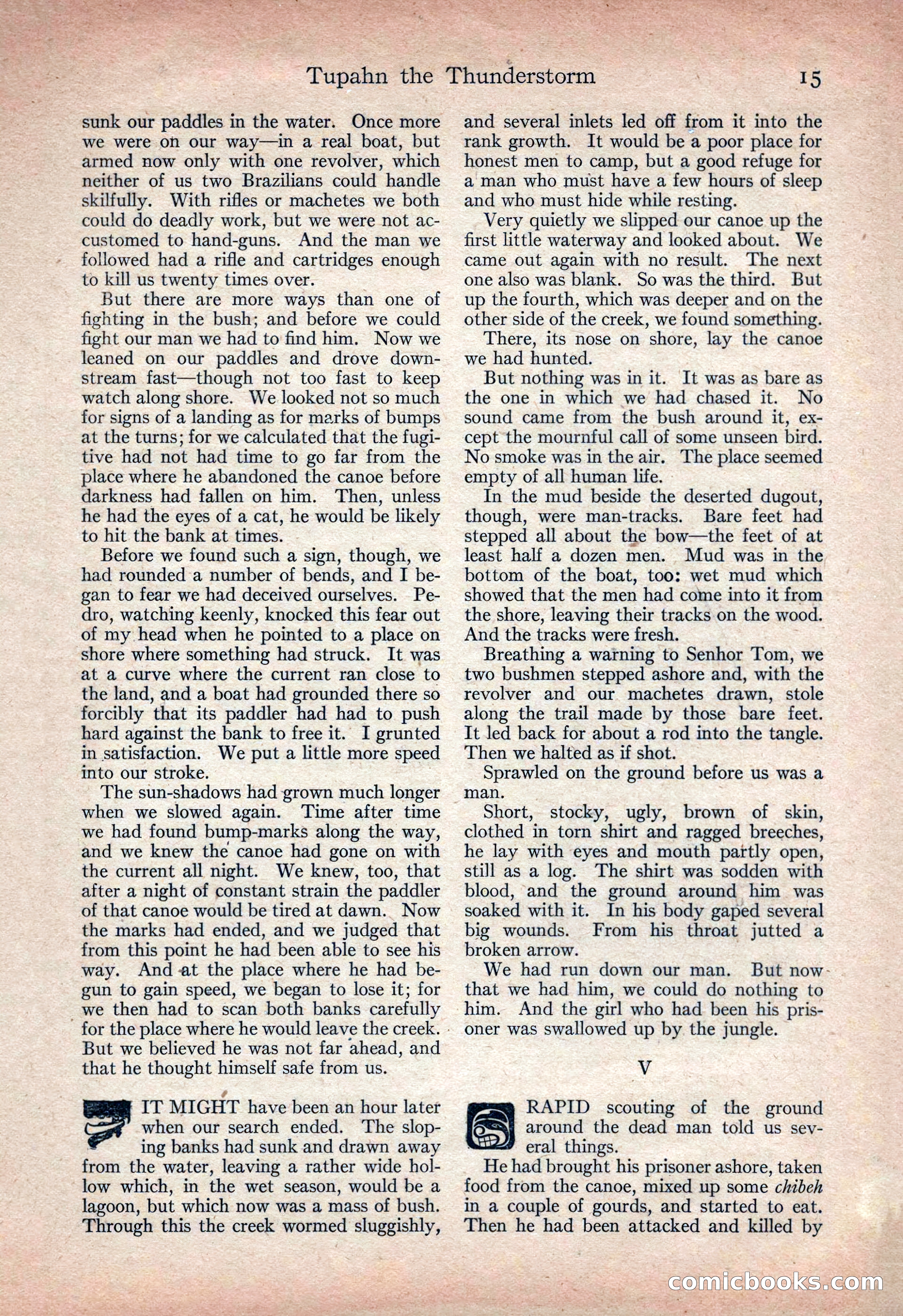
A restored page from Pulp Fiction, 1922. Page through the whole issue in the reader above.
📄 Transcribed text from this page (OCR, searchable)
Machine-transcribed from the original scan — historical spelling and the odd misread are preserved.
Tupahn the Thunderstorm sunk our paddles in the water. Once more we were on our way—in a real boat, but armed now only with one revolver, which neither of us two Brazilians could handle skilfully. With rifles or machetes we both could do deadly work, but we were not ac- customed to hand-guns. And the man we followed had a rifle and cartridges enough to kill us twenty times over. : But there are more ways than one of fighting in the bush; and before we could fight our man we had to find him. Now we leaned on our paddles and drove down- stream fast—though not too fast to keep watch along shore. We looked not so much for signs of a landing as for marks of bumps at the turns; for we calculated that the fugi- tive had not had time to go far from the place where he abandoned the canoe before darkness had fallen on him. Then, unless he had the eyes of a cat, he would be likely to hit the bank at times. Before we found such a sign, though, we had rounded a number of bends, and I be- gan to fear we had deceived ourselves. Pe- dro, watching keenly, knocked this fear out of my head when he pointed to a place on shore where something had struck. It was at a curve where the current ran close to the land, and a boat had grounded there so forcibly that its paddler had had to push hard against the bank to free it. I grunted in satisfaction. We put a little more speed into our stroke. The sun-shadows had grown much longer when we slowed again. Time after time we had found bump-marks along the way, and we knew the canoe had gone on with the current all night. We knew, too, that after a night of constant strain the paddler of that canoe would be tired at dawn.. Now the marks had ended, and we judged that from this point he had been able to see his way. And at the place where he had be- gun to gain speed, we began to lose it; for we then had to scan both banks carefully - for the place where he would leave the creek. - But we believed he was not far ahead, and that he thought himself safe from us. a IT MIGHT have been an hour later when our search ended. ‘The slop- ing banks had sunk and drawn away from the water, leaving a rather wide hol- low which, in the wet season, would be a lagoon, but which now was a mass of bush. Through this the creek wormed sluggishly, Ip and several inlets led off from it into the rank growth. It would be a poor place for honest men to camp, but a good refuge for a man who must have a few hours of sleep and who must hide while resting. Very quietly we slipped our canoe up the first little waterway and looked about. We came out again with no result. The next one also was blank. So was the third. But up the fourth, which was deeper and on the other side of the creek, we found something. There, its nose on shore, lay the canoe we had hunted. But nothing was in it. It was as bare as the one in which we had chased it. No sound came from the bush around it, ex- cept the mournful call of some unseen bird. No smoke was in the air. The place seemed empty of all human life. In the mud beside the deserted dugout, though, were man-tracks. Bare feet had stepped all about the bow—the feet of at least half a dozen men. Mud was in the bottom of the boat, too: wet mud which showed that the men had come into it from the shore, leaving their tracks on the wood. And the tracks were fresh. Breathing a warning to Senhor Tom, we two bushmen stepped ashore and, with the revolver and our machetes drawn, stole along the trail made by those bare feet. It led back for about a rod into the tangle. Then we halted as if shot. Sprawled on the ground before us was a man. Short, stocky, ugly, brown of skin, clothed in torn shirt and ragged breeches, he lay with eyes and mouth partly open, still as a log. The shirt was sodden with blood, and the ground around him was soaked with it. In his body gaped several big wounds. From his throat jutted a broken arrow. We had run down our man. that we had him, we could do nothing to him. And the girl who had been his pris- oner was swallowed up by the jungle. Vv RAPID scouting of the ground cS around the dead man told us sey- MOL eral things. He had brought his prisoner ashore, taken food from the canoe, mixed up some chibeh in a couple of gourds, and started to eat. Then he had been attacked and killed by 8X 0X6) But now- com (Eo)