
Pulp Fiction, 1922 · page 19 of 200
Adventure Magazine Cover — page 19: what you’re looking at
A restored page from Pulp Fiction, 1922. Page through the whole issue in the reader above.
📄 Transcribed text from this page (OCR, searchable)
Machine-transcribed from the original scan — historical spelling and the odd misread are preserved.
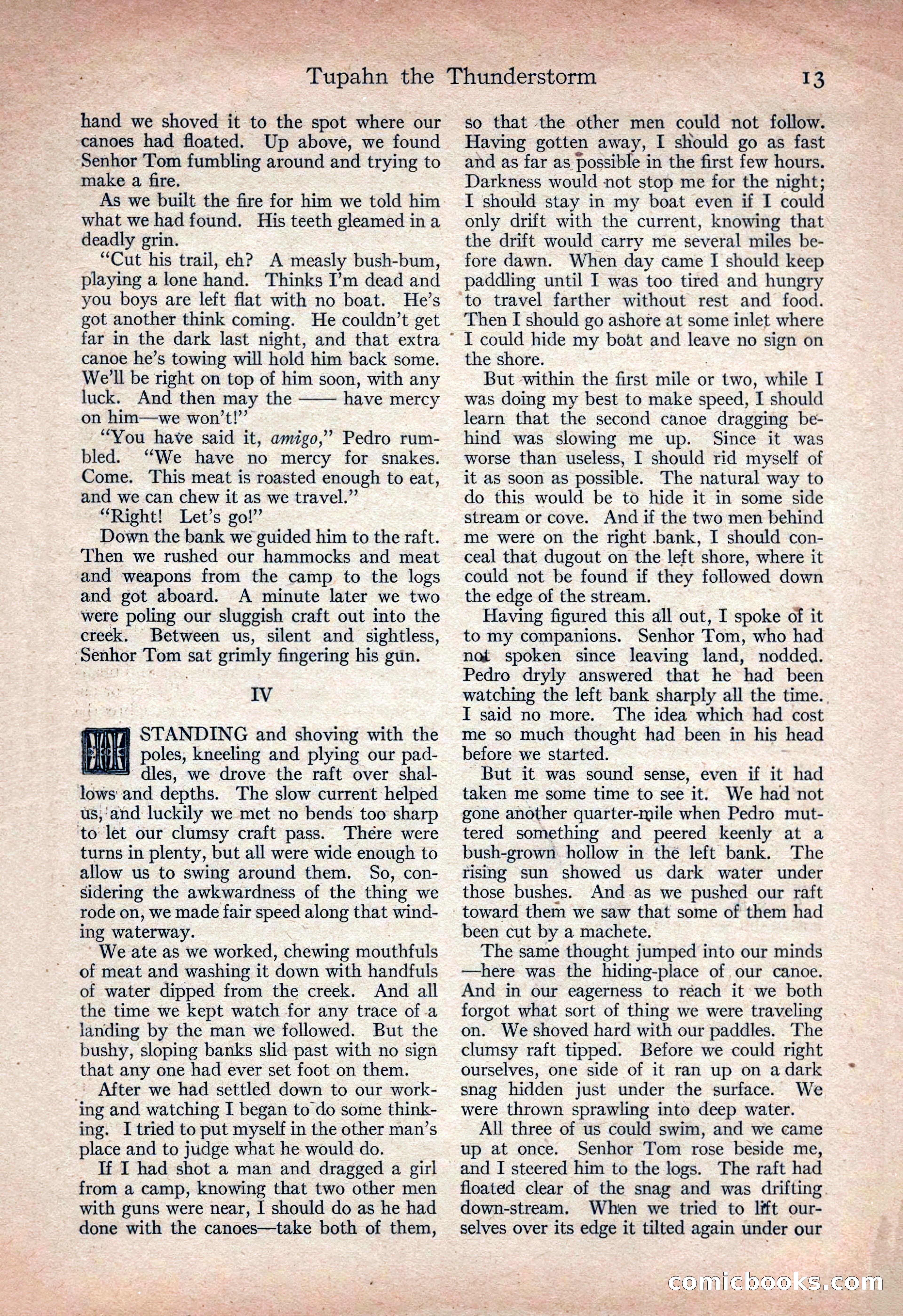
Tupahn the Thunderstorm hand we shoved it to the spot where our canoes had floated. Up above, we found ‘Senhor Tom fumbling around and trying to make a fire. As we built the fire for him we told him what we had found. His teeth gleamed in a deadly grin. “Cut his trail, eh? A measly bush-bum, playing a lone hand. Thinks I’m dead and you boys are left flat with no boat. He’s got another think coming. He couldn’t get far in the dark last night, and that extra ~ canoe he’s towing will hold him back some. We'll be right on top of him soon, with any luck. And then may the —— have mercy on him—we won’t!”’ “You have said it, amigo,” Pedro rum- bled. “We have no mercy for snakes. Come. This meat is roasted enough to eat, and we can chew it as we travel.” “Right! Let’s go!” Down the bank we guided him to the raft. Then we rushed our hammocks and meat and weapons from the camp to the logs and got aboard. A minute later we two were poling our sluggish craft out into the creek. Between us, silent and sightless, ‘Senhor Tom sat grimly fingering his gun. IV i 1 | STANDING and shoving with the il ¥ poles, kneeling and plying our pad- = dles, we drove the raft over shal- lows and depths. The slow current helped us,'and luckily we met no bends too sharp to let our clumsy craft pass. There were turns in plenty, but all were wide enough to allow us to swing around them. So, con- _ sidering the awkwardness of the thing we rode on, we made fair speed along that wind- ing waterway. ' We ate as we worked, chewing mouthfuls of meat and washing it down with handfuls of water dipped from the creek. And all the time we kept watch for any trace of a ‘ landing by the man we followed. But the bushy, sloping banks slid past with no sign that any one had ever set foot on them. After we had settled down to our work- ing and watching I began to do some think- ing. I tried to put myself in the other man’s place and to judge what he would do. If I had shot a man and dragged a girl from a camp, knowing that two other men with guns were near, I should do as he had done with the canoes—take both of them, a ee ._ < 13 so that the other men could not follow. Having gotten away, I should go as fast and as far as possible in the first few hours. Darkness would not stop me for the night; I should stay in my boat even if I could only drift with the current, knowing that the drift would carry me several miles be- fore dawn. When day came I should keep paddling until I was too tired and hungry ‘to travel farther without rest and food. Then I should go ashore at some inlet where I could hide my boat and leave no sign on the shore. But within the first mile or two, while I was doing my best to make speed, I should learn that the second canoe dragging be- hind was slowing me up. Since it was worse than useless, I should rid myself of it as soon as possible. The natural way to do this would be to hide it in some side stream or cove. And if the two men behind _me were on the right bank, I should con- ceal that dugout on the left shore, where it could not be found if they followed down the edge of the stream. Having figured this all out, I spoke of it to my companions. Senhor Tom, who had nat spoken since leaving land, nodded. Pedro dryly answered that he had been watching the left bank sharply all the time.. I said no more. The idea which had cost me so much thought had been in his head before we started. But it was sound sense, even if it had taken me some time to see it. We had not gone another quarter-mile when Pedro mut- tered something and peered keenly at a bush-grown hollow in the left bank. The Tising sun showed us dark water under those bushes. And-as we pushed our raft toward them we saw that some of them had been cut by a machete. The same thought jumped into our minds —here was the hiding-place of our canoe. And in our eagerness to réach it we both forgot what sort of thing we were traveling on. We shoved hard with our paddles. The clumsy raft tipped. Before we could right ourselves, one side of it ran up on a dark snag hidden just under the surface. We were thrown sprawling into deep water. All three of us could swim, and we came up at once. Senhor Tom rose beside me, and I steered him to the logs. The raft had floated clear of the snag and was drifting. down-stream. When we tried to lift our- selves over its edge it tilted again under our Gomichboo eS) (E(0)