
Pulp Fiction, 1922 · page 189 of 200
Adventure Magazine Cover — page 189: what you’re looking at
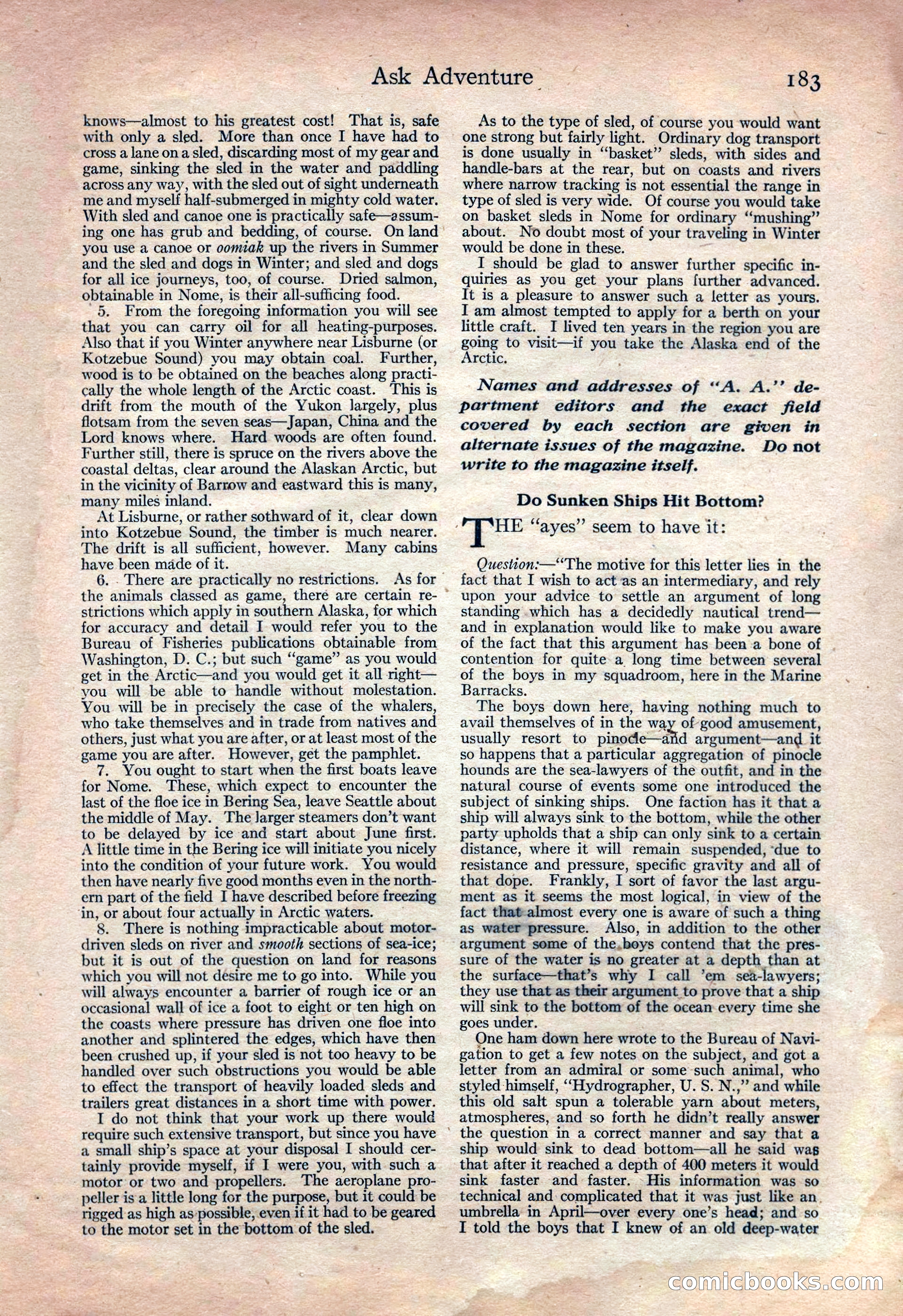
A restored page from Pulp Fiction, 1922. Page through the whole issue in the reader above.
📄 Transcribed text from this page (OCR, searchable)
Machine-transcribed from the original scan — historical spelling and the odd misread are preserved.
Ask Adventure knows—almost to his greatest cost! That is, safe with only a sled. More than once I have had to cross a lane on a sled, discarding most of my gear and game, sinking the sled in the water and paddling across any way, with the sled out of sight underneath me and myself half-submerged in mighty cold water. - With sled and canoe one is practically safe—assum- ing one has grub and bedding, of course. On land’ you use a canoe or oomiak up the rivers in Summer and the sled and dogs in Winter; and sled and dogs for all ice journeys, too, of course. Dried salmon, obtainable in Nome, is their all-sufficing food. 5. From the foregoing information you will see that you can carry oil for all heating-purposes. Also that if you Winter anywhere near Lisburne (or Kotzebue Sound) you may obtain coal. Further, wood is to be obtained on the beaches along practi- cally the whole length of the Arctic coast. This is drift from the mouth of the Yukon largely, plus flotsam from the seven seas—Japan, China and the Lord knows where. Hard woods are often found. Further still, there is spruce on the rivers above the coastal deltas, clear around the Alaskan Arctic, but in the vicinity of Barrow and eastward this is many, many miles inland. At Lisburne, or rather sothward of it, clear down into Kotzebue Sound, the timber is much nearer. The drift is all sufficient, however. Many cabins have been made of it. 6. . There are practically no restrictions. strictions which apply in southern Alaska, for which for accuracy and detail I would refer you to the Bureau of Fisheries publications obtainable from Washington, D. C.; but such “game” as you would get in the Arctic—and you would get it all right— you will be able to handle without molestation. You will be in precisely the case of the whalers, who take themselves and in trade from natives and others, just what you are after, or at least most of the game you are after. However, get the pamphlet. 7. You ought to start when the first boats leave for Nome. These, which expect to encounter the last of the floe ice in Bering Sea, leave Seattle about the middle of May. The Jarger steamers don’t want to be delayed by ice and start about June first. A little time in the Bering ice will initiate you nicely into the condition of your future work. You would then have nearly five good months even in the north- ern part of the field I have described before freezing ‘in, or about four actually in Arctic waters. 8. There is nothing impracticable about motor- driven sleds on river and smooth sections of sea-ice; but it is out of the question on land for reasons which you will not desire me to go into. While you will always encounter a barrier of rough ice or an occasional wall of ice a foot to eight or ten high on the coasts where pressure has driven one floe into another and splintered the edges, which have then been crushed up, if your sled is not too heavy to be handled over such obstructions you would be able to effect the transport of heavily loaded sleds and trailers great distances in a short time with power. I do not think that your work up there would require such extensive transport, but since you have a small ship’s space at your disposal I should cer- tainly provide myself, if I were you, with such a motor or two and propellers. The aeroplane pro- peller is a little long for the purpose, but it could be rigged as high as:possible, even if it had to be geared to the motor set in the bottom of the sled. As for the animals classed as game, there are certain re- © 183 As to the type of sled, of course you would want one strong but fairly light. Ordinary dog transport is done usually in “basket” sleds, with sides and handle-bars at the rear, but on coasts and rivers where narrow tracking is not essential the range in type of sled is very wide. Of course you would take on basket sleds in Nome for ordinary “mushing” about. No doubt most of your traveling in Winter would be done in these. I should be glad to answer further specific in- quinies as you get your plans further advanced. It is a pleasure to answer such a letter as yours. I am almost tempted to apply for a berth on your little craft. I lived ten years in the region you are going to visit—if you take the Alaska end of the rctic, Names and addresses of “A. A.’’ de- partment editors and the exact field covered by each section are given in alternate issues of the magazine. Do not write to the magazine itself. Do Sunken Ships Hit Bottom? ’ : ‘HE “ayes” seem to have it: Question: —‘The motive for this letter lies in the fact that I wish to act as an intermediary, and rely upon your advice to settle an argument of long standing .which has a decidedly nautical trend— and in explanation would like to make you aware of the fact that this argument has been a bone of contention for quite a long time between several of the boys in my squadroom, here in the Marine Barracks. The boys down here, having nothing much to avail themselves of in the way of good amusement, usually resort to pinocle—and argument—and it so happens that a particular aggregation of pinocle hounds are the sea-lawyers of the outfit, and in the natural course of events some one introduced the subject of sinking ships. One faction has it that a ship will always sink to the bottom, while the other party upholds that a ship can only sink to a certain distance, where it will remain suspended, “due to resistance and pressure, specific gravity and all of that dope. Frankly, I sort of favor the last argu- ment as it seems the most logical, in view of the fact that-almost every one is aware of such a thing as water pressure. Also, in addition to the other argument some of the,boys contend that the pres- sure of the water is no greater at a depth than at the surface—that’s why I call ’em se&-lawyers; they use that as their argument to prove that a ship will sink to the bottom of the ocean every time she goes under. One ham down here wrote to the Bureau of Navi- gation to get a few notes on the subject, and got a letter from an admiral or some such animal, who styled himself, ““Hydrographer, U.S. N.,” and while this old salt spun a tolerable yarn about meters, atmospheres, and so forth he didn’t really answer ’ the question in a correct manner and say that a ship would sink to dead bottom—all he said wag that after it reached a depth of 400 meters it would sink faster and faster. His information was so technical and: complicated that it was just like an. umbrella in April—over every one’s head; and so I told the boys that I knew of an old deep-water MICLOOOKS (CO) ff