
Pulp Fiction, 1922 · page 184 of 200
Adventure Magazine Cover — page 184: what you’re looking at
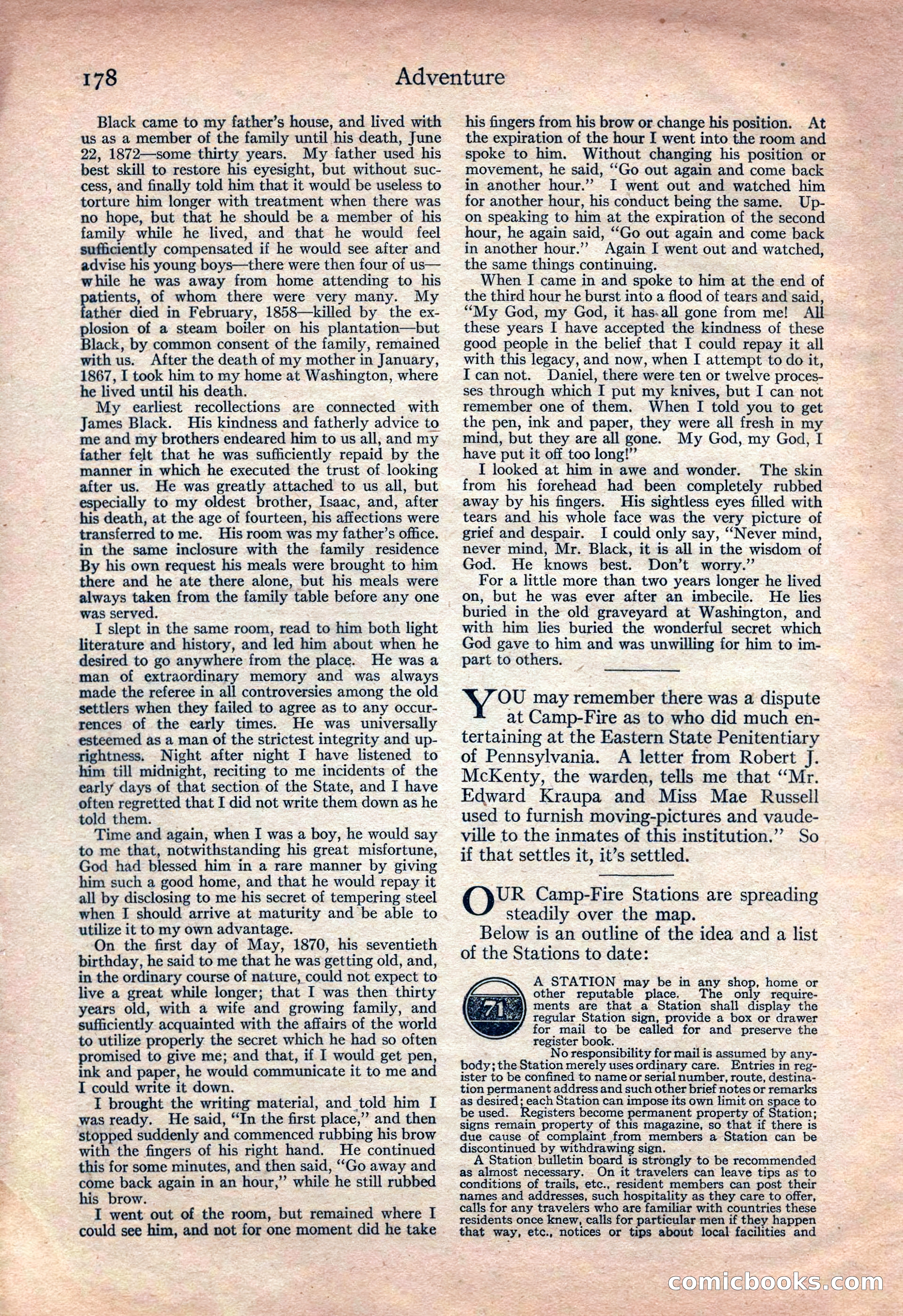
A restored page from Pulp Fiction, 1922. Page through the whole issue in the reader above.
📄 Transcribed text from this page (OCR, searchable)
Machine-transcribed from the original scan — historical spelling and the odd misread are preserved.
178 Adventure Black came to my father’s house, and lived with us as a member of the family until his death, June 22, 1872—some thirty years. My father used his best skill to restore his eyesight, but without suc- cess, and finally told him that it would be useless to torture him longer with treatment when there was no hope, but that he should be a member of his family while he lived, and that he would feel sufficiently compensated if he would see after and advise his young boys—there were then four of us— while he was away from home attending to his tients, of whom there were very many. My ther died in February, 1858—killed by the ex- plosion of a steam boiler on his plantation—but Black, by common consent of the family, remained with us. After the death of my mother in January, 1867, I took him to my home at Washington, where he lived until his death. My earliest recollections are connected with James Black. His kindness and fatherly advice to me and my brothers endeared him to us all, and my father felt that he was sufficiently repaid by the manner in which he executed the trust of. looking after us. He was greatly attached to us all, but especially to my oldest brother, Isaac, and, after his death, at the age of fourteen, his affections were transferred tome. His room was my father’s office. in the same inclosure with the family residence By his own request his meals were brought to him there and he ate there alone, but his meals were always taken from the family table before any one was served. I slept in the same room, read to him both light literature and history, and led him about when he desired to go anywhere from the place. He was a -man of extraordinary memory and was always made the referee in all controversies among the old settlers when they failed to agree as to any occur- rences of the early times. He was universally _ esteemed as a man of the strictest integrity and up- rightness. Night after night I have listened to him till midnight, reciting to me incidents of the early days of that section of the State, and I have often regretted that I did not write them down as he told them. _ Time and again, when I was a boy, he would say to me that, notwithstanding his great misfortune, God had blessed him in a rare manner by giving him such a good home, and that he would repay it all by disclosing to me his secret of tempering steel when I should arrive at maturity and be able to utilize it to my own advantage. On the first day of May, 1870, his seventieth birthday, he said to me that he was getting old, and, in the ordinary course of nature, could not expect to live a great while longer; that I was then thirty years old, with a wife and growing family, and sufficiently acquainted with the affairs of the world to utilize properly the secret which he had so often promised to give me; and that, if I would get pen, ink and paper, he would communicate it to me and I could write it down. I brought the writing material, and told him I was ready. He said, “In the first place,” and then stopped suddenly and commenced rubbing his brow with the fingers of his right hand. He continued this for some minutes, and then said, “Go away and come back again in an hour,” while he still rubbed his brow. I went out of the room, but remained where I could see him, and not for one moment did he take e ‘ ih t? ij ¥ his fingers from his brow or change his position. At the expiration of the hour I went into the room and spoke to him. Without changing his position or movement, he said, ‘‘Go out again and come back in another hour.” I went out and watched him for another hour, his conduct being the same. Up- on speaking to him at the expiration of the second hour, he again said, “Go out again and come back in another hour.” Again I went out and watched, the same things continuing. When I came in and spoke to him at the end of the third hour he burst into a flood of tears and said, “My God, my God, it has.all gone from me! All these years I have accepted the kindness of these good people in the belief that I could repay it all with this legacy, and now, when I attempt to do it, Ican not. Daniel, there were ten or twelve proces- ses through which I put my knives, but I can not remember one of them. When I told you to get the pen, ink and paper, they were all fresh in my mind, but they are all gone. My God, my God, I have put it off too long!” I looked at him in awe and wonder. The skin from his forehead had been completely rubbed away by his fingers. His sightless eyes filled with tears and his whole face was the very picture of grief and despair. I could only say, ‘‘Never mind, never mind, Mr. Black, it is all in the wisdom of God. He knows best. Don’t worry.” For a little more than two years longer he lived on, but he was ever after an imbecile. He lies buried in the old graveyard at Washington, and with him lies buried the wonderful secret which God gave to him and was unwilling for him to im- part to others. ae may remember there was a dispute at Camp-Fire as to who did much en- tertaining at the Eastern State Penitentiary of Pennsylvania. A letter from Robert J. McKenty, the warden, tells me that ‘Mr. Edward Kraupa and Miss Mae Russell used to furnish moving-pictures and vaude- ville to the inmates of this institution.’’ So if that settles it, it’s settled. Q)UR Camp-Fire Stations are spreading steadily over the map. Below is an outline of the idea and a list of the Stations to date: A STATION may be in any shop, home or other reputable place. The only require- ments are that a Station shall display the regular Station sign, provide a box or drawer for mail to be called for and preserve the register book. No responsibility for mail is assumed by any- body; the Station merely uses ordinary care. Entries in reg- ister to be confined to name or serial number, route, destina- tion permanent address and such other brief notes or remarks as desired; each Station can impose its own limit on space to be used. Registers become permanent property of Station; signs remain property of this magazine, so that if there is due cause of complaint from members a Station can be discontinued by withdrawing sign. A Station bulletin board is strongly to be recommended as almost necessary. On it travelers can leave tips as to conditions of trails, etc., resident members can post their names and addresses, such hospitality as they care to offer, calls for any travelers who are familiar with countries these residents once knew, calls for particular mien if they happen that way, etc., notices or tips about local facilities and oe *, , ares | ft OAM NOOLES