
Pulp Fiction, 1922 · page 150 of 200
Adventure Magazine Cover — page 150: what you’re looking at
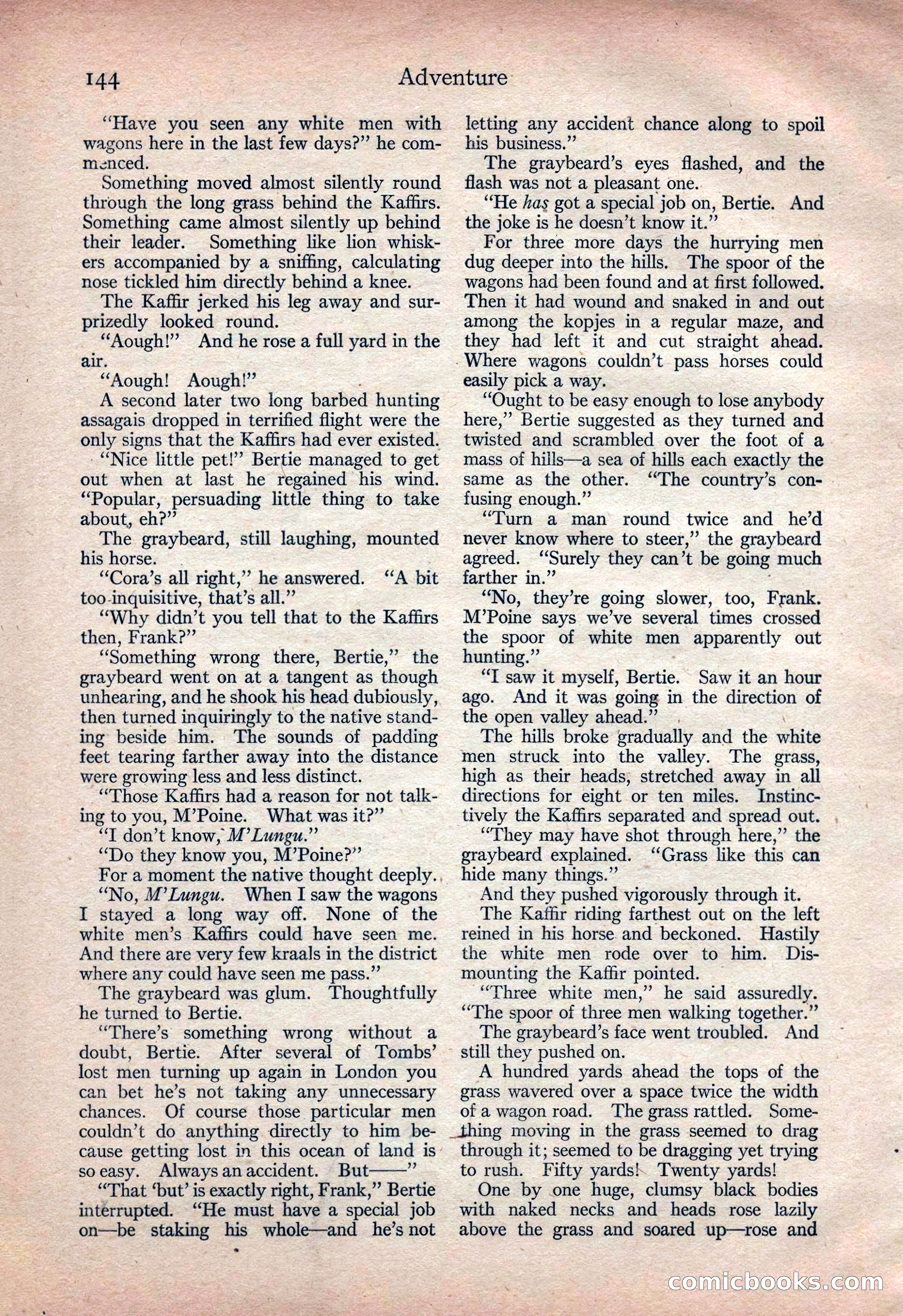
A restored page from Pulp Fiction, 1922. Page through the whole issue in the reader above.
📄 Transcribed text from this page (OCR, searchable)
Machine-transcribed from the original scan — historical spelling and the odd misread are preserved.
144 “Have you seen any white men with wagons here in the last few days?” he com- enced. Something moved almost silently round through the long grass behind the Kafhrs. Something came almost silently up behind their leader. Something like lion whisk- ers accompanied by a sniffing, calculating nose tickled him directly behind a knee. The Kaffir jerked his leg away and sur- prizedly looked round. “Aough!” And he rose a full yard in the air. “Aough! Aough!” A second later two long barbed hunting assagais dropped in terrified flight were the only signs that the Kaffirs had ever existed. “Nice little pet!” Bertie managed to get out when at last he regained ‘his. wind. “Popular, persuading little thing to take about, eh?” The graybeard, still laughing, mounted his horse. “Cora’s all right,” he answered. “A bit too-inquisitive, that’s all.” “Why didn’t you tell that to the Kaffirs then, Frank?” “Something wrong there, Bertie,’ the graybeard went on at a tangent as though unhearing, and he shook his head dubiously, then turned inquiringly to the native stand- ing beside him. The sounds of padding feet tearing farther away into the distance were growing less and less distinct. “Those Kaffirs had a reason for not talk- ing to you, M’Poine. What was it?” “T don’t know, M’Lungu.”’ “Do they know you, M’Poine?”’ For a moment the native thought deeply... “No, M’Lungu. When I saw the wagons I stayed a long way off. None of the white men’s Kaffirs could have seen me. And there are very few kraals in the district where any could have seen me pass.” The graybeard was glum. Thoughtfully he turned to Bertie. “There’s something wrong without a doubt, Bertie. After several of Tombs’ lost men turning up again in London you can bet he’s not taking any unnecessary chances. Of course those particular men couldn’t do anything directly to him be- cause getting lost in this ocean of land is soeasy. Alwaysanaccident. But “That ‘but’ is exactly right, Frank,” Bertie interrupted. “He must have a special job on—be staking his whole—and he’s not Adventure: letting any accident chance along to spoil his business.” The graybeard’s eyes flashed, and the flash was not a pleasant one. ‘He has got a special job on, Bertie. And — the joke is he doesn’t know it. ” For three more days the hurrying men dug deeper into the hills. The spoor of the wagons had been found and at first followed. Then it had wound and snaked in and out among the kopjes in a regular maze, and they had left it and cut straight ahead. -Where wagons couldn’t pass horses could easily pick a way. “Ought to be easy enough to lose anybody here,” Bertie suggested as they turned and twisted and scrambled over the foot of a mass of hills—a sea of hills each exactly the same as the other. fusing enough.” “Tum a man round twice and he’d never know where to steer,’ the graybeard agreed. “Surely they can t be going much farther in.’ “No, they’re going slower, too, Frank. M’Poine says we've several times crossed the spoor of white men apparently out hunting.” “T saw it myself, Bertie: Saw it an hour ago. And it was going in the direction of the open valley ahead.” . The hills broke gradually and the white men struck into the valley. The grass, high as their heads, stretched away in all directions for eight or ten miles. Instinc- tively the Kaffirs separated and spread out. “They may have shot through here,” the graybeard explained. “Grass like this can hide many things.” And they pushed vigorously through it. The Kafhr riding farthest out on the left reined in his horse and beckoned. Hastily the white men rode over to him. Dis- mounting the Kaffir pointed. | “Three white men,” he said assuredly. “The spoor of three men walking together.” The graybeard’s face went troubled. And ~ still they pushed on. A hundred yards ahead the tops of the grass wavered over a space twice the width of a wagon road. The grass rattled. Some- _thing moving in the grass seemed to drag through it; seemed to be dragging yet trying to rush. Fifty yards! Twenty yards! One by one huge, clumsy black bodies with naked necks and heads rose lazily above the grass and soared up—rose and “The country’s con- - Eomicbooks (E)