
Pulp Fiction, 1922 · page 148 of 200
Adventure Magazine Cover — page 148: what you’re looking at
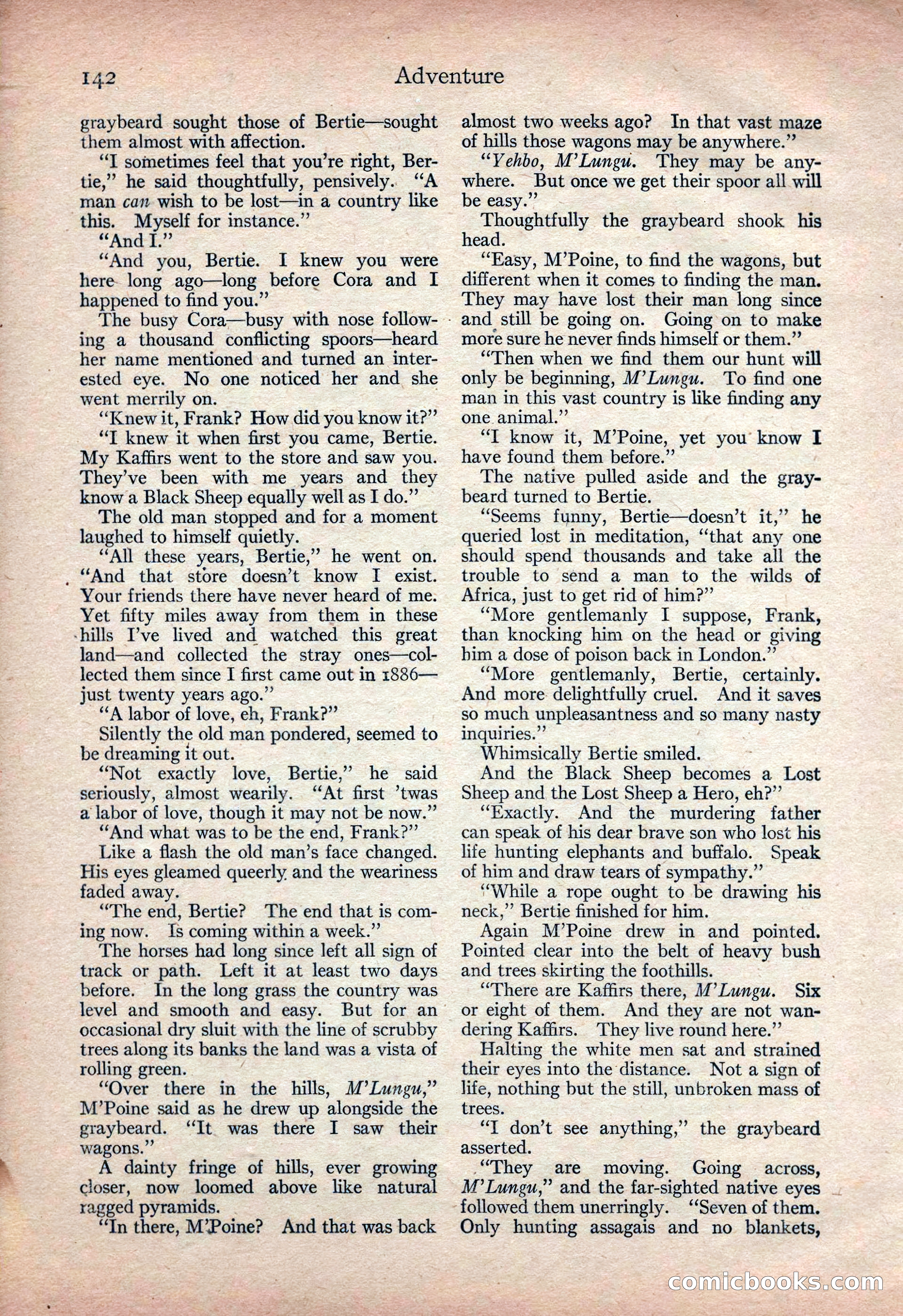
A restored page from Pulp Fiction, 1922. Page through the whole issue in the reader above.
📄 Transcribed text from this page (OCR, searchable)
Machine-transcribed from the original scan — historical spelling and the odd misread are preserved.
142 graybeard sought those of Bertie—sought them almost with affection. “T sometimes feel that you’re right, Ber- tie,” he said thoughtfully, pensively. “A man can wish to be lost—in a country like this. Myself for instance.” 6c An d 1’ “And you, Bertie. I knew you were here- long ago—long: before Cora and 1 happened to find you.’ The busy Cora—busy with nose follow- - ing a thousand conflicting spoors—heard her name mentioned and turned an inter- ested eye. No one noticed her and she went merrily on. “Knew it, Frank? How did you know it?” “T knew it when first you came, Bertie. My Kaffirs went to the store and saw you. They've been with me years and they know a Black Sheep equally well as I do.”’ The old man stopped and for a moment laughed to himself quietly. “All these years, Bertie,” he went on. _ “And that store doesn’t know I exist. Your friends there have never heard of me. Yet fifty miles away from them in these -hills Pve lived and watched this great land—and collected the stray ones—col- lected them since I first came out in 1886— just twenty years ago.” “A labor of love, eh, Frank?” Silently the old man pondered, seemed to be dreaming it out. “Not exactly love, Bertie,” he said seriously, almost wearily. “At first ’twas a labor of love, though it may not be now.” “And what was to be the end, Frank?” Like a flash the old man’s face changed. His eyes gleamed queerly and the weariness faded away. “The end, Bertie? The end that is com- ing now. Is coming within a week.” The horses had long since left all sign of track or path. Left it at least two days before. In the long grass the country was level and smooth and easy. But for an’ occasional dry sluit with the line of scrubby trees along its banks the land was a vista of rolling green. “Over there in the hills, M’Lungu,” M’Poine said as he drew up alongside the graybeard. “It was there I saw their wagons.” A dainty fringe of hills, ever growing closer, now loomed above like natural ragged pyramids. “Tn there, M’Poine? And that was back followed them unerringly. _— —— pS at 1 alt F ork —— Adventure almost two weeks ago? In that vast maze of hills those wagons may be anywhere.” “Yehbo, M’Lungu. They may be any- where. But once we get their spoor all will be eas Thoughtfully the ee ead shook his “Easy, M’Poine, to find the wagons, but different when it comes to finding the man. They may have lost their man long since and still be going on. Going on to make more sure he never finds himself or them.” ‘Then when we find them our hunt will only be beginning, M’Lungu. To find one man in this vast country is like finding any one. animal.” “IT know it, M’Poine, yet you know I have found them before.” The native pulled aside and the gray- beard turned to Bertie. “Seems funny, Bertie—doesn’t it,’’ he queried lost in meditation, “that any one should spend thousands and take all the trouble to send a man to the wilds of Africa, just to get rid of him?” ‘More gentlemanly I suppose, Frank, than knocking him on the head or giving bim a dose of poison back in London.” “More gentlemanly, Bertie, certainly. And more delightfully cruel. And it saves so much unpleasantness and so many nasty inquiries.”’ Whimsically Bertie smiled. And the Black Sheep becomes a Lost Sheep and the Lost Sheep a Hero, eh?” “Exactly. And the murdering father can speak of his dear brave son who lost his life hunting elephants and buffalo. Speak of him and draw tears of sympathy.”’ ‘While a rope ought to be drawing his neck,” Bertie finished for him. Again M’Poine drew in and pointed. Pointed clear into the belt of heavy bush and trees skirting the foothills. “There are Kaffirs there, M’Lungu. Six : or eight of them. And they are not wan- dering Kaffirs. They live round here.” Halting the white men sat and strained their eyes into the distance. Not a sign of life, nothing but the still, unbroken mass of trees. “YT don’t see anything, asserted. .““They are 29 the graybeard moving. Going — across, M’Lungu,” and the far-sighted native eyes _ “Seven of them. Only hunting assagais and no blankets, (EOMMIE KOOKS (EO)