
Pulp Fiction, 1922 · page 128 of 200
Adventure Magazine Cover — page 128: what you’re looking at
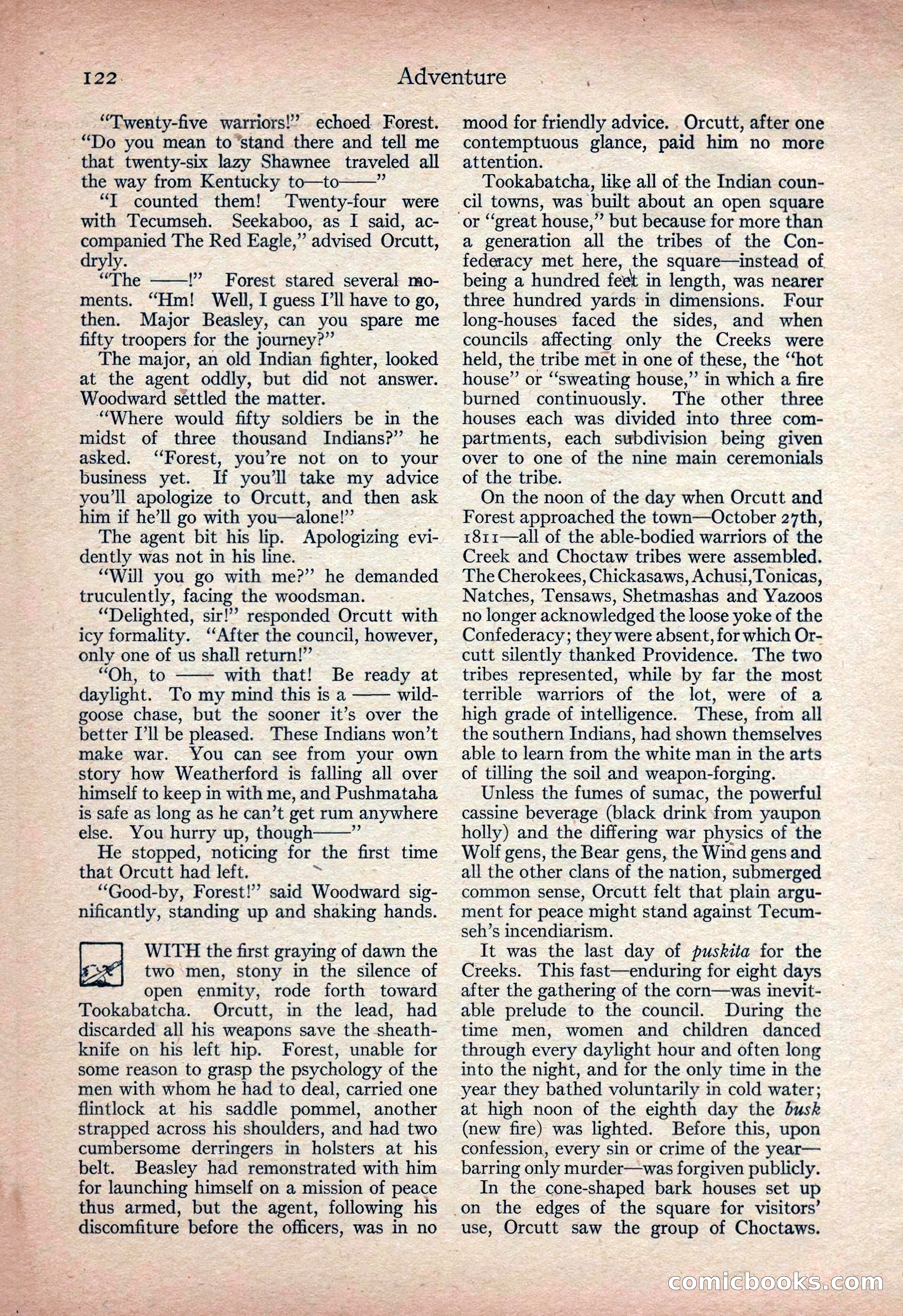
A restored page from Pulp Fiction, 1922. Page through the whole issue in the reader above.
📄 Transcribed text from this page (OCR, searchable)
Machine-transcribed from the original scan — historical spelling and the odd misread are preserved.
r Pe : Le ae 45. SAY I22. “Twenty-five warriors!” echoed Forest. ~“Do you mean to’stand there and tell me that twenty-six lazy Shawnee traveled all 3) the way from Kentucky to—to—— “T counted them! Twenty-four were with Tecumseh. Seekaboo, as I said, ac- companied The Red Eagle,” advised Orcutt, dryly. | “The ——!” Forest stared several mo- ments. “Hm! Well, I guess I’ll have to go, then. Major Beasley, can you spare me fifty troopers for the journey?” The major, an old Indian fighter, looked at the agent oddly, but did not answer. Woodward settled the matter. 3 “Where would fifty soldiers be in the midst of three thousand Indians?” he asked. “Forest, you’re not on to your business yet. If you'll take my advice you ll apologize to Orcutt, and then ask him if he’ll go with you—alone!” The agent bit his lip. Apologizing evi- dently was not in his line. “Will you go with me?” he demanded truculently, facing the woodsman. “Delighted, sir!”” responded Orcutt with icy formality. ‘After the council, however, only one of us shall return!” “Oh, to with that! Be ready at daylight. To my mind this is a wild- goose chase, but the sooner it’s over the better I’ll be pleased. These Indians won’t make war. You can see from your own story how Weatherford is falling all over himself to keep in with me, and Pushmataha is safe as long as he can’t get rum anywhere else. You hurry up, though He stopped, noticing for _the first time that Orcutt had left. ““Good-by, Forest!’ said Woodward sig- nificantly, standing up and shaking hands. p30 two men, stony in the silence of open enmity, rode forth toward Tookabatcha. Orcutt, in the lead, had discarded all his weapons save the sheath- knife on his left hip. Forest, unable for some reason to grasp the psychology of the men with whom he had to deal, carried one flintlock at his saddle pommel, another strapped across his shoulders, and had two cumbersome derringers in holsters at his belt. Beasley had remonstrated with him for launching himself on a mission of peace thus armed, but the agent, following his discomfiture before the officers, was in no WITH the first graying of dawn the os oe Adventure ; mood for friendly advice. . Orcutt, after one contemptuous glance, paid him no more attention. Tookabatcha, like all of the Indian coun- cil towns, was built about an open square r ‘great house,’ but because for more than a generation all the tribes of the Con- federacy met here, the square—instead of being a hundred feet in length, was nearer three hundred yards in dimensions. Four long-houses faced the sides, and when councils affecting only the Creeks were held, the tribe met in one of these, the ‘“‘hot house” or “sweating house,” in which a fire burned continuously. The other three houses each was divided into three com- partments, each subdivision being given over to one of the nine main ceremonials of the tribe. On the noon of the day when Orcutt and Forest approached the town—October 27th, 1811—all of the able-bodied warriors of the Creek and Choctaw tribes were assembled. The Cherokees, Chickasaws, Achusi, Tonicas, Natches, Tensaws, Shetmashas and Yazoos no longer acknowledged the loose yoke of the Confederacy; they were absent, for which Or- cutt silently thanked Providence. The two tribes represented, while by far the most terrible warriors of the lot, were of a high grade of intelligence. These, from all the southern Indians, had shown themselves able to learn from the white man in the arts of tilling the soil and weapon-forging. Unless the fumes of sumac, the powerful cassine beverage (black drink from yaupon holly) and the differing war physics of the Wolf gens, the Bear gens, the Wind gens and all the other clans of the nation, submerged common sense, Orcutt felt that plain argu- ment for peace might stand against Tecum- seh’s incendiarism. It was the last day of puskita for the Creeks. This fast—enduring for eight days after the gathering of the corn—was inevit- able prelude to the council. During the time men, women and children danced through every daylight hour and often long into the night, and for the only time in the year they bathed voluntarily in cold water; at high noon of the eighth day the busk (new fire) was lighted. Before this, upon confession, every sin or crime of the year— barring only murder—was forgiven publicly. In the cone-shaped bark houses set up on the edges of the square for visitors’ use, Orcutt saw the group of Choctaws. ecomichbooks (EC)