
Pulp Fiction, 1922 · page 78 of 200
Adventure Magazine Cover — page 78: what you’re looking at
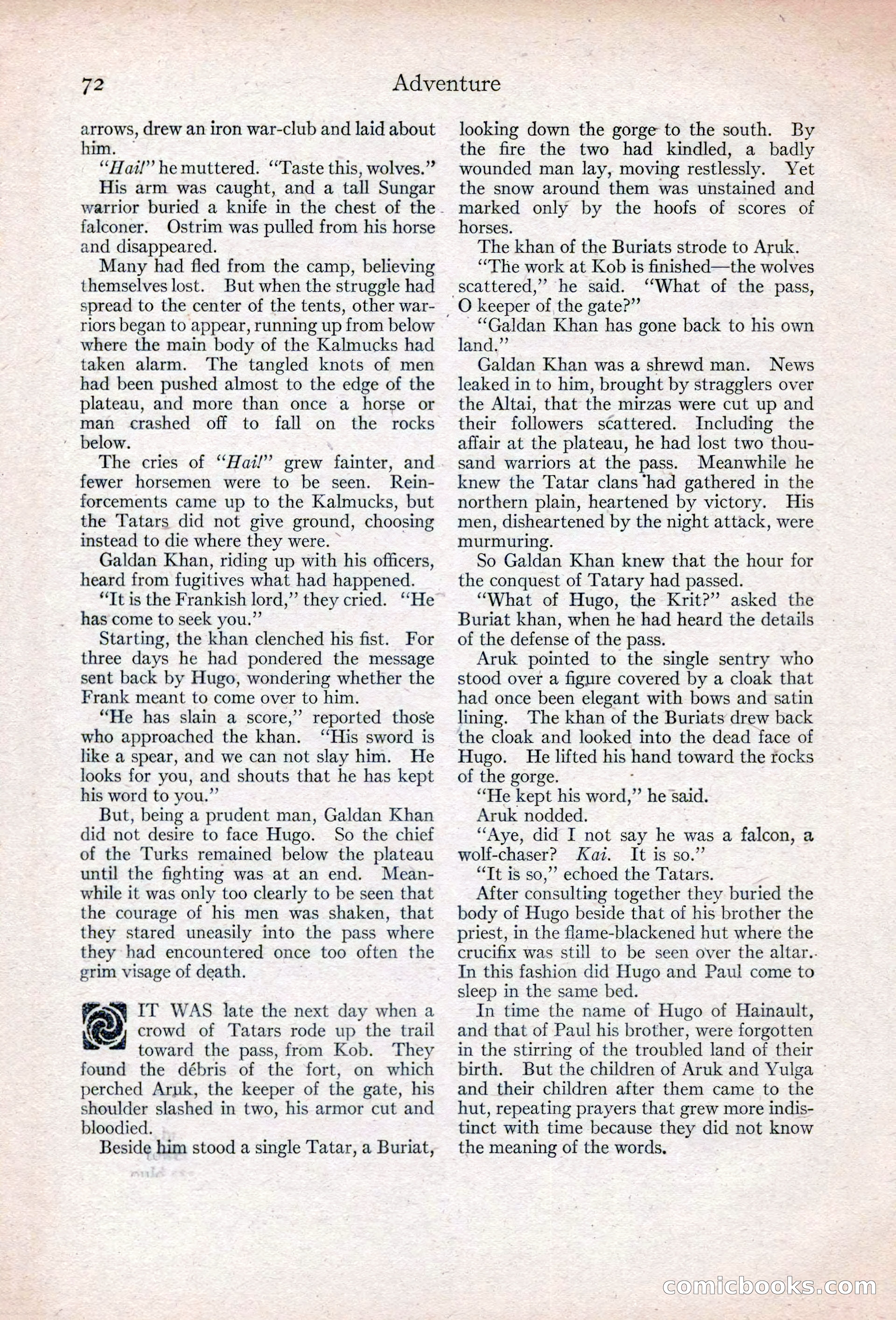
A restored page from Pulp Fiction, 1922. Page through the whole issue in the reader above.
📄 Transcribed text from this page (OCR, searchable)
Machine-transcribed from the original scan — historical spelling and the odd misread are preserved.
72 arrows, drew an iron war-club and laid about him. | “Hail” he muttered. ‘Taste this, wolves.” His arm was caught, and a tall Sungar watrior buried a knife in the chest of the. falconer. Ostrim was pulled from his horse and disappeared. Many had fled from the camp, believing themselves lost. But when the struggle had spread to the center of the tents, other war- riors began to appear, running up from below — where the main body of the Kalmucks had taken alarm. The tangled knots of men had been pushed almost to the edge of the plateau, and more than once a horse or man crashed off to fall on the rocks ~ below. The cries of “Hai!’”’ grew fainter, and fewer horsemen were to be seen. Rein- forcements came up to the Kalmucks, but the Tatars did not give ground, choosing instead to die where they were. Galdan Khan, riding up with his officers, heard from fugitives what had happened. “Tt is the Frankish lord,” they cried. “He has come to seek you.”’ Starting, the khan clenched his fist. For three days he had pondered the message sent back by Hugo, wondering whether the Frank meant to come over to him. “He has slain a score,” reported those who approached the khan. ‘His sword is hke a spear, and we can not slay him. He looks for you, and shouts that he has kept his word to you.” But, being a prudent man, Galdan Khan did not desire to face Hugo. So the chief of the Turks remained below the plateau until the fighting was at an end. Mean- while it was only too clearly to be seen that the courage of his men was shaken, that they stared uneasily into the pass where they had encountered once too often the grim visage of death. Peay IT WAS late the next day when a @ crowd of Tatars rode up the trail a toward the pass, from Kob. They found the débris of the fort, on which perched Aruk, the keeper of the gate, his shoulder slashed in two, his armor cut and bloodied. Beside him stood a single Tatar, a Buriat, Adventure looking down the gorge to the south. By the fire the two had kindled, a_ badly wounded man lay, moving restlessly. Yet the snow around them was unstained and marked only by the hoofs of scores of horses. The khan of the Buriats strode to Aruk. “The work at Kob is finished—the wolves scattered,” he said. ‘‘What of the pass, O keeper of the gate?” ~“Galdan Khan has gone back to his own land.” Galdan Khan was a shrewd man. News leaked in to him, brought by stragglers over the Altai, that the mirzas were cut up and their followers scattered. Including the affair at the plateau, he had lost two thou- sand warriors at the pass. Meanwhile he knew the Tatar clans ‘had gathered in the northern plain, heartened by victory. His men, disheartened by the night attack, were murmuring. So Galdan Khan knew that the hour for the conquest of Tatary had passed. “What of Hugo, the Krit?” asked the Buriat khan, when he had heard the details of the defense of the pass. Aruk pointed to the single sentry who stood over a figure covered by a cloak that had once been elegant with bows and satin lining. The khan of the Buriats drew back the cloak and looked into the dead face of Hugo. He lifted his hand toward the rocks of the gorge. “He kept his word,” he said. Aruk nodded. “Aye, did I not say he was a falcon, a wolf-chaser? Kaz. It is so.” “Tt is so,” echoed the Tatars. After consulting together they buried the body of Hugo beside that of his brother the priest, in the flame-blackened hut where the crucifix was still to be seen over the altar.. In this fashion did Hugo and Paul come to sleep in the same bed. In time the name of Hugo of Hainault, and that of Paul his brother, were forgotten in the stirring of the troubled land of their birth. But the children of Aruk and Yulga ~ and their children after them came to the hut, repeating prayers that grew more indis- tinct with time because they did not know the meaning of the words, GComicbook (E@)