
Pulp Fiction, 1922 · page 161 of 200
Adventure Magazine Cover — page 161: what you’re looking at
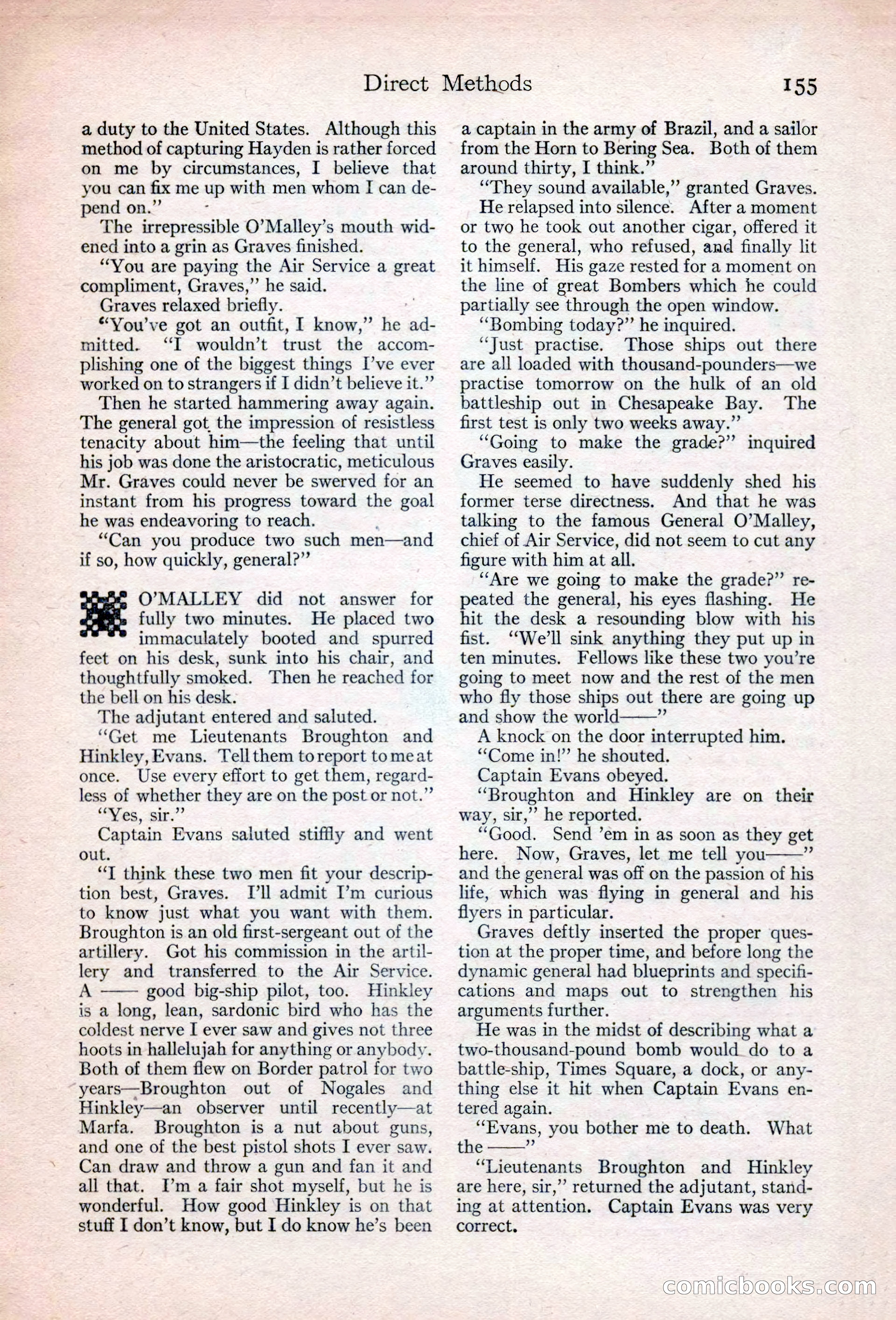
A restored page from Pulp Fiction, 1922. Page through the whole issue in the reader above.
📄 Transcribed text from this page (OCR, searchable)
Machine-transcribed from the original scan — historical spelling and the odd misread are preserved.
Direct Methods a duty to the United States. Although this method of capturing Hayden is rather forced on me by circumstances, I believe that you can fix me up with men whom I can de- pend on.” The irrepressible O’Malley’s mouth wid- ened into a grin as Graves finished. “You are paying the Air Service a great compliment, Graves,”’ he said. Graves relaxed briefly. “You've got an outfit, I know,” he ad- mitted. “I wouldn’t trust the accom- plishing one of the biggest things I’ve ever worked on to strangers if I didn’t believe it.” Then he started hammering away again. The general got, the impression of resistless tenacity about him—the feeling that until his job was done the aristocratic, meticulous Mr. Graves could never be swerved for an instant from his progress toward the goal he was endeavoring to reach. “Can you produce two such men—and if so, how quickly, general?” ee fully two minutes. He placed two immaculately booted and spurred feet on his desk, sunk into his chair, and thoughtfully smoked. Then he reached for the bell on his desk. The adjutant entered and saluted. “Get me Lieutenants Broughton and Hinkley, Evans. Tellthem toreport tomeat once. Use every effort to get them, regard- less of whether they are on the post or not.” ‘Ves, sir.” Captain Evans saluted stiffly and went out. “T think these two men fit your descrip- tion best, Graves. Tll admit I’m curious to know just what you want with them. Broughton is an old first-sergeant out of the artillery. Got his commission in the artil- lery and transferred to the Air Service. A —— good big-ship pilot, too. Hinkley is a long, lean, sardonic bird who has the coldest nerve I ever saw and gives not three hoots in hallelujah for anything or anybody. Both of them flew on Border patrol for two years—Broughton out of Nogales and Hinkley—an observer until recently—at Marfa. Broughton is a nut about guns, and one of the best pistol shots I ever saw. Can draw and throw a gun and fan it and all that. I’m a fair shot myself, but he is wonderful. How good Hinkley is on that stuff I don’t know, but I do know he’s been O’MALLEY did not answer for 155 a captain in the army of Brazil, and a sailor from the Horn to Bering Sea. Both of them around thirty, I think.” ‘They sound available,” granted Graves. He relapsed into silence. After a moment or two he took out another cigar, offered it to the general, who refused, and finally lit it himself. His gaze rested for a moment on the line of great Bombers which he could partially see through the open window. “Bombing today?” he inquired. ‘‘Just practise. Those ships out there are all loaded with thousand-pounders—we practise tomorrow on the hulk of an old battleship out in Chesapeake Bay. The first test is only two weeks away.”’ “Going to make the grade?” inquired Graves easily. He seemed to have suddenly shed his former terse directness. And that he was talking to the famous General O’Malley, chief of Air Service, did not seem to cut any figure with him at all. ‘““Are we going to make the grade?” re- peated the general, his eyes flashing. He hit the desk a resounding blow with his fist. ‘We'll sink anything they put up in ten minutes. Fellows like these two you’re going to meet now and the rest of the men who fly those ships out there are going up and show the world - A knock on the door interrupted him. “Come in!’ he shouted. Captain Evans obeyed. “Broughton and Hinkley are on their way, sir,’’ he reported. “Good. Send ’em in as soon as they get here. Now, Graves, let me tell you and the general was off on the passion of his life, which was flying in general and his flyers in particular. Graves deftly inserted the proper ques- tion at the proper time, and before long the dynamic general had blueprints and specifi- cations and maps out to strengthen his arguments further. He was in the midst of describing what a two-thousand-pound bomb would do to a battle-ship, Times Square, a dock, or any- thing else it hit when Captain Evans en- tered again. “Evans, you bother me to death. What the in “Lieutenants Broughton and Hinkley are here, sir,’’ returned the adjutant, stand- ing at attention. Captain Evans was very correct, COmicloool< (C@