
Pulp Fiction, 1922 · page 16 of 200
Adventure Magazine Cover — page 16: what you’re looking at
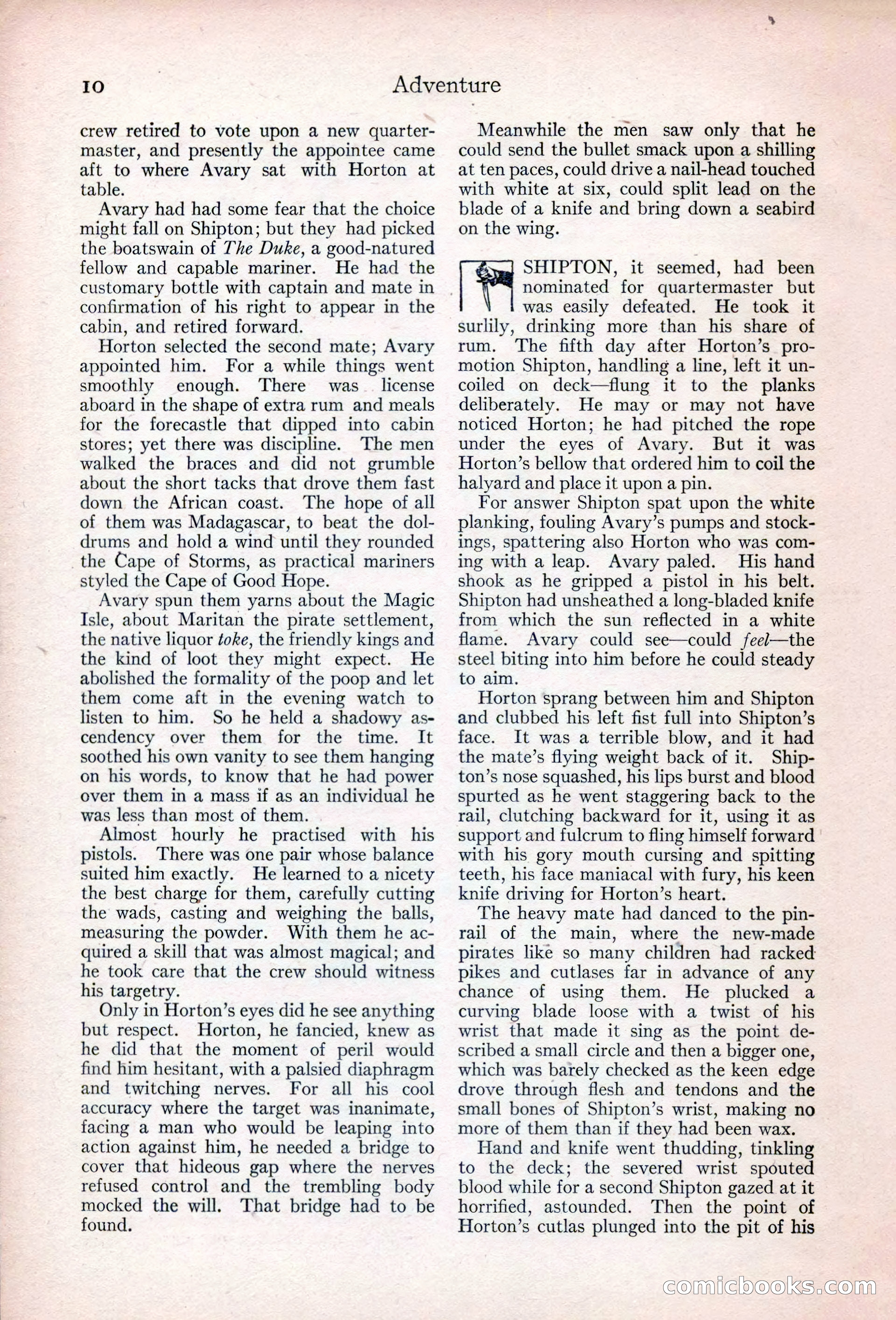
A restored page from Pulp Fiction, 1922. Page through the whole issue in the reader above.
📄 Transcribed text from this page (OCR, searchable)
Machine-transcribed from the original scan — historical spelling and the odd misread are preserved.
IO crew retired to vote upon a new quarter- master, and presently the appointee came aft to where Avary sat with Horton at table. Avary had had some fear that the choice might fall on Shipton; but they had picked the boatswain of The Duke, a good-natured fellow and capable mariner. He had the customary bottle with captain and mate in confirmation of his right to appear in the cabin, and retired forward. Horton selected the second mate; Avary appointed him. For a while things went smoothly enough. There was _ license aboard in the shape of extra rum and meals for the forecastle that dipped into cabin stores; yet there was discipline. The men walked the braces and did not grumble about the short tacks that drove them fast down the African coast. The hope of all of them was Madagascar, to beat the dol- drums and hold a wind until they rounded the Cape of Storms, as practical mariners styled the Cape of Good Hope. Avary spun them yarns about the Magic Isle, about Maritan the pirate settlement, the native liquor éoke, the friendly kings and the kind of loot they might expect. He abolished the formality of the poop and let them come aft in the evening watch to listen to him. So he held a shadowy as- cendency over them for the time. It soothed his own vanity to see them hanging on his words, to know that he had power over them in a mass if as an individual he was less than most of them. Almost hourly he practised with his pistols. There was one pair whose balance suited him exactly. He learned to a nicety the best charge for them, carefully cutting the wads, casting and weighing the balls, measuring the powder. With them he ac- quired a skill that was almost magical; and he took care that the crew should witness his targetry. Only in Horton’s eyes did he see anything but respect. Horton, he fancied, knew as he did that the moment of peril would find him hesitant, with a palsied diaphragm and twitching nerves. For all his cool accuracy where the target was inanimate, facing a man who would be leaping into action against him, he needed a bridge to cover that hideous gap where the nerves refused control and the trembling body mocked the will. That bridge had to be found. he Adventure Meanwhile the men saw only that he could send the bullet smack upon a shilling at ten paces, could drive a nail-head touched with white at six, could split lead on the blade of a knife and bring down a seabird on the wing. SHIPTON, it seemed, had been nominated for quartermaster but was easily defeated. He took it surlily, drinking more than his share of rum. The fifth day after Horton’s pro- motion Shipton, handling a line, left it un- coiled on deck—flung it to the planks deliberately. He may or may not have noticed Horton; he had pitched the rope under the eyes of Avary. But it was Horton’s bellow that ordered him to coil the halyard and place it upon a pin. For answer Shipton spat upon the white planking, fouling Avary’s pumps and stock- ings, spattering also Horton who was com- ing with a leap. Avary paled. His hand shook as he gripped a pistol in his belt. Shipton had unsheathed a long-bladed knife from which the sun reflected in a white flame. Avary could see—could feel—the steel biting into him before he could steady to aim. Horton sprang between him and Shipton and clubbed his left fist full into Shipton’s face. It was a terrible blow, and it had the mate’s flying weight back of it. Ship- ton’s nose squashed, his lips burst and blood spurted as he went staggering back to the rail, clutching backward for it, using it as support and fulcrum to fling himself forward with his gory mouth cursing and spitting teeth, his face maniacal with fury, his keen knife driving for Horton’s heart. The heavy mate had danced to the pin- rail of the main, where the new-made pirates like so many children had racked pikes and cutlases far in advance of any chance of using them. He plucked a curving blade loose with a twist of his wrist that made it sing as the point de- scribed a small circle and then a bigger one, which was barely checked as the keen edge drove through flesh and tendons and the small bones of Shipton’s wrist, making no more of them than if they had been wax. Hand and knife went thudding, tinkling to the deck; the severed wrist spouted blood while for a second Shipton gazed at it horrified, astounded. Then the point of Horton’s cutlas plunged into the pit of his CORICLOO© S (C@