
Pulp Fiction, 1922 · page 68 of 202
Adventure Magazine Cover — page 68: what you’re looking at
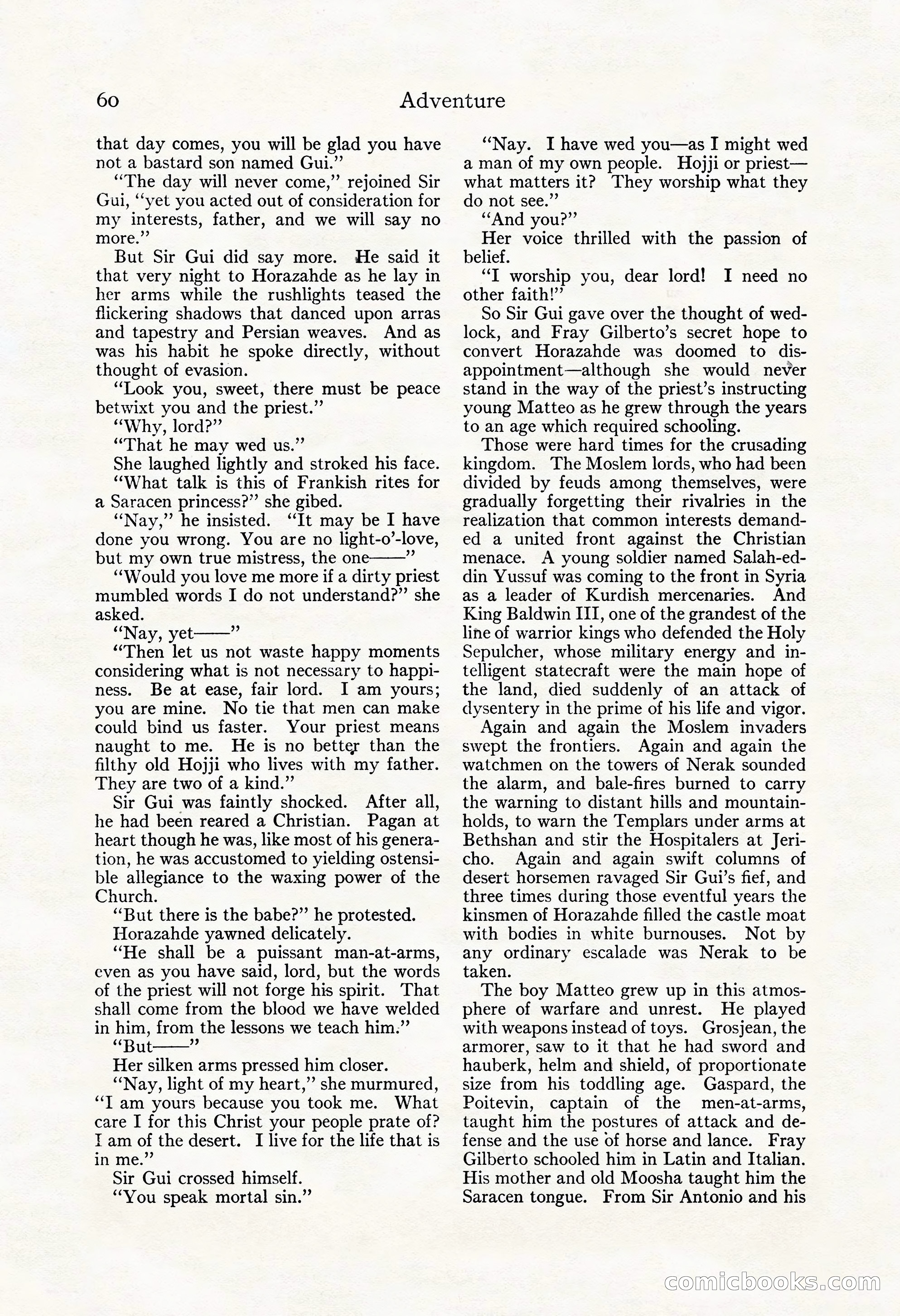
A restored page from Pulp Fiction, 1922. Page through the whole issue in the reader above.
📄 Transcribed text from this page (OCR, searchable)
Machine-transcribed from the original scan — historical spelling and the odd misread are preserved.
60 that day comes, you will be glad you have not a bastard son named Gui.” “The day will never come,” rejoined Sir Gui, “‘yet you acted out of consideration for my interests, father, and we will say no more.” But Sir Gui did say more. He said it that very night to Horazahde as he lay in her arms while the rushlights teased the flickering shadows that danced upon arras and tapestry and Persian weaves. And as was his habit he spoke directly, without thought of evasion. “Look you, sweet, there must be peace betwixt you and the priest.” “Why, lord?” “That he may wed us.”’ She laughed lightly and stroked his face. “What talk is this of Frankish rites for a Saracen princess?” she gibed. “Nay,” he insisted. ‘‘It may be I have done you wrong. You are no light-o’-love, but my own true mistress, the one Z “Would you love me more if a dirty priest mumbled words I do not understand?” she asked. “Nay, yet——” ‘Then let us not waste happy moments considering what is not necessary to happi- ness. Be at ease, fair lord. I am yours; you are mine. No tie that men can make could bind us faster. Your priest means naught to me. He is no better than the filthy old Hojji who lives with my father. They are two of a kind.” Sir Gui was faintly shocked. After all, he had been reared a Christian. Pagan at heart though he was, like most of his genera- tion, he was accustomed to yielding ostensi- ble allegiance to the waxing power of the Church. “But there is the babe?” he protested. Horazahde yawned delicately. “He shall be a puissant man-at-arms, even as you have said, lord, but the words of the priest will not forge his spirit. That shall come from the blood we have welded in him, from the lessons we teach him.” “But 99 Her silken arms pressed him closer. “Nay, light of my heart,” she murmured, “Tam yours because you took me. What care I for this Christ your people prate of? ¥ am of the desert. I live for the life that is in me.” Sir Gui crossed himself. “You speak mortal sin.” Adventure “Nay. I have wed you—as I might wed a man of my own people. Hojji or priest— what matters it? They worship what they do not see.” ‘And you?” Her voice thrilled with the passion of belief. “TY worship you, dear lord! other faith!” So Sir Gui gave over the thought of wed- lock, and Fray Gilberto’s secret hope to convert Horazahde was doomed to dis- appointment—although she would never stand in the way of the priest’s instructing young Matteo as he grew through the years to an age which required schooling. Those were hard times for the crusading kingdom. The Moslem lords, who had been divided by feuds among themselves, were gradually forgetting their rivalries in the realization that common interests demand- ed a united front against the Christian menace. A young soldier named Salah-ed- din Yussuf was coming to the front in Syria as a leader of Kurdish mercenaries. And King Baldwin III, one of the grandest of the line of warrior kings who defended the Holy Sepulcher, whose military energy and in- telligent statecraft were the main hope of the land, died suddenly of an attack of dysentery in the prime of his life and vigor. Again and again the Moslem invaders swept the frontiers. Again and again the watchmen on the towers of Nerak sounded the alarm, and bale-fires burned to carry the warning to distant hills and mountain- holds, to warn the Templars under arms at Bethshan and stir the Hospitalers at Jeri- cho. Again and again swift columns of desert horsemen ravaged Sir Gui’s fief, and three times during those eventful years the kinsmen of Horazahde filled the castle moat with bodies in white burnouses. Not by any ordinary escalade was Nerak to be taken. The boy Matteo grew up in this atmos- phere of warfare and unrest. He played with weapons instead of toys. Grosjean, the armorer, saw to it that he had sword and hauberk, helm and shield, of proportionate size from his toddling age. Gaspard, the Poitevin, captain of the men-at-arms, taught him the postures of attack and de- fense and the use of horse and lance. Fray Gilberto schooled him in Latin and Italian. His mother and old Moosha taught him the Saracen tongue. From Sir Antonio and his I need no COMmicaoo® S (©