
Pulp Fiction, 1922 · page 51 of 202
Adventure Magazine Cover — page 51: what you’re looking at
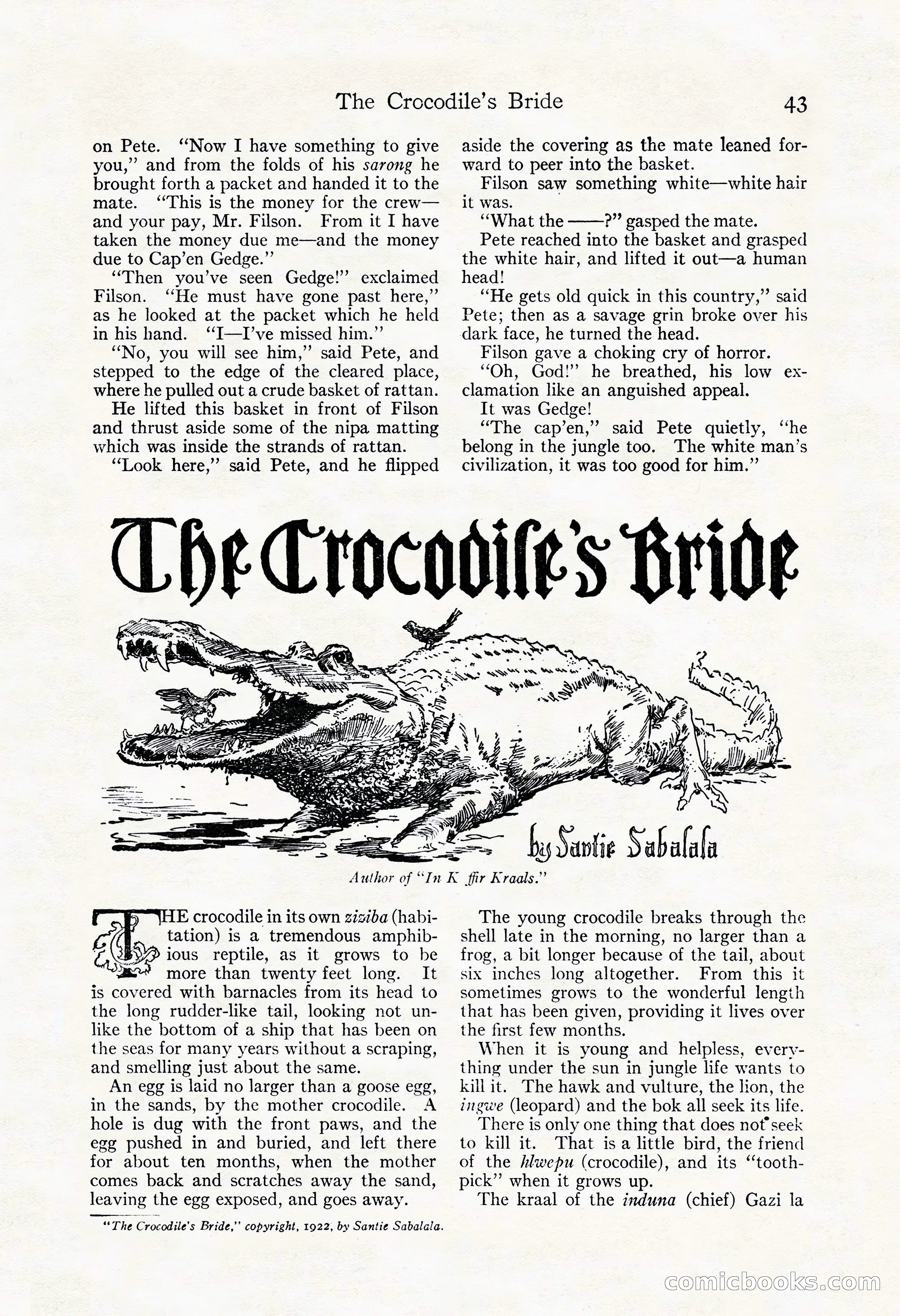
A restored page from Pulp Fiction, 1922. Page through the whole issue in the reader above.
📄 Transcribed text from this page (OCR, searchable)
Machine-transcribed from the original scan — historical spelling and the odd misread are preserved.
The Crccodile’s Bride on Pete. “Now I have something to give you,” and from the folds of his sarong he brought forth a packet and handed it to the mate. ‘This is the money for the crew— and your pay, Mr. Filson. From it I have taken the money due me—and the money due to Cap’en Gedge.” ‘“‘Then you’ve seen Gedge!” exclaimed Filson. ‘He must have gone past here,”’ as he looked at the packet which he held in his hand. ‘“I—TI’ve missed him.” ‘“‘No, you will see him,” said Pete, and stepped to the edge of the cleared place, where he pulled out a crude basket of rattan. He lifted this basket in front of Filson and thrust aside some of the nipa matting which was inside the strands of rattan. “Look here,” said Pete, and he flipped $9) 43 aside the covering as the mate leaned for- ward to peer into the basket. Filson saw something white—white hair it was. ‘What the ?”’ gasped the mate. Pete reached into the basket and grasped the white hair, and lifted it out—a human head! “He gets old quick in this country,” said Pete; then as a savage grin broke over his dark face, he turned the head. Filson gave a choking cry of horror. “Oh, God!’ he breathed, his low ex- clamation like an anguished appeal. It was Gedge! “The cap’en,” said Pete quietly, “‘he belong in the jungle too. The white man’s civilization, it was too good for him.” Ouse gle Page Le ~~ * ty poh cS ws ae o~ < MN ew Pe eae Sy es ons ae ws nantie Sabalala Author of “In ak ffir Kraals.” HE crocodile in its own ziziba (habi- tation) is a tremendous amphib- ious reptile, as it grows to be more than twenty feet long. It is covered with barnacles from its head to the long rudder-like tail, looking not un- like the bottom of a ship that has been on the seas for many years without a scraping, and smelling just about the same. An egg is laid no larger than a goose egg, in the sands, by the mother crocodile. A hole is dug with the front paws, and the egg pushed in and buried, and left there for about ten months, when the mother comes back and scratches away the sand, leaving the egg exposed, and goes away. “The Crocodile’s Bride,” copyright, 1922, by Santie Sabalala. The young crocodile breaks through the shell late in the morning, no larger than a frog, a bit longer because of the tail, about six inches long altogether. From this it sometimes grows to the wonderful length that has been given, providing it lives over the first few months. When it is young and helpless, every- thing under the sun in jungle life wants to kill it. The hawk and vulture, the lion, the ingwe (leopard) and the bok all seek its life. There is only one thing that does not’ seek to kill it. That is a little bird, the friend of the klwepu (crocodile), and its ‘‘tooth- pick” when it grows up. The kraal of the induna (chief) Gazi la COmiclook S C@