
Pulp Fiction, 1922 · page 197 of 202
Adventure Magazine Cover — page 197: what you’re looking at
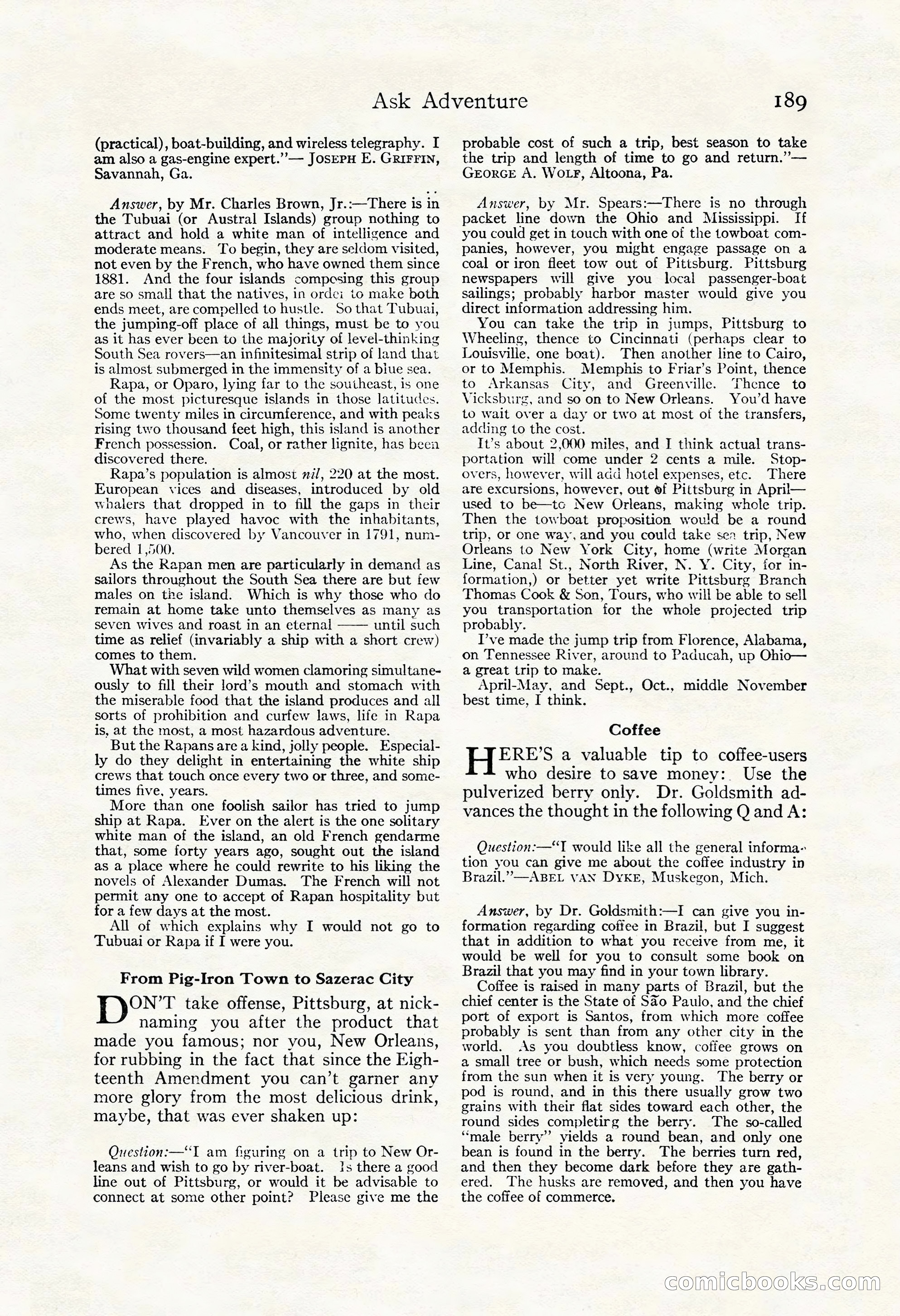
A restored page from Pulp Fiction, 1922. Page through the whole issue in the reader above.
📄 Transcribed text from this page (OCR, searchable)
Machine-transcribed from the original scan — historical spelling and the odd misread are preserved.
Ask Adventure (practical), boat-building, and wireless telegraphy. I am also a gas-engine expert.”’— JOSEPH E. GRIFFIN, Savannah, Ga. Answer, by Mr. Charles Brown, Jr.:—There is in the Tubuai (or Austral Islands) group nothing to attract and hold a white man of intelligence and moderate means. To begin, they are seldom visited, not even by the French, who have owned them since 1881. And the four islands compesing this group are so small that the natives, in ordei to make both ends meet, are compelled to hustle. So that Tubuai, the jumping-off place of all things, must be to you as it has ever been to the majority of level-thinking South Sea rovers—an infinitesimal strip of land that is almost submerged in the immensity of a blue sea. Rapa, or Oparo, lying far to the southeast, is one of the most picturesque islands in those latitudes. Some twenty miles in circumference, and with peaks rising two thousand feet high, this island is another French possession. Coal, or rather lignite, has been discovered there. Rapa’s population is almosi z7/, 220 at the most. European vices and diseases, introduced by old whalers that dropped in to fill the gaps in their crews, have played havoc with the inhabitants, who, when discovered by Vancouver in 1791, num- bered 1,500. As the Rapan men are particularly in demand as sailors throughout the South Sea there are but few males on the island. Which is why those who do remain at home take unto themselves as many as seven wives and roast in an eternal until such time as relief (invariably a ship with a short crew) comes to them. What with seven wild women clamoring simultane- ously to fill their lord’s mouth and stomach with the miserable food that the island produces and all sorts of prohibition and curfew laws, life in Rapa is, at the most, a most hazardous adventure. But the Rapansare a kind, jolly people. Especial- ly do they delight in entertaining the white ship crews that touch once every two or three, and some- times five, years. More than one foolish sailor has tried to jump ship at Rapa. Ever on the alert is the one solitary white man of the island, an old French gendarme that, some forty years ago, sought out the island as a place where he could rewrite to his liking the novels of Alexander Dumas. The French will not permit any one to accept of Rapan hospitality but for a few days at the most. All of which explains why I would not go to Tubuai or Rapa if I were you. From Pig-Iron Town to Sazerac City (Ose take offense, Pittsburg, at nick- naming you after the product that made you famous; nor you, New Orleans, for rubbing in the fact that since the Eigh- teenth Amendment you can’t garner any more glory from the most delicious drink, maybe, that was ever shaken up: Ouestion:—“T am figuring on a trip to New Or- leans and wish to go by river-boat. Is there a good line out of Pittsburg, or would it be advisable to connect at some other point? Please give me the 189 probable cost of such a trip, best season to take the trip and length of time to go and return.”— GEORGE A. WOLF, Altoona, Pa. Answer, by Mr. Spears:—There is no through packet line down the Ohio and Mississippi. If you could get in touch with one of the towboat com- panies, however, you might engage passage on a coal or iron fleet tow out of Pittsburg. Pittsburg newspapers will give you local passenger-boat sailings; probably harbor master would give you direct information addressing him. You can take the trip in jumps, Pittsburg to Wheeling, thence to Cincinnati (perhaps clear to Louisville. one boat). Then another line to Cairo, or to Memphis. Memphis to Friar’s Point, thence to Arkansas City, and Greenville. Thence to Vicksburg, and so on to New Orleans. You’d have to wait over a day or two at most of the transfers, adding to the cost. It’s about 2,000 miles, and I think actual trans- portation will come under 2 cents a mile. Stop- overs, however, will add hotel expenses, etc. There are excursions, however, out of Pittsburg in April— used to be—tc New Orleans, making whole trip. Then the towboat proposition would be a round trip, or one way, and you could take sea trip, New Orleans to New York City, home (write Morgan Line, Canal St., North River, N. Y. City, for in- formation,) or better yet write Pittsburg Branch Thomas Cook & Son, Tours, who will be able to sell you transportation for the whole projected trip probably. I’ve made the jump trip from Florence, Alabama, on Tennessee River, around to Paducah, up Ohio— a great trip to make. Apmnil-May, and Sept., Oct., middle November best time, I think. Coffee ERE’S a valuable tip to coffee-users who desire to save money: Use the pulverized berry only. Dr. Goldsmith ad- vances the thought in the following Q and A: Question: —“T would like all the general informa- tion you can give me about the coffee industry in Brazil.”—ABEL VAN DykE, Muskegon, Mich. Answer, by Dr. Goldsmith:—I can give you in- formation regarding coffee in Brazil, but I suggest that in addition to what you receive from me, it would be well for you to consult some book on Brazil that you may find in your town library. Coffee is raised in many parts of Brazil, but the chief center is the State of Sao Paulo, and the chief port of export is Santos, from which more coffee probably is sent than from any other city in the world. As you doubtless know, coffee grows on a small tree or bush, which needs some protection from the sun when it is very young. The berry or pod is round, and in this there usually grow two grains with their flat sides toward each other, the round sides completirg the berry. The so-called “male berry” yields a round bean, and only one bean is found in the berry. The berries turn red, and then they become dark before they are gath- ered. The husks are removed, and then you have the coffee of commerce. Conn (Cc DOOKS © iin i)