
Pulp Fiction, 1922 · page 188 of 202
Adventure Magazine Cover — page 188: what you’re looking at
A restored page from Pulp Fiction, 1922. Page through the whole issue in the reader above.
📄 Transcribed text from this page (OCR, searchable)
Machine-transcribed from the original scan — historical spelling and the odd misread are preserved.
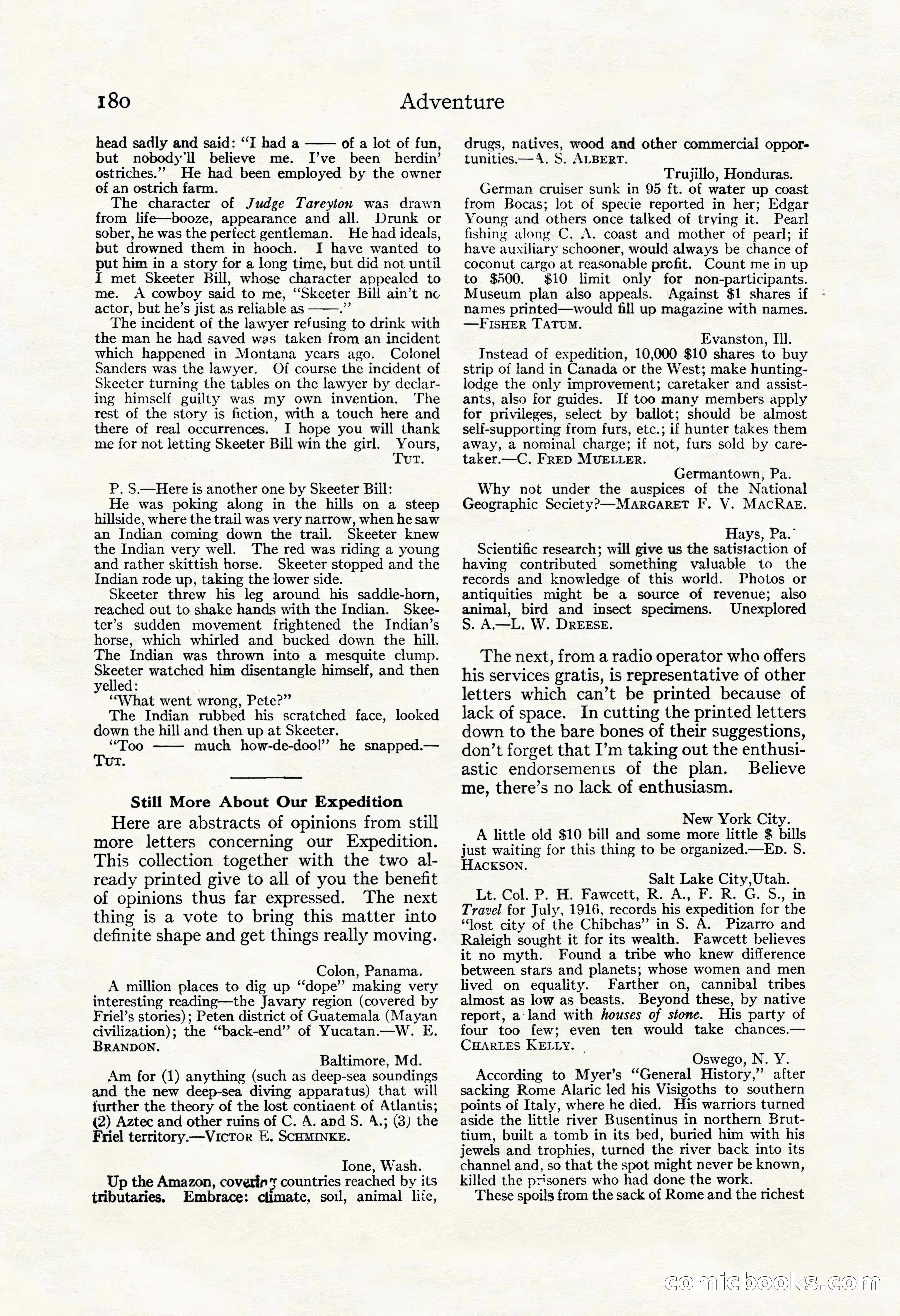
180 head sadly and said: “I had a of a lot of fun, but nobody'll believe me. I’ve been herdin’ ostriches.”” He had been employed by the owner of an ostrich farm. The character of Judge Tareyton was drawn from life—booze, appearance and all. Drunk or sober, he was the perfect gentleman. He had ideals, but drowned them in hooch. I have wanted to put him in a story for a long time, but did not until I met Skeeter Bill, whose character appealed to me. <A cowboy said to me, “Skeeter Bill ain’t ne actor, but he’s jist as reliable as ES The incident of the lawyer refusing to drink with the man he had saved was taken from an incident which happened in Montana years ago. Colonel Sanders was the lawyer. Of course the incident of Skeeter turning the tables on the lawyer by declar- ing himself guilty was my own invention. The rest of the story is fiction, with a touch here and there of real occurrences. I hope you will thank me for not letting Skeeter Bill win the girl. Yours, P. S.—Here is another one by Skeeter Bill: He was poking along in the hills on a steep hillside, where the trail was very narrow, when he saw an Indian coming down the trail. Skeeter knew the Indian very well. The red was riding a young and rather skittish horse. Skeeter stopped and the Indian rode up, taking the lower side. Skeeter threw his leg around his saddle-horn, reached out to shake hands with the Indian. Skee- ter’s sudden movement frightened the Indian’s horse, which whirled and bucked down the hill. The Indian was thrown into a mesquite clump. Skeeter watched him disentangle himself, and then yelled: ‘“‘What went wrong, Pete?” The Indian rubbed his scratched face, looked down the hill and then up at Skeeter. ae much how-de-doo!”’ he snapped.— T. Still More About Our Expedition Here are abstracts of opinions from still more letters concerning our Expedition. This collection together with the two al- ready printed give to all of you the benefit of opinions thus far expressed. The next thing is a vote to bring this matter into definite shape and get things really moving. Colon, Panama. A million places to dig up ‘‘dope’”’ making very interesting reading—the Javary region (covered by Friel’s stories); Peten district of Guatemala (Mayan civilization); the “back-end” of Yucatan.—W. E. BRANDON. Baltimore, Md. Am for (1) anything (such as deep-sea soundings and the new deep-sea diving apparatus) that will further the theory of the lost continent of Atlantis; (2) Aztec and other ruins of C. A. and S. A.; (8) the Friel territory —VicToR EK. SCHMINKE. Tone, Wash. Up the Amazon, coverin countries reached by its tributaries. Embrace: climate, soil, animal life, Adventure drugs, natives, wood and other commercial oppor- tunities.— 4. S. ALBERT. Trujillo, Honduras. German cruiser sunk in 95 ft. of water up coast from Bocas; lot of specie reported in her; Edgar Young and others once talked of trying it. Pearl fishing along C. A. coast and mother of pearl; if have auxiliary schooner, would always be chance of coconut cargo at reasonable prefit. Count me in up to $500. $10 lmit only for non-participants. Museum plan also appeals. Against $1 shares if hames printed—would fill up magazine with names. —FISHER TATUM. Evanston, Ill. Instead of expedition, 10,000 $10 shares to buy strip of land in Canada or the West; make hunting- lodge the only improvement; caretaker and assist- ants, also for guides. If too many members apply for privileges, select by ballot; should be almost self-supporting from furs, etc.; if hunter takes them away, a nominal charge; if not, furs sold by care- taker.—C. FRED MUELLER. Germantown, Pa. Why not under the auspices of the National Geographic SccietyP—MARGARET F. V. MACRAE. Hays, Pa. Scientific research; will give us the satistaction of having contributed something valuable to the records and knowledge of this world. Photos or antiquities might be a source of revenue; also animal, bird and insect specimens. Unexplored 5. A.—L. W. DREESE. The next, from a radio operator who offers his services gratis, is representative of other letters which can’t be printed because of lack of space. In cutting the printed letters down to the bare bones of their suggestions, don’t forget that I’m taking out the enthusi- astic endorsements of the plan. Believe me, there’s no lack of enthusiasm. New York City. A little old $10 bill and some more little $ bills just waiting for this thing to be organized.—Eb. S. HACKSON. Salt Lake City,Utah. Lt. Col. P. BH. Fawcett, &. A., F. R..G. S., in Travel for July, 1916, records his expedition for the “lost city of the Chibchas” in S. A. Pizarro and Raleigh sought it for its wealth. Fawcett believes it no myth. Found a tribe who knew difference between stars and planets; whose women and men lived on equality. Farther on, cannibal tribes almost as low as beasts. Beyond these, by native report, a land with houses of stone. His party of four too few; even ten would take chances.— CHARLES KELLY. | Oswego, N. Y. According to Myer’s ‘‘General History,” after sacking Rome Alaric led his Visigoths to southern points of Italy, where he died. His warriors turned aside the little river Busentinus in northern Brut- tium, built a tomb in its bed, buried him with his jewels and trophies, turned the river back into its channel and, so that the spot might never be known, killed the prisoners who had done the work. These spoils from the sack of Rome and the richest cCoOmiclook S (©