
Pulp Fiction, 1922 · page 183 of 202
Adventure Magazine Cover — page 183: what you’re looking at
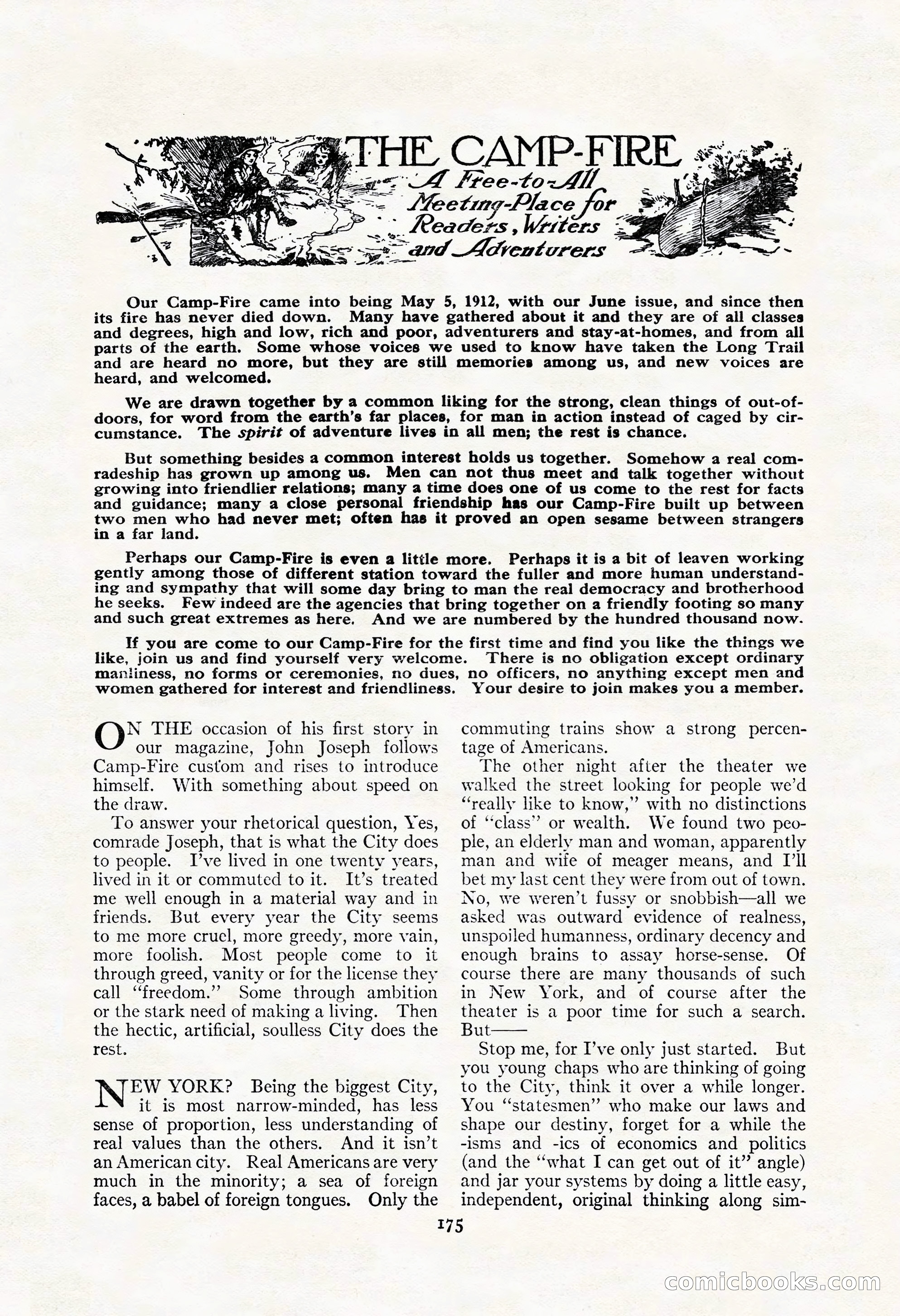
A restored page from Pulp Fiction, 1922. Page through the whole issue in the reader above.
📄 Transcribed text from this page (OCR, searchable)
Machine-transcribed from the original scan — historical spelling and the odd misread are preserved.
= E =. Meetu Place for _ Se _. Readers, Writers J BSso oe. ad. Adventurers —_ Coane Our Camp-Fire came into being May 5, 1912, with our June issue, and since then its fire has never died down. Many have gathered about it and they are of all classes and degrees, high and low, rich and poor, adventurers and stay-at-homes, and from all parts of the earth. Some whose voices we used to know have taken the Long Trail and are heard no more, but they are still memories among us, and new voices are heard, and welcomed. We are drawn together by a common liking for the strong, clean things of out-of- doors, for word from the earth’s far places, for man in action instead of caged by cir- cumstance. The spirit of adventure lives in all men; the rest is chance. But something besides a common interest holds us together. Somehow a real com- radeship has grown up among us. Men can not thus meet and talk together without growing into friendlier relations; many a time does one of us come to the rest for facts and guidance; many a close personal friendship has our Camp-Fire built up between two men who had never met; often has it proved an open sesame between strangers in a far land. Perhaps our Camp-Fire is even a little more. Perhaps it is a bit of leaven working gently among those of different station toward the fuller and more human understand- ing and sympathy that will some day bring to man the real democracy and brotherhood he seeks. Few indeed are the agencies that bring together on a friendly footing so many and such great extremes as here. And we are numbered by the hundred thousand now. If you are come to our Camp-Fire for the first time and find you like the things we like, join us and find yourself very welcome. There is no obligation except ordinary maniiness, no forms or ceremonies, no dues, no officers, no anything except men and women gathered for interest and friendliness. Your desire to join makes you a member. N THE occasion of his first story in our magazine, John Joseph follows Camp-Fire custom and rises to introduce himself. With something about speed on the draw. To answer your rhetorical question, Yes, comrade Joseph, that is what the City does to people. Ive lived in one twentv years, lived in it or commuted to it. It’s treated me well enough in a material way and in friends. But every year the City seems to me more crucl, more greedy, more vain, more foolish. Most people come to it through greed, vanity or for the license they call ‘“‘freedom.”’ Some through ambition or the stark need of making a living. Then the hectic, artificial, soulless City does the rest. EW YORK? Being the biggest City, it is most narrow-minded, has less sense of proportion, less understanding of real values than the others. And it isn’t an American city. Real Americans are very much in the minority; a sea of foreign faces, a babel of foreign tongues. Only the commuting trains show a strong percen- tage of Americans. The other night after the theater we walked the street looking for people we’d “really like to know,” with no distinctions of ‘class’ or wealth. We found two peo- ple, an elderly man and woman, apparently man and wife of meager means, and I'll bet my last cent they were from out of town. No, we weren’t fussy or snobbish—all we asked was outward evidence of realness, unspoiled humanness, ordinary decency and enough brains to assay horse-sense. Of course there are many thousands of such in New York, and of course after the theater is a poor time for such a search. But Stop me, for I’ve only just started. But you young chaps who are thinking of going to the City, think it over a while longer. You “statesmen” who make our laws and shape our destiny, forget for a while the -isms and -ics of economics and politics (and the ‘‘what I can get out of it” angle) and jar your systems by doing a little easy, independent, original thinking along sim- 175 Conn (Cc DOOKS C@