
Pulp Fiction, 1922 · page 162 of 202
Adventure Magazine Cover — page 162: what you’re looking at
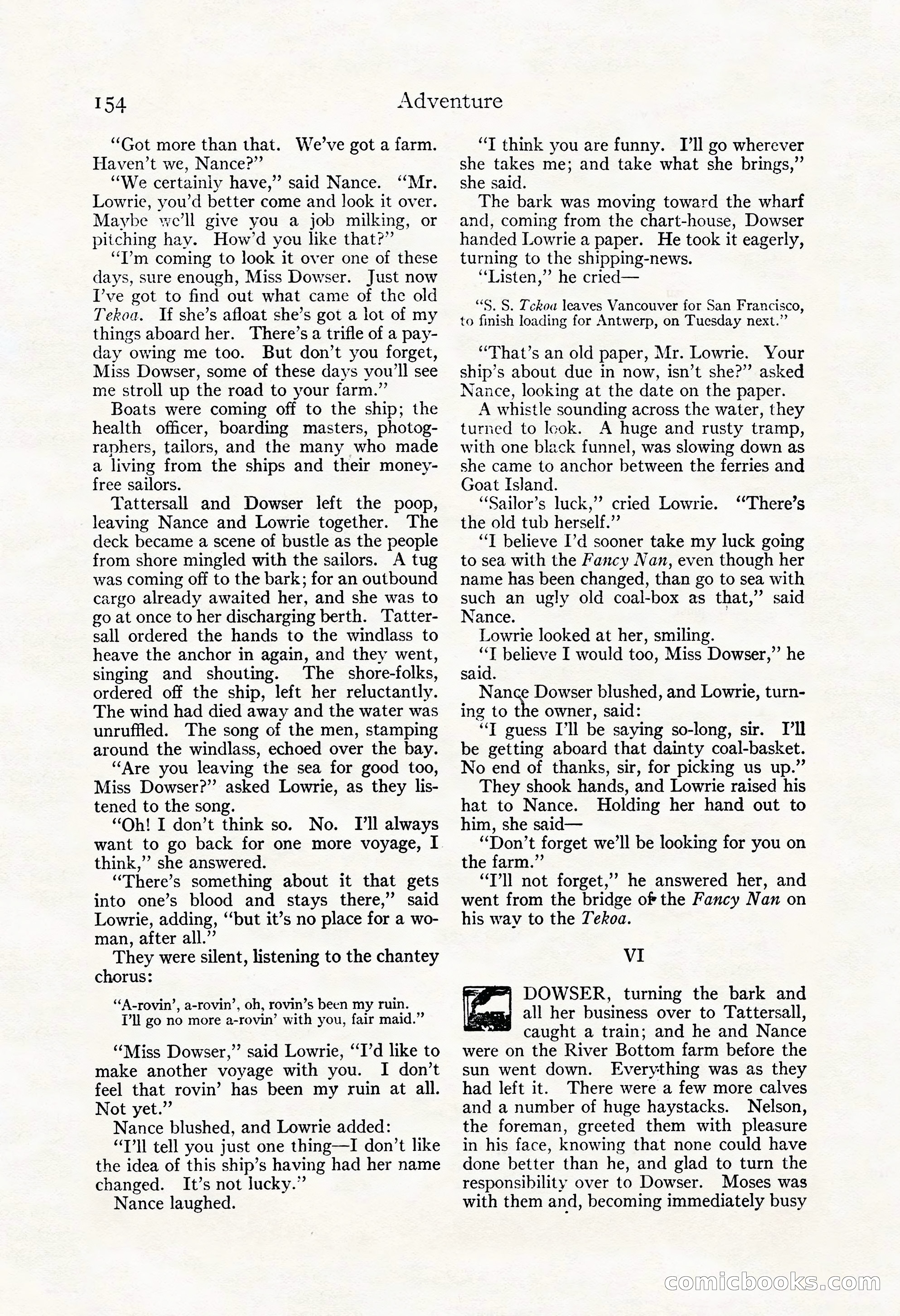
A restored page from Pulp Fiction, 1922. Page through the whole issue in the reader above.
📄 Transcribed text from this page (OCR, searchable)
Machine-transcribed from the original scan — historical spelling and the odd misread are preserved.
154 “Got more than that. We’ve got a farm. Haven’t we, Nance?” “We certainiy have,” said Nance. ‘Mr. Lowrie, you’d better come and look it over. Maybe we'll give you a job milking, or pitching hay. How’d you like that?” “T’m coming to look it over one of these days, sure enough, Miss Dowser. Just now I’ve got to find out what came of the old Tekoa. If she’s afloat she’s got a lot of my things aboard her. There’s a trifle of a pay- day owing me too. But don’t you forget, Miss Dowser, some of these days you'll see me stroll up the road to your farm.” Boats were coming off to the ship; the health officer, boarding masters, photog- raphers, tailors, and the many who made a living from the ships and their money- free sailors. Tattersall and Dowser left the poop, leaving Nance and Lowrie together. The deck became a scene of bustle as the people from shore mingled with the sailors. A tug was coming off to the bark; for an outbound cargo already awaited her, and she was to go at once to her discharging berth. Tatter- sall ordered the hands to the windlass to heave the anchor in again, and they went, singing and shouting. The shore-folks, ordered off the ship, left her reluctantly. The wind had died away and the water was unruffled. The song of the men, stamping around the windlass, echoed over the bay. “Are you leaving the sea for good too, Miss Dowser?”’ asked Lowrie, as they lis- tened to the song. “Oh! I don’t think so. No. I'll always want to go back for one more voyage, I. think,”’ she answered. “There’s something about it that gets into one’s blood and stays there,” said Lowrie, adding, “‘but it’s no place for a wo- man, after all.” They were silent, listening to the chantey chorus: ‘“‘A-rovin’, a-rovin’, oh, rovin’s been my ruin. T’ll go no more a-rovin’ with you, fair maid.” “Miss Dowser,” said Lowrie, ‘‘I’d like to make another voyage with you. I don’t feel that rovin’ has been my ruin at all. Not yet.” Nance blushed, and Lowrie added: “T’ll tell you just one thing—I don’t like the idea of this ship’s having had her name changed. It’s not lucky.” Nance laughed. Adventure “T think you are funny. I’ll go wherever she takes me; and take what she brings,” she said. The bark was moving toward the wharf and, coming from the chart-house, Dowser handed Lowrie a paper. He took it eagerly, turning to the shipping-news. “Listen,” he cried— “S. 5S. Tckoau leaves Vancouver for San Francisco, to finish loading for Antwerp, on Tuesday next.” “That’s an old paper, Mr. Lowrie. Your ship’s about due in now, isn’t she?” asked Nance, looking at the date on the paper. A whistle sounding across the water, they turned to Icok. A huge and rusty tramp, with one black funnel, was slowing down as she came to anchor between the ferries and Goat Island. ‘“Sailor’s luck,” cried Lowrie. the old tub herself.” “T believe I’d sooner take my luck going to sea with the Fancy Nan, even though her name has been changed, than go to sea with such an ugly old coal-box as that,” said Nance. | Lowrie looked at her, smiling. “T believe I would too, Miss Dowser,”’ he said. Nance Dowser blushed, and Lowrie, turn- ing to the owner, said: “T guess I'll be saying so-long, sir. Tl be getting aboard that dainty coal-basket. No end of thanks, sir, for picking us up.” They shook hands, and Lowrie raised his hat to Nance. Holding her hand out to him, she said— “Ton’t forget we’ll be looking for you on the farm.” “T’ll not forget,’ he answered her, and went from the bridge of the Fancy Nan on his wav to the Tekoa. “There’s VI 7 DOWSER, turning the bark and saesg all her business over to Tattersall, caught a train; and he and Nance were on the River Bottom farm before the sun went down. Everything was as they had left it. There were a few more calves and a number of huge haystacks. Nelson, the foreman, greeted them with pleasure in his face, knowing that none could have done better than he, and glad to turn the responsibility over to Dowser. Moses was with them and, becoming immediately busy © DOOKS (C@