
Pulp Fiction, 1922 · page 16 of 202
Adventure Magazine Cover — page 16: what you’re looking at
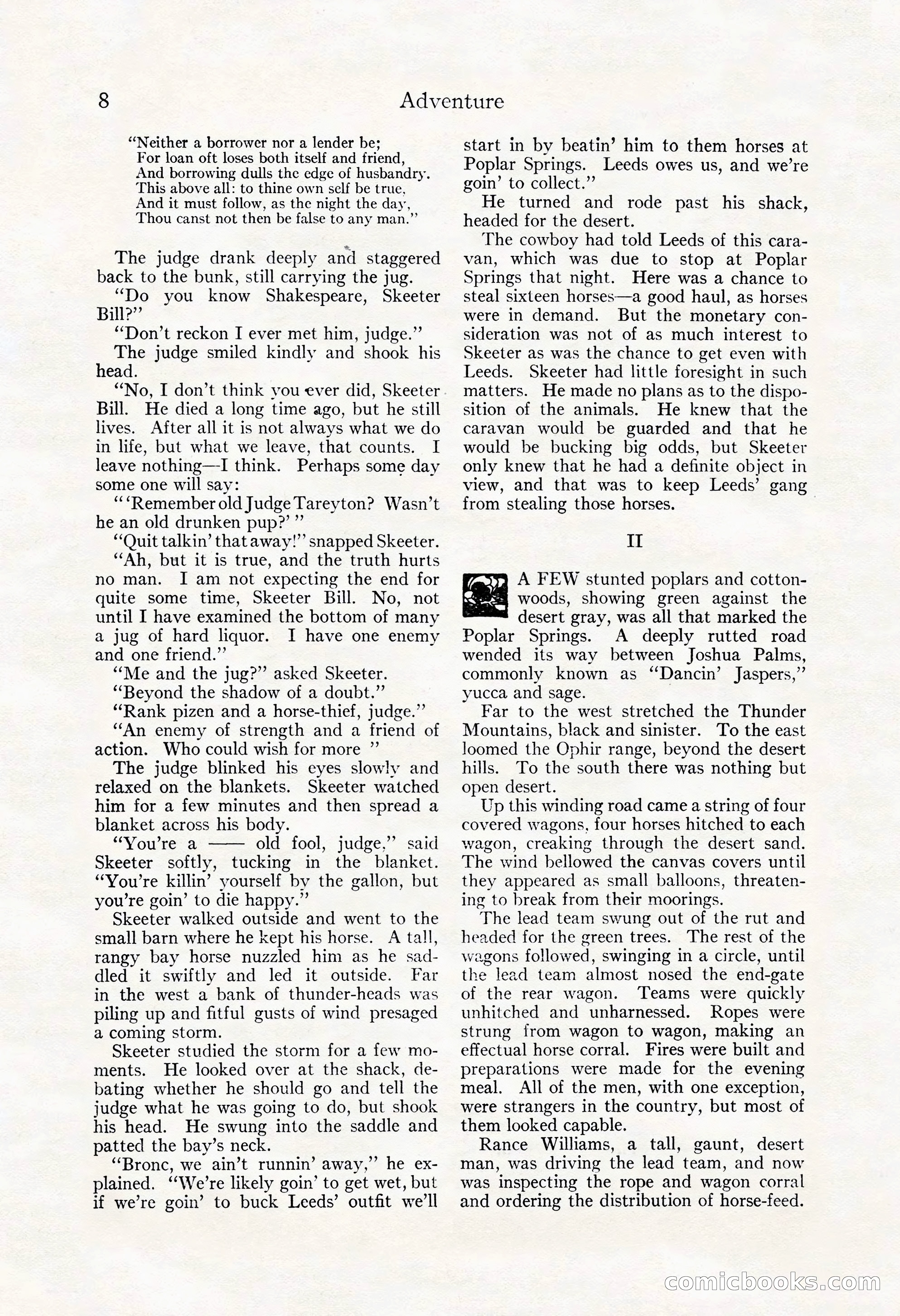
A restored page from Pulp Fiction, 1922. Page through the whole issue in the reader above.
📄 Transcribed text from this page (OCR, searchable)
Machine-transcribed from the original scan — historical spelling and the odd misread are preserved.
“Neither a borrower nor a lender be; For loan oft loses both itself and friend, And borrowing dulls the edge of husbandry. This above all: to thine own self be true, And it must follow, as the night the day, Thou canst not then be false to any man.” The judge drank deeply and staggered back to the bunk, still carrying the jug. “Do you know Shakespeare, Skeeter Bill?” “Don’t reckon I ever met him, judge.”’ The judge smiled kindly and shook his head. “No, I don’t think vou ever did, Skeeter Bill. He died a long time ago, but he still lives. After all it is not always what we do in life, but what we leave, that counts. I leave nothing—I think. Perhaps some day some one will say: ‘“*“Remember old Judge Tareyton? Wasn’t he an old drunken pup?’ ” “Quit talkin’ that away!” snapped Skeeter. ‘Ah, but it is true, and the truth hurts no man. I am not expecting the end for quite some time, Skeeter Bill. No, not until I have examined the bottom of many a jug of hard liquor. I have one enemy and one friend.” ““Me and the jug?” asked Skeeter. “Beyond the shadow of a doubt.” “Rank pizen and a horse-thief, judge.”’ ‘“‘An enemy of strength and a friend of action. Who could wish for more ”’ The judge blinked his eyes slowly and relaxed on the blankets. Skeeter watched him for a few minutes and then spread a blanket across his body. “You’re a old fool, judge,” said Skeeter softly, tucking in the blanket. “You're killin’ yourself by the gallon, but yow’re goin’ to die happy.” Skeeter walked outside and went to the small barn where he kept his horse. A tall, rangy bay horse nuzzled him as he sad- dled it swiftly and led it outside. Far in the west a bank of thunder-heads was piling up and fitful gusts of wind presaged a coming storm. Skeeter studied the storm for a few mo- ments. He looked over at the shack, de- bating whether he should go and tell the judge what he was going to do, but shook his head. He swung into the saddle and patted the bay’s neck. “Bronc, we ain’t runnin’ away,” he ex- plained. “We’ re likely goin’ to get wet, but if we’re goin’ to buck Leeds’ outfit we'll Adventure start in by beatin’ him to them horses at Poplar Springs. Leeds owes us, and we’re goin’ to collect.” He turned and rode past his shack, headed for the desert. The cowboy had told Leeds of this cara- van, which was due to stop at Poplar Springs that night. Here was a chance to steal sixteen horses—a good haul, as horses were in demand. But the monetary con- sideration was not of as much interest to Skeeter as was the chance to get even with Leeds. Skeeter had little foresight in such matters. He made no plans as to the dispo- sition of the animals. He knew that the caravan would be guarded and that he would be bucking big odds, but Skeeter only knew that he had a definite object in view, and that was to keep Leeds’ gang from stealing those horses. II iy A FEW stunted poplars and cotton- & a woods, showing green against the desert gray, was all that marked the Poplit Springs. A deeply rutted road wended its way between Joshua Palms, commonly known as “Dancin’ Jaspers,” yucca and sage. | Far to the west stretched the Thunder Mountains, black and sinister. To the east loomed the Ophir range, beyond the desert hills. To the south there was nothing but open desert. Up this winding road came a string of four covered wagons, four horses hitched to each wagon, creaking through the desert sand. The wind bellowed the canvas covers until they appeared as small balloons, threaten- ing to break from their moorings. The lead team swung out of the rut and headed for the green trees. The rest of the wagons followed, swinging in a circle, until the lead team almost nosed the end-gate of the rear wagon. Teams were quickly unhitched and unharnessed. Ropes were strung from wagon to wagon, making an effectual horse corral. Fires were built and preparations were made for the evening meal. All of the men, with one exception, were strangers in the country, but most of them looked capable. Rance Williams, a tall, gaunt, desert man, was driving the lead team, and now was inspecting the rope and wagon corral and ordering the distribution of horse-feed. COMmicooolk S (©) iin