
Pulp Fiction, 1922 · page 158 of 202
Adventure Magazine Cover — page 158: what you’re looking at
A restored page from Pulp Fiction, 1922. Page through the whole issue in the reader above.
📄 Transcribed text from this page (OCR, searchable)
Machine-transcribed from the original scan — historical spelling and the odd misread are preserved.
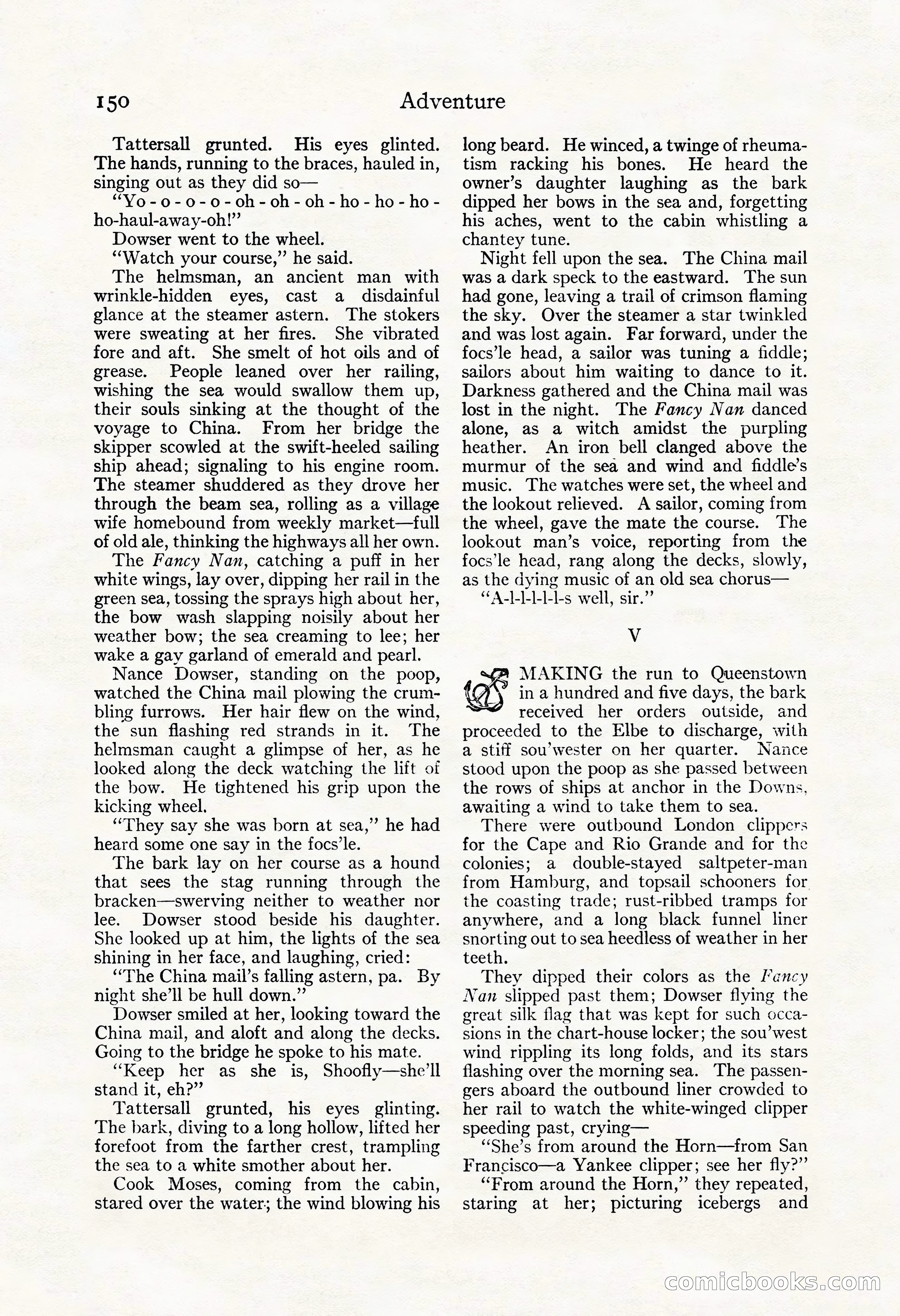
150 Tattersall grunted. His eyes glinted. The hands, running to the braces, hauled in, singing out as they did so— “Yo-0-0-0-oh-oh- oh -ho-ho-ho- ho-haul-away-oh!”’ Dowser went to the wheel. ‘‘Watch your course,” he said. The helmsman, an ancient man with wrinkle-hidden eyes, cast a disdainful glance at the steamer astern. The stokers were sweating at her fires. She vibrated fore and aft. She smelt of hot oils and of grease. People leaned over her railing, wishing the sea would swallow them up, their souls sinking at the thought of the voyage to China. From her bridge the skipper scowled at the swift-heeled sailing ship ahead; signaling to his engine room. The steamer shuddered as they drove her through the beam sea, rolling as a village wife homebound from weekly market—full of old ale, thinking the highways all her own. The Fancy Nan, catching a puff in her white wings, lay over, dipping her rail in the green sea, tossing the sprays high about her, the bow wash slapping noisily about her weather bow; the sea creaming to lee; her wake a gay garland of emerald and pearl. Nance Dowser, standing on the poop, watched the China mail plowing the crum- bling furrows. Her hair flew on the wind, the sun flashing red strands in it. The helmsman caught a glimpse of her, as he looked along the deck watching the lift of the bow. He tightened his grip upon the kicking wheel. ‘They say she was born at sea,” he had heard some one say in the focs’le. The bark lay on her course as a hound that sees the stag running through the bracken—swerving neither to weather nor lee. Dowser stood beside his daughter. She looked up at him, the lights of the sea shining in her face, and laughing, cried: “The China mail’s falling astern, pa. By night she’ll be hull down.” Dowser smiled at her, looking toward the China mail, and aloft and along the decks. Going to the bridge he spoke to his mate. “Keep her as she is, Shoofly—she’ll stand it, eh?” Tattersall grunted, his eyes glinting. The bark, diving to a long hollow, lifted her forefoot from the farther crest, trampling the sea to a white smother about her. Cook Moses, coming from the cabin, stared over the water; the wind blowing his Adventure long beard. He winced, a twinge of rheuma- tism racking his bones. He heard the owner’s daughter laughing as the bark dipped her bows in the sea and, forgetting his aches, went to the cabin whistling a chantey tune. Night fell upon the sea. The China mail was a dark speck to the eastward. The sun had gone, leaving a trail of crimson flaming the sky. Over the steamer a star twinkled and was lost again. Far forward, under the focs’le head, a sailor was tuning a fiddle; sailors about him waiting to dance to it. Darkness gathered and the China mail was lost in the night. The Fancy Nan danced alone, as a witch amidst the purpling heather. An iron bell clanged above the murmur of the sea and wind and fiddle’s music. The watches were set, the wheel and the lookout relieved. A sailor, coming from the wheel, gave the mate the course. The lookout man’s voice, reporting from the focs’le head, rang along the decks, slowly, as the dying music of an old sea chorus— ‘*A-1-]-1-1-l-s well, sir.”’ V _< MAKING the run to Queenstown (A) ina hundred and five days, the bark =“ received her orders outside, and proceeded to the Elbe to discharge, with a stiff sou’wester on her quarter. Nance stood upon the poop as she passed between the rows of ships at anchor in the Downs, awaiting a wind to take them to sea. There were outbound London clippers for the Cape and Rio Grande and for the colonies; a double-stayed saltpeter-man from Hamburg, and topsail schooners for the coasting trade; rust-ribbed tramps for anywhere, and a long black funnel liner snorting out to sea heedless of weather in her teeth. They dipped their colors as the Fency Nan slipped past them; Dowser flying the ereat silk flag that was kept for such occa- sions in the chart-house locker; the sou’ west wind rippling its long folds, and its stars flashing over the morning sea. The passen- gers aboard the outbound liner crowded to her rail to watch the white-winged clipper speeding past, crying— “She’s from around the Horn—from San Francisco—a Yankee clipper; see her fly>?”’ “From around the Horn,” they repeated, staring at her; picturing icebergs and COMmicaoo® S ©