
Pulp Fiction, 1922 · page 142 of 202
Adventure Magazine Cover — page 142: what you’re looking at
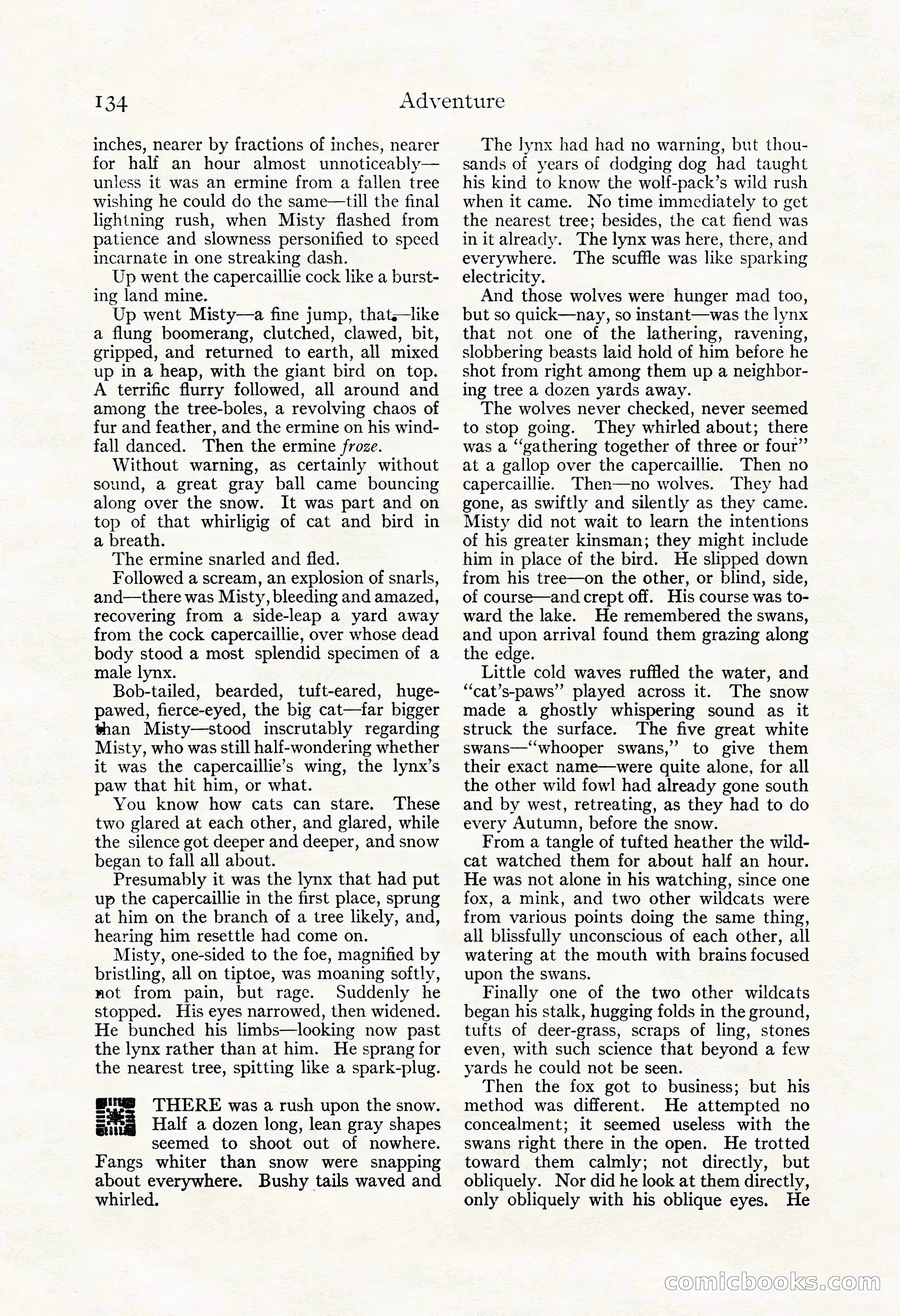
A restored page from Pulp Fiction, 1922. Page through the whole issue in the reader above.
📄 Transcribed text from this page (OCR, searchable)
Machine-transcribed from the original scan — historical spelling and the odd misread are preserved.
134 inches, nearer by fractions of inches, nearer for half an hour almost unnoticeably— unless it was an ermine from a fallen tree wishing he could do the same—till the final lightning rush, when Misty flashed from patience and slowness personified to speed incarnate in one streaking dash. Up went the capercaillie cock like a burst- ing land mine. Up went Misty—a fine jump, thats—like a flung boomerang, clutched, clawed, bit, gripped, and returned to earth, all mixed up in a heap, with the giant bird on top. A terrific flurry followed, all around and among the tree-boles, a revolving chaos of fur and feather, and the ermine on his wind- fall danced. Then the ermine froze. Without warning, as certainly without sound, a great gray ball came bouncing along over the snow. It was part and on top of that whirligig of cat and bird in a breath. The ermine snarled and fled. Followed a scream, an explosion of snarls, and—there was Misty, bleeding and amazed, recovering from a side-leap a yard away from the cock capercaillie, over whose dead body stood a most splendid specimen of a male lynx. Bob-tailed, bearded, tuft-eared, huge- pawed, fierce-eyed, the big cat—tfar bigger than Misty—stood inscrutably regarding Misty, who was still half-wondering whether it was the capercaillie’s wing, the lynx’s paw that hit him, or what. You know how cats can stare. These two glared at each other, and glared, while the silence got deeper and deeper, and snow began to fall all about. Presumably it was the lynx that had put up the capercaillie in the first place, sprung at him on the branch of a tree likely, and, hearing him resettle had come on. Misty, one-sided to the foe, magnified by bristling, all on tiptoe, was moaning softly, not from pain, but rage. Suddenly he stopped. His eyes narrowed, then widened. He bunched his limbs—looking now past the lynx rather than at him. He sprang for the nearest tree, spitting like a spark-plug. es THERE was a rush upon the snow. asks Half a dozen long, lean gray shapes seemed to shoot out of nowhere. Fangs whiter than snow were snapping about everywhere. Bushy tails waved and whirled. Adventure The lynx had had no warning, but thou- sands of years of dodging dog had taught his kind to know the wolf-pack’s wild rush when it came. No time immediately to get the nearest tree; besides, the cat fiend was in it already. The lynx was here, there, and everywhere. The scuffle was like sparking electricity. And those wolves were hunger mad too, but so quick—nay, so instant—was the lynx that not one of the lathering, ravening, slobbering beasts laid hold of him before he shot from right among them up a neighbor- ing tree a dozen yards away. The wolves never checked, never seemed to stop going. They whirled about; there was a “gathering together of three or four” at a gallop over the capercaillie. Then no capercaillie. Then—no wolves. They had gone, as swiftly and silently as they came. Misty did not wait to learn the intentions of his greater kinsman; they might include him in place of the bird. He slipped down from his tree—on the other, or blind, side, of course—and crept off. His course was to- ward the lake. He remembered the swans, and upon arrival found them grazing along the edge. Little cold waves ruffled the water, and “cat’s-paws”’ played across it. The snow made a ghostly whispering sound as it struck the surface. The five great white swans—“‘whooper swans,” to give them their exact name—were quite alone, for all the other wild fowl had already gone south and by west, retreating, as they had to do every Autumn, betore the snow. From a tangle of tufted heather the wild- cat watched them for about half an hour. He was not alone in his watching, since one fox, a mink, and two other wildcats were from various points doing the same thing, all blissfully unconscious of each other, all watering at the mouth with brains focused upon the swans. Finally one of the two other wildcats began his stalk, hugging folds in the ground, tufts of deer-grass, scraps of ling, stones even, with such science that beyond a few yards he could not be seen. Then the fox got to business; but his method was different. He attempted no concealment; it seemed useless with the swans right there in the open. He trotted toward them calmly; not directly, but obliquely. Nor did he look at them directly, only obliquely with his oblique eyes. He GOMIIGooOo S C@