
Pulp Fiction, 1922 · page 110 of 202
Adventure Magazine Cover — page 110: what you’re looking at
A restored page from Pulp Fiction, 1922. Page through the whole issue in the reader above.
📄 Transcribed text from this page (OCR, searchable)
Machine-transcribed from the original scan — historical spelling and the odd misread are preserved.
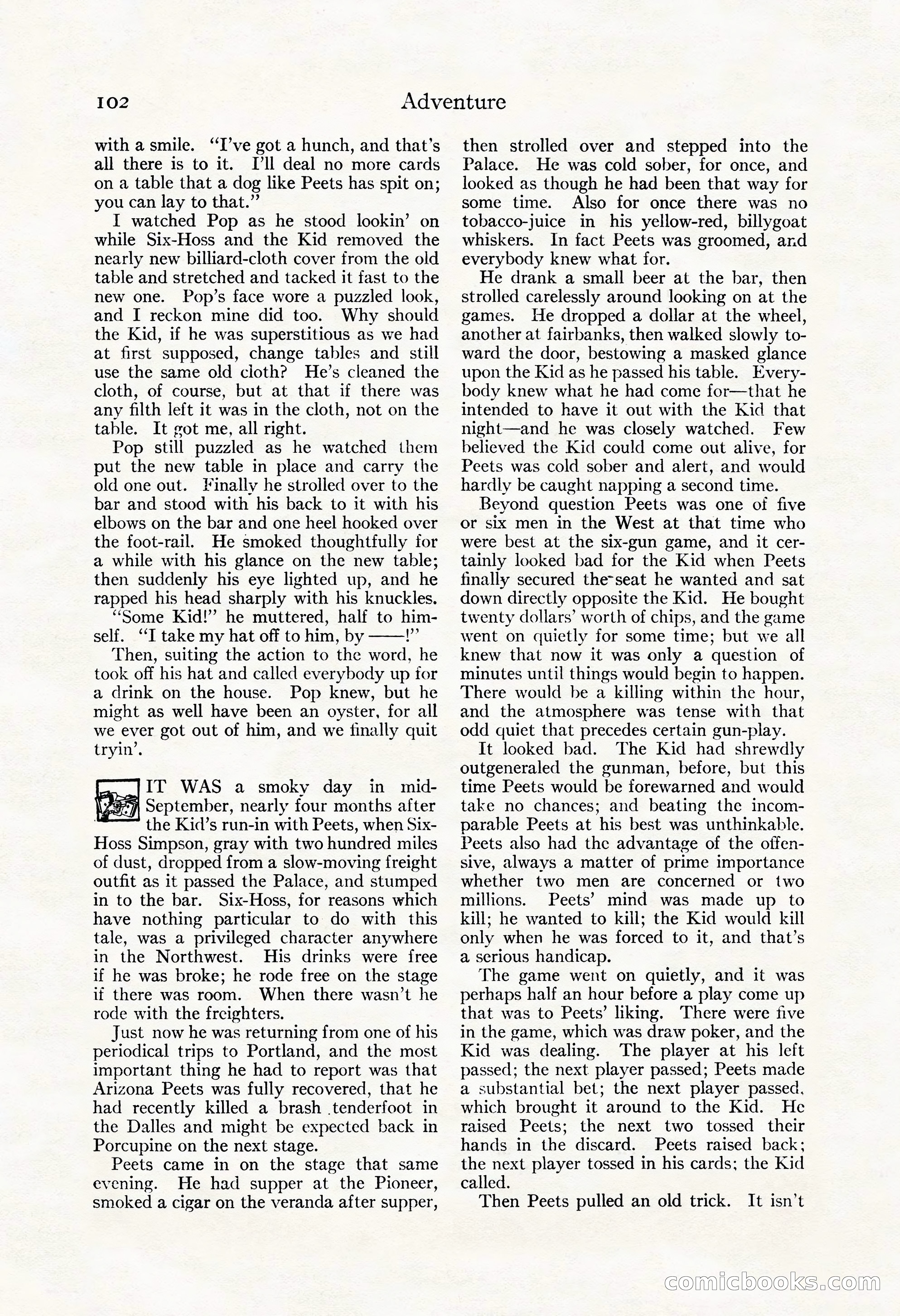
102 with a smile. ‘I’ve got a hunch, and that’s all there is to it. Dll deal no more cards on a table that a dog like Peets has spit on; you can lay to that.” I watched Pop as he stood lookin’ on while Six-Hoss and the Kid removed the nearly new billiard-cloth cover from the old table and stretched and tacked it fast to the new one. Pop’s face wore a puzzled look, and I reckon mine did too. Why should the Kid, if he was superstitious as we had at first supposed, change tables and still use the same old cioth? He’s cleaned the cloth, of course, but at that if there was any filth left it was in the cloth, not on the table. It got me, all right. Pop still puzzled as he watched them put the new table in place and carry the old one out. Finally he strolled over to the bar and stood with his back to it with his elbows on the bar and one heel hooked over the foot-rail. He smoked thoughtfully for a while with his glance on the new table; then suddenly his eye lighted up, and he rapped his head sharply with his knuckles. “Some Kid!” he muttered, half to him- self. ‘I take my hat off to him, by Y Then, suiting the action to the word, he took off his hat and called everybody up tor a drink on the house. Pop knew, but he might as well have been an oyster, for all we ever got out of him, and we finally quit tryin’. IT WAS a smoky day in mid- “4 September, nearly four months after the Kid’s run-in with Peets, when Six- Hoss Simpson, gray with two hundred miles of dust, dropped from a slow-moving freight outfit as it passed the Palace, and stumped in to the bar. Six-Hoss, for reasons which have nothing particular to do with this tale, was a privileged character anywhere in the Northwest. His drinks were free if he was broke; he rode free on the stage if there was room. When there wasn’t he rode with the freighters. Just now he was returning from one of his periodical trips to Portland, and the most important thing he had to report was that Arizona Peets was fully recovered, that he had recently killed a brash tenderfoot in the Dalles and might be expected back in Porcupine on the next stage. Peets came in on the stage that same evening. He had supper at the Pioneer, smoked a cigar on the veranda after supper, Adventure then strolled over and stepped into the Palace. He was cold sober, for once, and looked as though he had been that way for some time. Also for once there was no tobacco-juice in his yellow-red, billygoat whiskers. In fact Peets was groomed, and everybody knew what for. He drank a small beer at the bar, then strolled carelessly around looking on at the games. He dropped a dollar at the wheel, another at fairbanks, then walked slowly to- ward the door, bestowing a masked glance upon the Kid as he passed his table. Every- body knew what he had come for—that he intended to have it out with the Kid that night—and he was closely watched. Few believed the Kid could come out alive, for Peets was cold sober and alert, and would hardly be caught napping a second time. Beyond question Peets was one of five or six men in the West at that time who were best at the six-gun game, and it cer- tainly looked bad for the Kid when Peets finally secured the-seat he wanted and sat down directly opposite the Kid. He bought twenty dollars’ worth of chips, and the game went on quietly for some time; but we all knew that now it was only a question of minutes until things would begin to happen. There would be a killing within the hour, and the atmosphere was tense with that odd quiet that precedes certain gun-play. It looked bad. The Kid had shrewdly outgeneraled the gunman, before, but this time Peets would be forewarned and would take no chances; and beating the incom- parable Peets at his best was unthinkable. Peets also had the advantage of the offen- sive, always a matter of prime importance whether two men are concerned or two millions. Peets’ mind was made up to kill; he wanted to kill; the Kid would kill only when he was forced to it, and that’s a serious handicap. The game went on quietly, and it was perhaps half an hour before a play come up that was to Peets’ liking. There were five in the game, which was draw poker, and the Kid was dealing. The player at his left passed; the next. player passed; Peets made a substantial bet; the next player passed, which brought it around to the Kid. He raised Peets; the next two tossed _ their hands in the discard. Peets raised back; the next player tossed in his cards; the Kid called. Then Peets pulled an old trick. It isn’t Go NOOLK S (©