
Pulp Fiction, 1922 · page 88 of 196
Adventure, January 20, 1922 — page 88: what you’re looking at
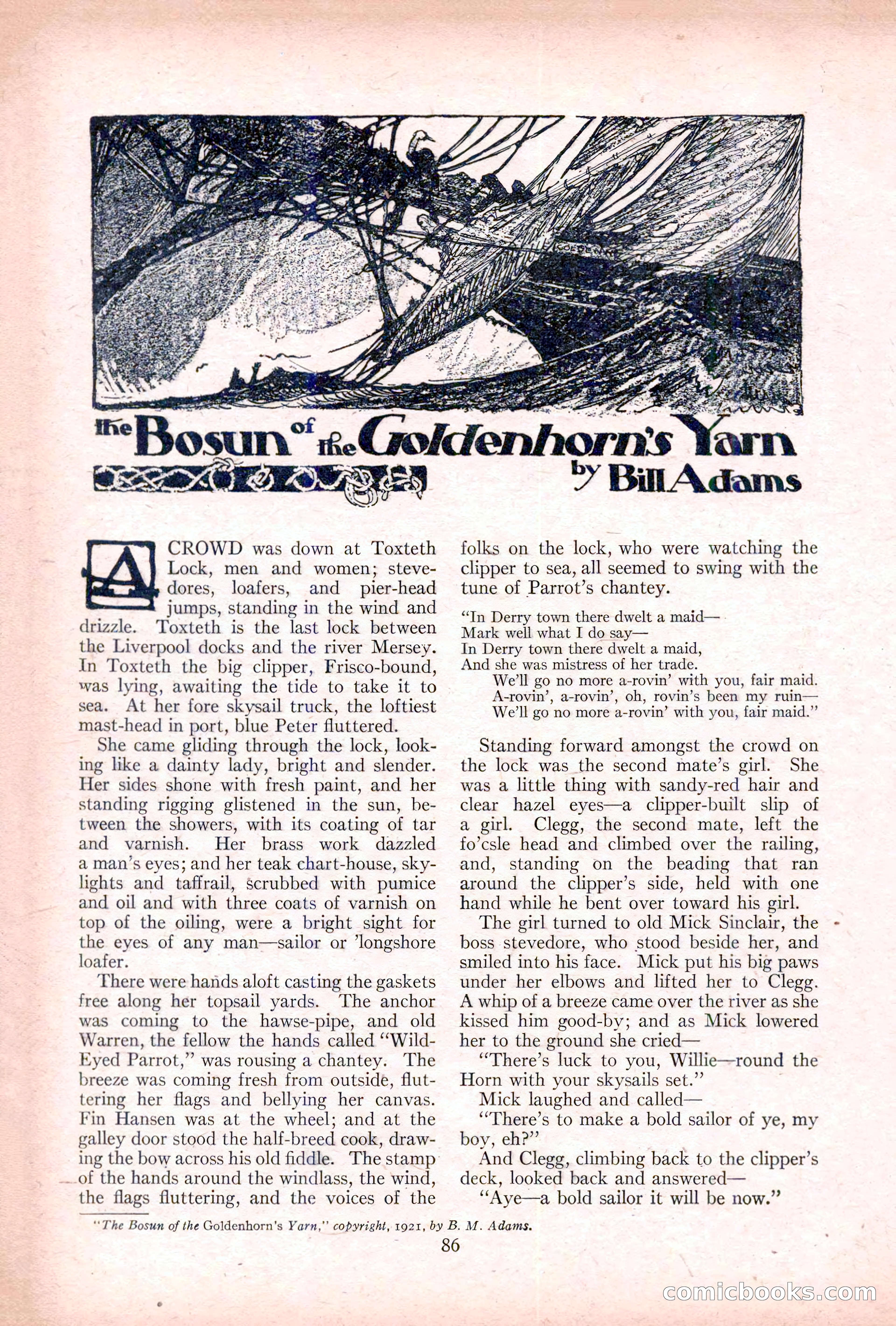
A restored page from Pulp Fiction, 1922. Page through the whole issue in the reader above.
📄 Transcribed text from this page (OCR, searchable)
Machine-transcribed from the original scan — historical spelling and the odd misread are preserved.
~ . pa —— ~*~ > oO Se — SS = —T. oe ae Q YS CROWD was down at Toxteth Lock, men and women; steve- dores, loafers, and_ pier-head jumps, standing in the wind and drizzle. Toxteth is the last lock between the Liverpool docks and the river Mersey. In Toxteth the big clipper, Frisco-bound, was lying, awaiting the tide to take it to sea. At her fore skysail truck, the loftiest mast-head in port, blue Peter fluttered. She came gliding through the lock, look- ing like a dainty lady, bright and slender. Her sides shone with fresh paint, and her standing rigging glistened in the sun, be- tween the showers, with its coating of tar and varnish. Her brass work dazzled a man’s eyes; and her teak chart-house, sky- lights and taffrail, scrubbed with pumice and oil and with three coats of varnish on top of the oiling, were a bright sight for the eyes of any man—-sailor or ‘longshore loafer. There were hands aloft casting the gaskets free along her topsail yards. ‘The anchor was coming to the hawse-pipe, and old Warren, the fellow the hands called ‘‘Wild- Eyed Parrot,” was rousing a chantey. The breeze was coming fresh from outside, flut- tering her flags and bellying her canvas. Fin Hansen was at the wheel; and at the galley door stood the half-breed cook, draw- ing the bow across his old fiddle. The stamp of the hands around the windlass, the wind, the flags fluttering, and the voices of the A= » y) See ee, SE oe a + saat? sah Bosun” «-Gold PS, Py Les a OLE EZ CAA /, 4 “ - a / . WES 4 s . > Si 20 MO ¢ 7 Oe < ) ~ - se - pn a * oe bs - . * <% nhorn’s Yar »Y Bil Adams at > rs - ~ folks on the lock, who were watching the clipper to sea, all seemed to swing with the tune of Parrot’s chantey. “In Derry town there dwelt a maid— Mark well what I do say— In Derry town there dwelt a maid, And she was mistress of her trade. We'll go no more a-rovin’ with you, fair maid. A-rovin’, a-rovin’, oh, rovin’s been my ruin— We'll go no more a-rovin’ with you, fair maid.” Standing forward amongst the crowd on the lock was the second mate’s girl. She was a little thing with sandy-red hair and clear hazel eyes—a clipper-built slip of a girl. Clegg, the second mate, left the fo’csle head and climbed over the railing, and, standing on the beading that ran around the clipper’s side, held with one hand while he bent over toward his girl. The girl turned to old Mick Sinclair, the boss stevedore, who stood beside her, and smiled into his face. Mick put his big paws under her elbows and lifted her to Clegg. A whip of a breeze came over the river as she kissed him good-by; and as Mick lowered her to the ground she cried— “There’s luck to you, Willie—round the Horn with your skysails set.”’ Mick laughed and called— ‘“‘There’s to make a bold sailor of ye, my boy, eh?”’ And Clegg, climbing back to the clipper’s deck, looked back and answered— ‘“Aye—a bold sailor it will be now.” “The Bosun of the Goldenhorn's Yarn," copyright, 1921, by B. M. Adams. 86 Go JOO = (C@