
Pulp Fiction, 1922 · page 71 of 196
Adventure, January 20, 1922 — page 71: what you’re looking at
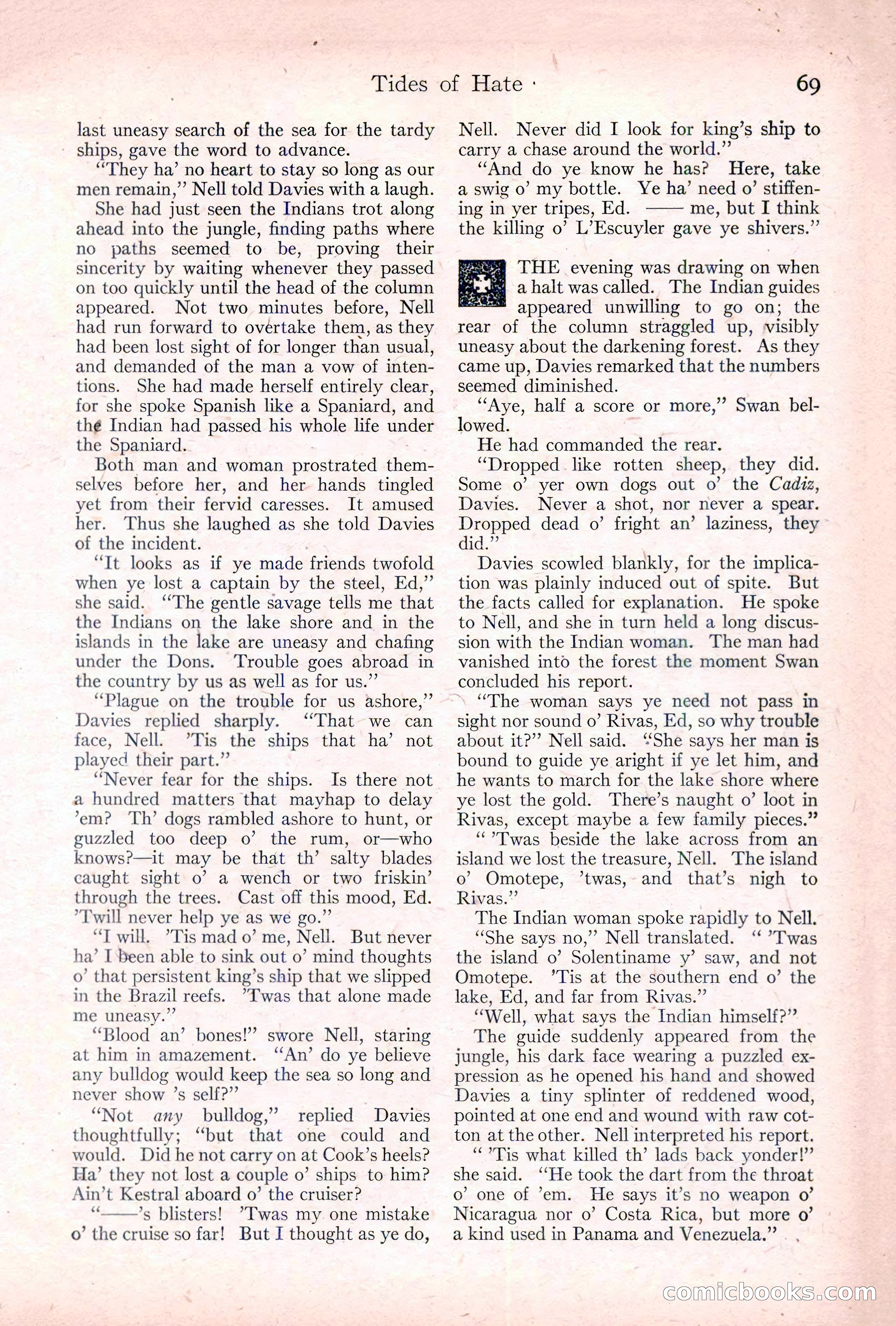
A restored page from Pulp Fiction, 1922. Page through the whole issue in the reader above.
📄 Transcribed text from this page (OCR, searchable)
Machine-transcribed from the original scan — historical spelling and the odd misread are preserved.
Tides of Hate : last uneasy search of the sea for the tardy ships, gave the word to advance. “They ha’ no heart to stay so long as our men remain,” Nell told Davies with a laugh. She had just seen the Indians trot along ahead into the jungle, finding paths where no paths seemed to be, proving their sincerity by waiting whenever they passed on too quickly until the head of the column appeared. Not two minutes before, Nell had run forward to overtake them, as they had been lost sight of for longer than usual, and demanded of the man a vow of inten- tions. She had made herself entirely clear, for she spoke Spanish like a Spaniard, and thé Indian had passed his whole life under the Spaniard. Both man and woman prostrated them- selves before her, and her hands tingled yet from their fervid caresses. It amused her. ‘Thus she laughed as she told Davies of the incident. “It looks as if ye made friends twofold when ye lost a captain by the steel, Ed,” she said. “The gentle savage tells me that the Indians on the lake shore and in the islands in the lake are uneasy and chafing under the Dons. ‘Trouble goes abroad in the country by us as well as for us.” “Plague on the trouble for us ashore,” Davies replied sharply. “That we can face, Nell. ’Tis the ships that ha’ not played their part.” ‘“‘Never fear for the ships. Is there not a hundred matters that mayhap to delay "em? Th’ dogs rambled ashore to hunt, or guzzled too deep o’ the rum, or—who knows?P—it may be that th’ salty blades caught sight o’? a wench or two friskin’ through the trees. Cast off this mood, Ed. "Twill never help ye as we go.” “T will. ’Tis mad o’ me, Nell. But never ha’ I Been able to sink out 0’ mind thoughts o’ that persistent king’s ship that we slipped in the Brazil reefs. "Iwas that alone made me uneasy.” “Blood an’ bones!” swore Nell, staring at him in amazement. ‘An’ do ye believe any bulldog would keep the sea so long and never show ’s self?” “Not any bulldog,” replied Davies thoughtfully; “but that one could and would. Did he not carry on at Cook’s heels? Ha’ they not lost a couple o’ ships to him? Ain’t Kestral aboard o’ the cruiser? ‘“‘____’s blisters! "T'was my one mistake o’ the cruise so far! But I thought as ye do, 69 Nell. Never did I look for king’s ship to carry a chase around the world.” “And do ye know he has? Here, take a swig o’ my bottle. Ye ha’ need o’ stiffen- ing in yer tripes, Ed. me, but I think the killing o’ L’Escuyler gave ye shivers.” wae THE evening was drawing on when Me sed a halt wascalled. The Indian guides ' appeared unwilling to go on; the rear of the column straggled up, visibly uneasy about the darkening forest. As they came up, Davies remarked that the numbers seemed diminished. “Aye, half a score or more,’ Swan hel- lowed. He had commanded the rear. “Dropped. like rotten sheep, they did. Some o’ yer own dogs out o’ the Cadiz, Davies. Never a shot, nor never a spear. Dropped dead o’ fright an’ laziness, they did.’ Davies scowled blankly, for the implica- tion was plainly induced out of spite. But the facts called for explanation. He spoke to Nell, and she in turn held a long discus- sion with the Indian woman. The man had vanished into the forest the moment Swan concluded his report. “The woman says ye need not pass in sight nor sound o’ Rivas, Ed, so why trouble about itr’? Nell said. “She says her man is bound to guide ye aright if ye let him, and he wants to march for the lake shore where ye lost the gold. There’s naught o’ loot in Rivas, except maybe a few family pieces.” “°Twas beside the lake across from an island we lost the treasure, Nell. The island o’ Omotepe, ’twas, and that’s nigh to Rivas.” The Indian woman spoke rapidly to Nell. “She says no,” Nell translated. ‘‘ "T'was the island o’ Solentiname y’ saw, and not Omotepe. ‘’Tis at the southern end o’ the lake, Ed, and far from Rivas.” “Well, what says the Indian himself?” The guide suddenly appeared from the jungle, his dark face wearing a puzzled ex- pression as he opened his hand and showed Davies a tiny splinter of reddened wood, pointed at one end and wound with raw cot- ton at the other. Nell interpreted his report. “°Tis what killed th’ lads back yonder!” she said. “He took the dart from the throat o’ one of ’em. He says it’s no weapon 0’ Nicaragua nor 0’ Costa Rica, but more 0’ a kind used in Panama and Venezuela.” COmiclboool (C@