
Pulp Fiction, 1922 · page 63 of 196
Adventure, January 20, 1922 — page 63: what you’re looking at
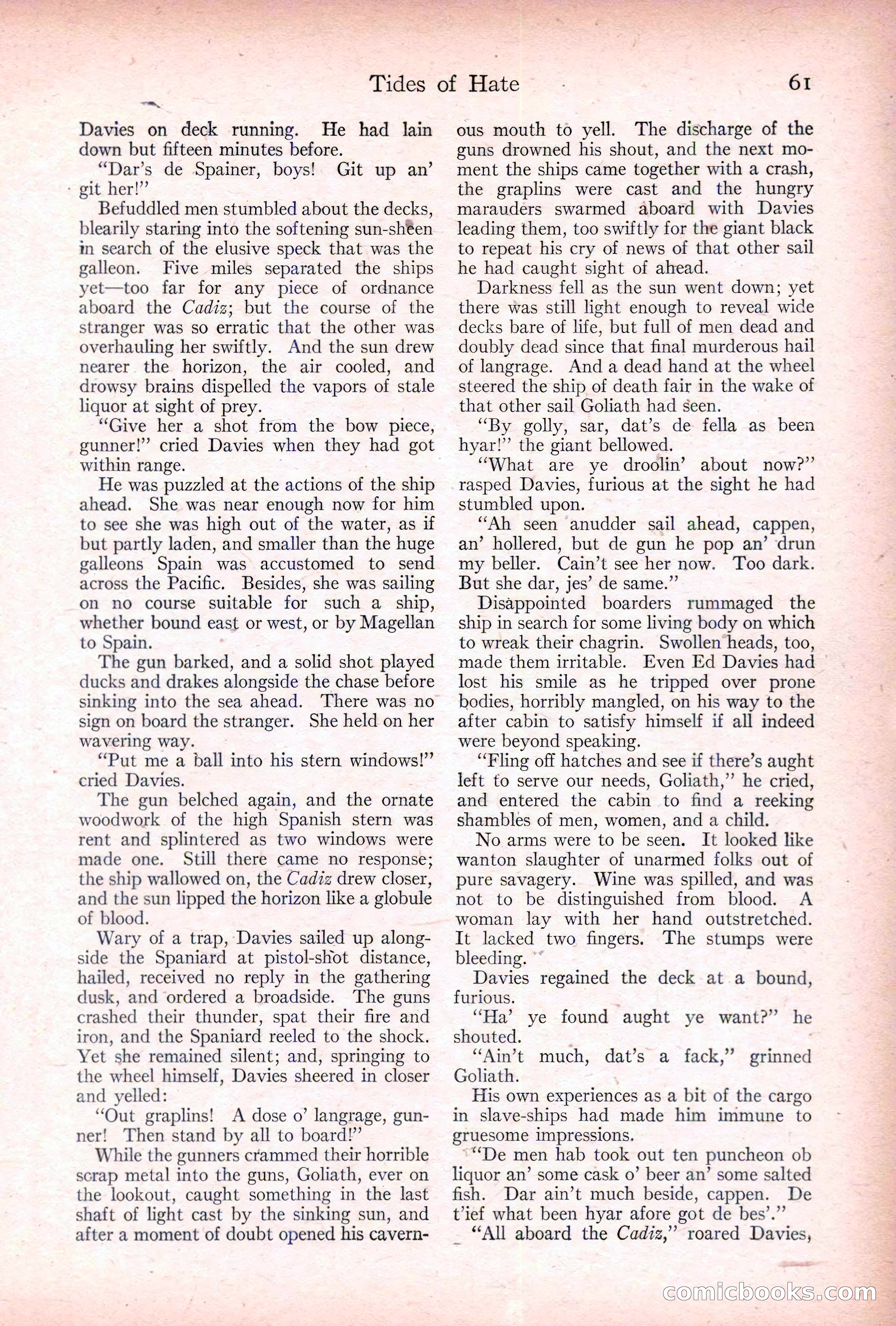
A restored page from Pulp Fiction, 1922. Page through the whole issue in the reader above.
📄 Transcribed text from this page (OCR, searchable)
Machine-transcribed from the original scan — historical spelling and the odd misread are preserved.
Tides of Hate — ~ Davies on deck running. He had lain down but fifteen minutes before. “Dar’s de Spainer, boys! Git up an’ git her!” Befuddled men stumbled about the decks, blearily staring into the softening sun-sh€en m search of the elusive speck that was the galleon. Five miles separated the ships yet—too far for any piece of ordnance aboard the Cadiz; but the course of the stranger was so erratic that the other was overhauling her swiftly. And the sun drew nearer the horizon, the air cooled, and drowsy brains dispelled the vapors of stale liquor at sight of prey. “Give her a shot from the bow piece, gunner!” cried Davies when they had got within range. 3 He was puzzled at the actions of the ship ahead. She was near enough now for him to see she was high out of the water, as if but partly laden, and smaller than the huge galleons Spain was accustomed to send across the Pacific. Besides, she was sailing on no course suitable for such a ship, whether bound east or west, or by Magellan to Spain. The gun barked, and a solid shot played ducks and drakes alongside the chase before sinking into the sea ahead. There was no sign on board the stranger. She held on her wavering way. “Put me a ball into his stern windows!” cried Davies. The gun belched again, and the ornate woodwork of the high Spanish stern was rent and splintered as two windows were made one. Still there came no response; the ship wallowed on, the Cadiz drew closer, and the sun lipped the horizon like a globule of blood. Wary of a trap, Davies sailed up along- side the Spaniard at pistol-shot distance, hailed, received no reply in the gathering dusk, and ordered a broadside. The guns crashed their thunder, spat their fire and iron, and the Spaniard reeled to the shock. Yet she remained silent; and, springing to the wheel himself, Davies sheered in closer and yelled: “Out graplins! A dose o’ langrage, gun- ner! Then stand by all to board!” While the gunners crammed their horrible scrap metal into the guns, Goliath, ever on the lookout, caught something in the last shaft of light cast by the sinking sun, and after a moment of doubt opened his cavern- 61 ous mouth to yell. The discharge of the guns drowned his shout, and the next mo- ment the ships came together with a crash, the graplins were cast and the hungry marauders swarmed aboard with Davies leading them, too swiftly for the giant black to repeat his cry of news of that other sail he had caught sight of ahead. Darkness fell as the sun went down; yet there was still light enough to reveal wide decks bare of life, but full of men dead and doubly dead since that final murderous hail of langrage. And a dead hand at the wheel steered the ship of death fair in the wake of that other sail Goliath had seen. “By golly, sar, dat’s de fella as been hyar!” the giant bellowed. “What are ye droolin’ about now?’ rasped Davies, furious at the sight he had stumbled upon. “Ah seen anudder sail ahead, cappen, an’ hollered, but de gun he pop an’ drun my beller. Cain’t see her now. Too dark. But she dar, jes’ de same.”’ Disappointed boarders rummaged the ship in search for some living body on which to wreak their chagrin. Swollen heads, too, made them irritable. Even Ed Davies had lost his smile as he tripped over prone bodies, horribly mangled, on his way to the after cabin to satisfy himself if all indeed were beyond speaking. “Fling off hatches and see if there’s aught left to serve our needs, Goliath,” he cried, and entered the cabin to find a reeking shambles of men, women, and a child. No arms were to be seen. It looked like wanton slaughter of unarmed folks out of pure savagery. Wine was spilled, and was not to be distinguished from blood. A woman lay with her hand outstretched. It lacked two fingers. The stumps were bleeding. Davies regained the deck at a bound, furious. “Ha’ ye found aught ye want?” he shouted. | ‘““Ain’t much, dat’s a fack,” grinned Goliath. His own experiences as a bit of the cargo in slave-ships had made him immune to gruesome impressions. “*“De men hab took out ten puncheon ob liquor an’ some cask o’ beer an’ some salted fish. Dar ain’t much beside, cappen. De tief what been hyar afore got de bes’.” _ “All aboard the Cadiz,” roared Davies, COmiclboooks (C@