
Pulp Fiction, 1922 · page 36 of 196
Adventure, January 20, 1922 — page 36: what you’re looking at
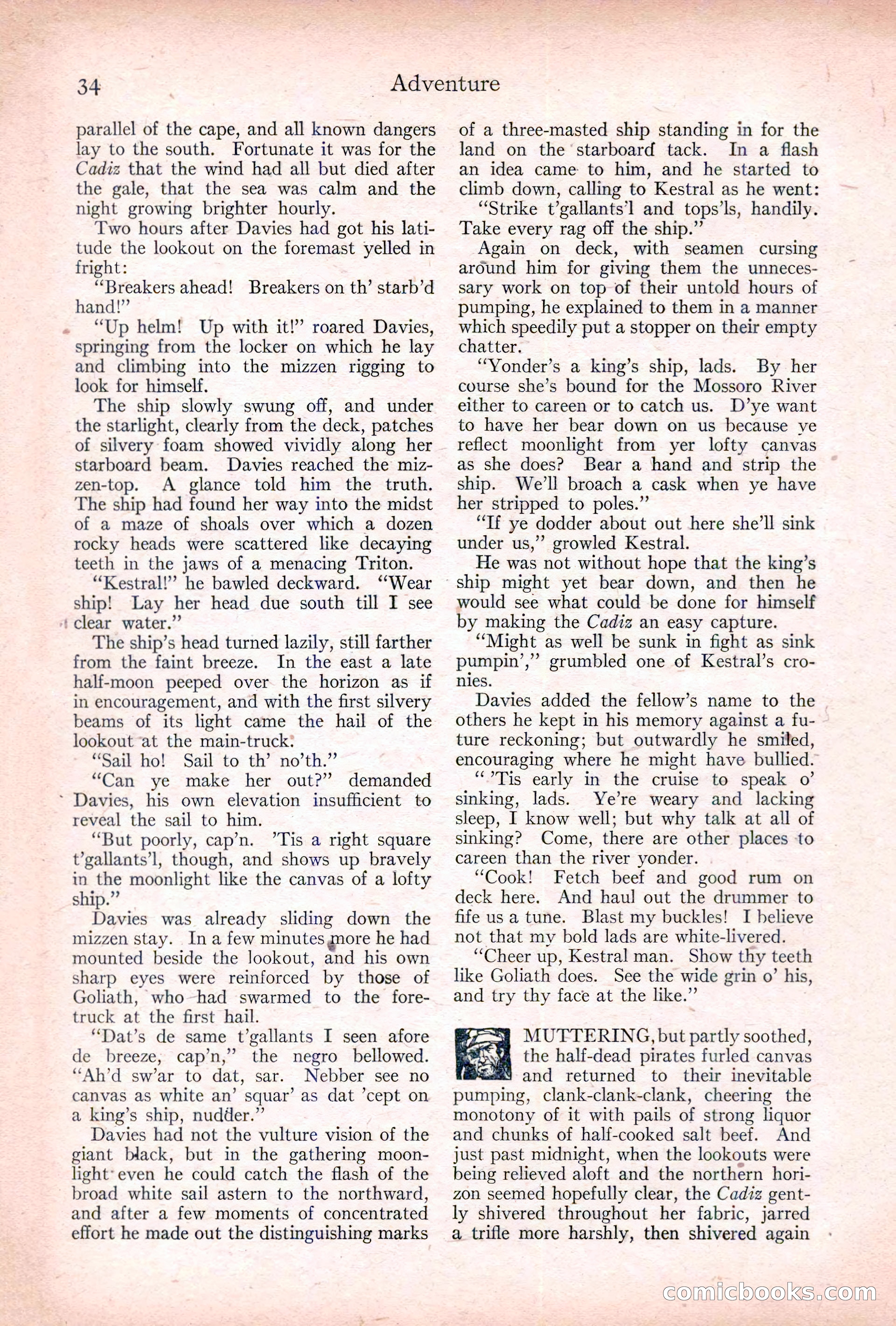
A restored page from Pulp Fiction, 1922. Page through the whole issue in the reader above.
📄 Transcribed text from this page (OCR, searchable)
Machine-transcribed from the original scan — historical spelling and the odd misread are preserved.
34 parallel of the cape, and all known dangers lay to the south. Fortunate it was for the Cadiz that the wind had all but died after the gale, that the sea was calm and the night growing brighter hourly. Two hours after Davies had got his lati- tude the lookout on the foremast yelled in fright: “Breakers ahead! Breakers on th’ starb’d hand!” “Up helm! Up with it!” roared Davies, springing from the locker on which he lay and climbing into the mizzen rigging to look for himself. The ship slowly swung off, and under the starlight, clearly from the deck, patches of silvery foam showed vividly along her starboard beam. Davies reached the miz- zen-top. A glance told him the truth. The ship had found her way into the midst of a maze of shoals over which a dozen rocky heads were scattered like decaying teeth in the jaws of a menacing Triton. “Kestral!” he bawled deckward. ‘Wear ship! Lay her head due south till I see ‘clear water.” The ship’s head turned lazily, still farther from the faint breeze. In the east a late half-moon peeped over the horizon as if in encouragement, and with the first silvery beams of its light came the hail of the lookout ‘at the main-truck: “Sail ho! Sail to th’ no’th.” “Can ye make her out?” demanded * Davies, his own elevation insufficient to reveal the sail to him. “But poorly, cap’n. ’Tis a right square t’gallants’l, though, and shows up bravely in the moonlight like the canvas of a lofty ship.” Davies was already sliding down the mizzen stay. In afew minutes more he had mounted beside the lookout, and his own sharp eyes were reinforced by those of Goliath, who-had swarmed to the fore- truck at the first hail. “Dat’s de same t’gallants I seen afore de breeze, cap’n,”’ the negro bellowed. ‘““Ah’d sw’ar to dat, sar. Nebber see no canvas as white an’ squar’ as dat ’cept on a king’s ship, nudéder.” Davies had not the vulture vision of the giant black, but in the gathering moon- light*even he could catch the flash of the broad white sail astern to the northward, and after a few moments of concentrated effort he made out the distinguishing marks _ Adventure of a three-masted ship standing in for the land on the starboard tack. In a flash an idea came to him, and he started to climb down, calling to Kestral as he went: “Strike t’gallants’l and tops’ls, handily. Take every rag off the ship.” Again on deck, with seamen cursing around him for giving them the unneces- sary work on top of their untold hours of pumping, he explained to them in a manner which speedily put a stopper on their empty chatter. ‘“Yonder’s a king’s ship, lads. By her course she’s bound for the Mossoro River either to careen or to catch us. D’ye want to have her bear down on us because ve reflect moonlight from yer lofty canvas as she does? Bear a hand and strip the ship. We’ll broach a cask when ye have her stripped to poles.”’ “If ye dodder about out here she’ll sink under us,” growled Kestral. He was not without hope that the king’s 'ship might yet bear down, and then he would see what could be done for himself by making the Cadiz an easy capture. “Might as well be sunk in fight as sink pumpin’,”” grumbled one of Kestral’s cro- nies. Davies added the fellow’s name to the others he kept in his memory against a fu- ture reckoning; but outwardly he smiled, encouraging where he might have bullied. “°Tis early in the cruise to speak 0’ sinking, lads. Ye’re weary and _ lacking sleep, I know well; but why talk at all of sinking? Come, there are other places to careen than the river yonder. “Cook! Fetch beef and good rum on deck here. And haul out the drummer to fife usa tune. Blast my buckles! I believe not that my bold lads are white-livered. “Cheer up, Kestral man. Show thy teeth like Goliath does. See the wide grin o’ his, and try thy face at the like.” MUTTERING, but partly soothed, the half-dead pirates furled canvas “iam and returned to their inevitable pumping, clank-clank-clank, cheering the monotony of it with pails of strong liquor and chunks of half-cooked salt beef. And just past midnight, when the lookouts were being relieved aloft and the northern hori- zon seemed hopefully clear, the Cadzz gent- ly shivered throughout her fabric, jarred a trifle more harshly, then shivered again COmMiICLookKks (C@