
Pulp Fiction, 1922 · page 193 of 196
Adventure, January 20, 1922 — page 193: what you’re looking at
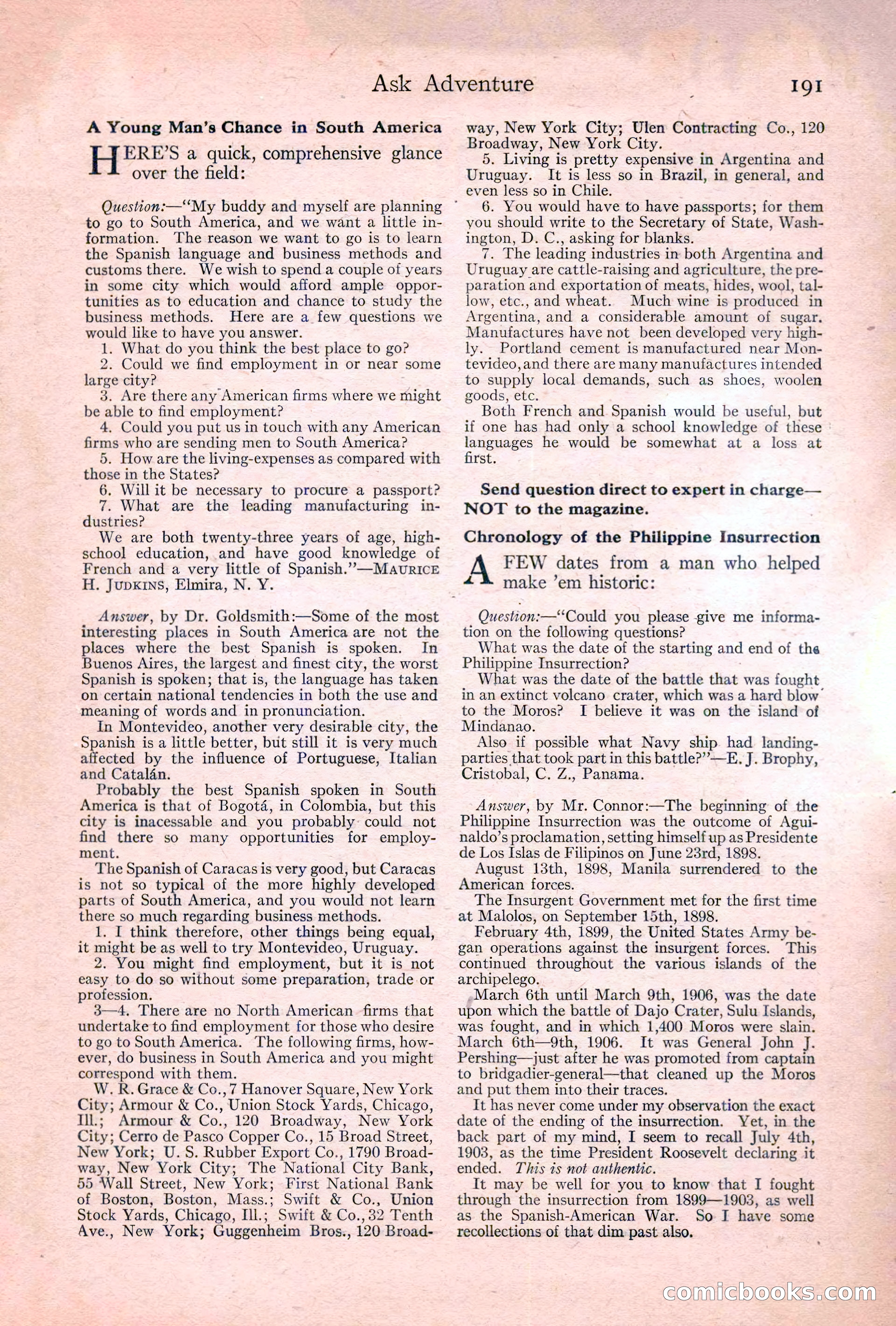
A restored page from Pulp Fiction, 1922. Page through the whole issue in the reader above.
📄 Transcribed text from this page (OCR, searchable)
Machine-transcribed from the original scan — historical spelling and the odd misread are preserved.
‘Acde Adventure A Young Man’s Chance in South America PFEReS a quick, comprehensive glance over the field: Question:—“My buddy and myself are planning ~ to go to South America, and we want a little in- formation. The reason we want to go is to learn the Spanish language and business methods and customs there. We wish to spend a couple of years in some city which would afford ample oppor- tunities as to education and chance to study the business methods. Here are a few questions we would like to have you answer. 1. What do you think the best place to go? 2. Could we find employment in or near some large city? 3. Are there any American firms where we might be able to find employment? 4. Could you put us in touch with any American firms who are sending men to South America? 5. How are the living-expenses as compared with those in the States? 6. Will it be necessary to procure a passport? 7. What are the leading manufacturing in- dustries? We are both twenty-three years of age, high- school education, and have good knowledge of French and a very little of Spanish.” —Mavrice H. JupKins, Elmira, N. Y Answer, by Dr. Goldsmith:—Some of the most interesting places in South America are not the places where the best Spanish is spoken. In Buenos Aires, the largest and finest city, the worst Spanish is spoken; that is, the language has taken on certain national tendencies in both the use and meaning of words and in pronunciation. In Montevideo, another very desirable city, the Spanish is a little better, but still it is very much affected by the influence of Portuguese, Italian and Catalan. Probably the best Spanish spoken in South America is that of Bogota, in Colombia, but this city is inacessable and you probably: could not find there so many opportunities for employ- ment. The Spanish of Caracas is very good, but Caracas is not so typical of the more highly developed parts of South America, and you would not learn there so much regarding business methods. 1. I think therefore, other things being equal, it might be as well to try Montevideo, Uruguay. 2. You might find employment, but it is not easy to do so without some preparation, trade or profession. 3—4, There are no North American firms that undertake to find employment for those who desire to go to South America. The following firms, how- ever, do business in South America and you might correspond with them. W.R. Grace & Co.,7 Hanover Square, New York City; Armour & Co., Union Stock Yards, Chicago, Ill.; Armour & Co., 120 Broadway, New York City; Cerro de Pasco Copper Co., 15 Broad Street, New York; U.S. Rubber Export Co., 1790 Broad- Mies New York City; The National City Bank, 5 Wall Street, New York; First National Bank of Boston, Boston, Mass.; Swift & Co., Union Stock Yards, Chicago, Ill.; Swift & Co.,32 Tenth Ave., New York; Guggenheim Bros., 120 Broad- IQI way, New York City; Ulen Contracting Co., 120 Broadway, New York City. 5. Living is pretty expensive in Argentina and Uruguay. It is less so in Brazil, in general, and even less so in Chile. 6. You would have to have passports; for them you should write to the Secretary of State, Wash- ington, D. C., asking for blanks. 7. The leading industries in both Argentina and Uruguay are cattle-raising and agriculture, the pre- paration and exportation of meats, hides, wool, tal- low, etc., and wheat. Much wine is produced in Argentina, and a considerable amount of sugar, Manufactures have not been developed very high- ly. Portland cement is manufactured near Mon- tevideo, and there are many manufactures intended to supply local demands, such as shoes, woolen goods, etc. Both French and Spanish would be useful, but if one has had only a school knowledge of these innepear he would be somewhat at a loss at rst. Send question direct to expert in charge— NOT to the magazine. Chronology of the Philippine Insurrection FEW dates from a man who helped 43 make ’em historic: Question:—“Could you please -give me informa- tion on the following questions? What was the date of the starting and end of the Philippine Insurrection? What was the date of the battle that was fought in an extinct volcano crater, which was a hard blow to the Moros? I believe it was on the island of Mindanao. Also if possible what Navy ship had landing- parties that took part in this battle?” —E, J. Brophy, Cristobal, C. Z., Panama. Answer, by Mr. Connor:—The beginning of the Philippine Insurrection was the outcome of Agui- naldo’s proclamation, setting himself up as Presidente de Los Islas de Filipinos on June 23rd, 1898. August 13th, 1898, Manila surrendered to the American forces. The Insurgent Government met for the first time at Malolos, on September 15th, 1898. February 4th, 1899, the United States Army be- gan operations against the insurgent forces. This continued throughout the various islands of the archipelego. March 6th until March 9th, 1906, was the date upon which the battle of Dajo Crater, Sulu Islands, was fought, and in which 1,400 Moros were slain. March 6th—9th, 1906. It was General John J. Pershing—just after he was promoted from captain to bridgadier-general—that cleaned up the Moros and put them into their traces. It has never come under my observation the exact date of the ending of the insurrection. Yet, in the back part of my mind, I seem to recall July 4th, 19038, as the time President Roosevelt declaring it ended. This ts not authentic. It may be well for you to know that I fought through the insurrection from 1899—1903, as well as the Spanish-American War. So I have some recollections of that dim past also. _.OOK = a (C@) (E@)