
Pulp Fiction, 1922 · page 190 of 196
Adventure, January 20, 1922 — page 190: what you’re looking at
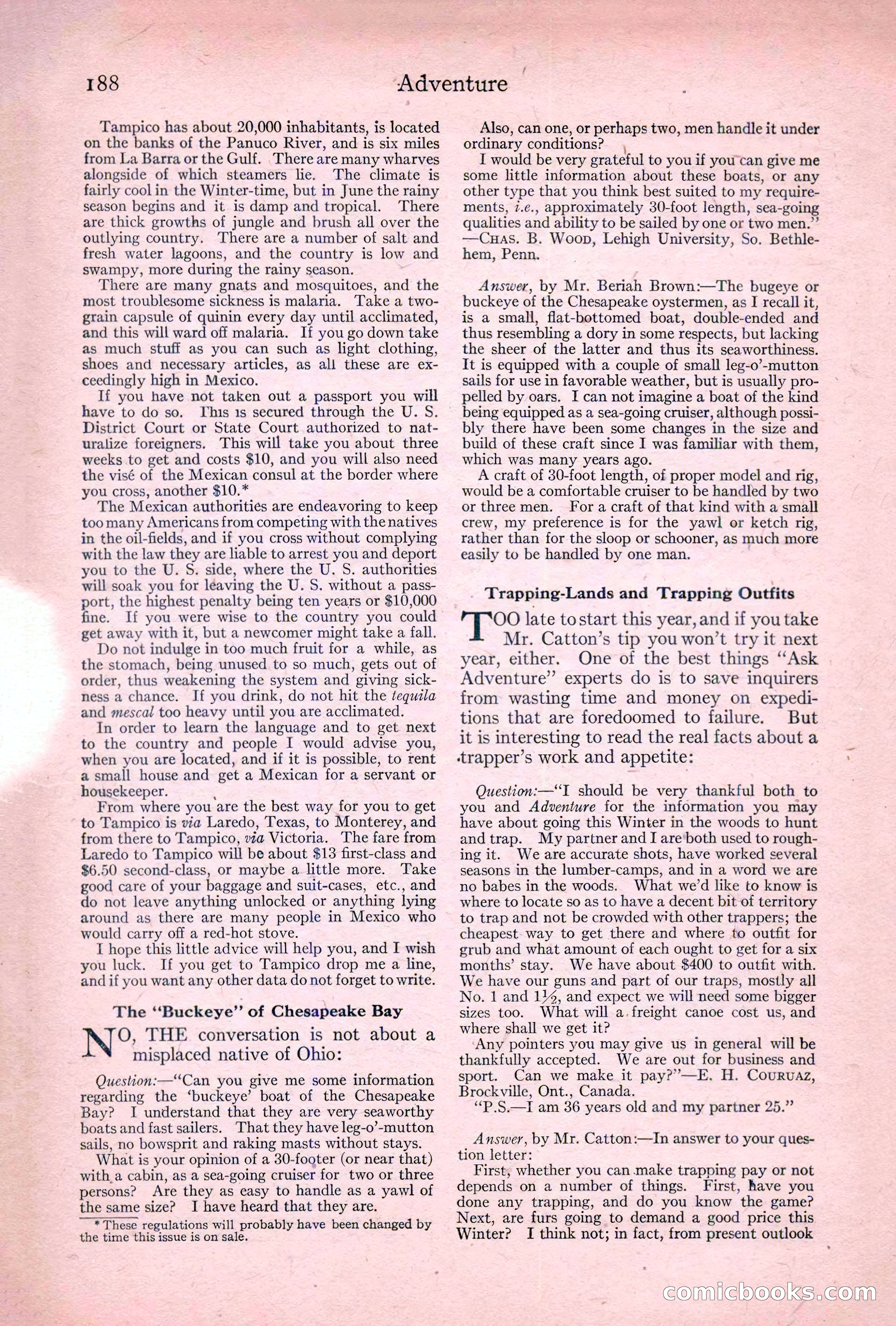
A restored page from Pulp Fiction, 1922. Page through the whole issue in the reader above.
📄 Transcribed text from this page (OCR, searchable)
Machine-transcribed from the original scan — historical spelling and the odd misread are preserved.
188 Tampico has about 20,000 inhabitants, is located on the banks of the Panuco River, and is six miles from La Barra or the Gulf. There are many wharves alongside of which steamers lie. The climate is fairly cool in the Winter-time, but in June the rainy season begins and it is damp and tropical. There are thick growths of jungle and brush all over the outlying country. There are a number of salt and fresh water lagoons, and the country is low and swampy, more during the rainy season. There are many gnats and mosquitoes, and the most troublesome sickness is malaria. Take a two- grain capsule of quinin every day until acclimated, and this will ward off malaria. If you go down take as much stuff as you can such as light clothing, shoes and necessary articles, as all these are ex- ceedingly high in Mexico. If you have not taken out a passport you will have to do so. This 1s secured through the U. S. District Court or State Court authorized to nat- uralize foreigners. This will take you about three weeks to get and costs $10, and you will also need the visé of the Mexican consul at the border where you cross, another $10.* The Mexican authorities are endeavoring to keep too many Americans from competing with the natives in the oil-fields, and if you cross without complying with the law they are liable to arrest you and deport you to the U. S. side, where the U. S. authorities will soak you for leaving the U. S. without a pass- port, the highest penalty being ten years or $10,000 fine. If you were wise to the country you could get away with it, but a newcomer might take a fall. Do not indulge in too much fruit for a while, as the stomach, being unused to so much, gets out of order, thus weakening the system and giving sick- ness a chance. If you drink, do not hit the teguala and mescal too heavy until you are acclimated. In order to learn the language and to get next to the country and people I would advise you, when you are located, and if it is possible, to rent a small house and get a Mexican for a servant or housekeeper. From where you are the best way for you to get to Tampico is via Laredo, Texas, to Monterey, and from there to Tampico, vza Victoria. The fare from Laredo to Tampico will be about $13 first-class and $6.50 second-class, or maybe a little more. Take good care of your baggage and suit-cases, etc., and do not leave anything unlocked or anything lying around as there are many people in Mexico who would carry off a red-hot stove. I hope this little advice will help you, and I wish you luck. If you get to Tampico drop me a line, and if you want any other data do not forget to write. The ‘‘Buckeye”’ of Chesapeake Bay O, THE conversation is not about a misplaced native of Ohio: Question: —“Can you give me some information regarding the ‘buckeye’ boat of the Chesapeake Bay? I understand that they are very seaworthy boats and fast sailers. That they have leg-o’-mutton sails, no bowsprit and raking masts without stays. What is your opinion of a 30-footer (or near that) witha cabin, as a sea-going cruiser for two or three persons? Are they as easy to handle as a yawl of the same size? I have heard that they are. * These regulations will probably have been changed by the time this issue is on sale. Adventure Also, can one, or perhaps two, men handle it under ordinary conditions? I would be very grateful to you if youcan give me some little information about these boats, or any other type that you think best suited to my require- ments, 7.¢., approximately 30-foot length, sea-going qualities and ability to be sailed by one or two men.” —Cuas. B. Woop, Lehigh University, So. Bethle- hem, Penn. Answer, by Mr. Beriah Brown:—The bugeye or buckeye of the Chesapeake oystermen, as I recall it, is a small, flat-bottomed boat, double-ended and thus resembling a dory in some respects, but lacking the sheer of the latter and thus its seaworthiness. It is equipped with a couple of small leg-o’-mutton sails for use in favorable weather, but is usually pro- pelled by oars. I can not imagine a boat of the kind being equipped as a sea-going cruiser, although possi- bly there have been some changes in the size and build of these craft since I was familiar with them, which was many years ago. A craft of 30-foot length, of proper model and rig, would be a comfortable cruiser to be handled by two or three men. Fora craft of that kind with a small crew, my preference is for the yawl or ketch rig, rather than for the sloop or schooner, as much more easily to be handled by one man. Trapping-Lands and Trapping Outfits i Bac late tostart this year, and if you take Mr. Catton’s tip you won’t try it next year, either. One of the best things “Ask Adventure” experts do is to save inquirers from wasting time and money on expedi- tions that are foredoomed to failure. But it is interesting to read the real facts about a ‘trapper’s work and appetite: Question: —“I should be very thankful both to you and Adventure for the information you may have about going this Winter in the woods to hunt and trap. My partner and I are'both used to rough- ing it. We are accurate shots, have worked several seasons in the lumber-camps, and in a word we are no babes in the woods. What we'd like to know is where to locate so as to have a decent bit of territory to trap and not be crowded with other trappers; the cheapest- way to get there and where to outfit for grub and what amount of each ought to get for a six months’ stay. We have about $400 to outfit with. We have our guns and part of our traps, mostly all No. 1 and 1%, and expect we will need some bigger sizes too. What will a. freight canoe cost us, and where shall we get it? Any pointers you may give us in general will be thankfully accepted. We are out for business and sport. Can we make it pay?’—E. H. Courvuaz, Brockville, Ont., Canada. “P.S.—I am 36 years old and my partner 25.” Answer, by Mr. Catton:—In answer to your ques- tion letter: First, whether you can make trapping pay or not depends on a number of things. First, have you done any trapping, and do you know the game? Next, are furs going to demand a good price this Winter? I think not; in fact, from present outlook COMMICLOOOKS (C@