
Pulp Fiction, 1922 · page 184 of 196
Adventure, January 20, 1922 — page 184: what you’re looking at
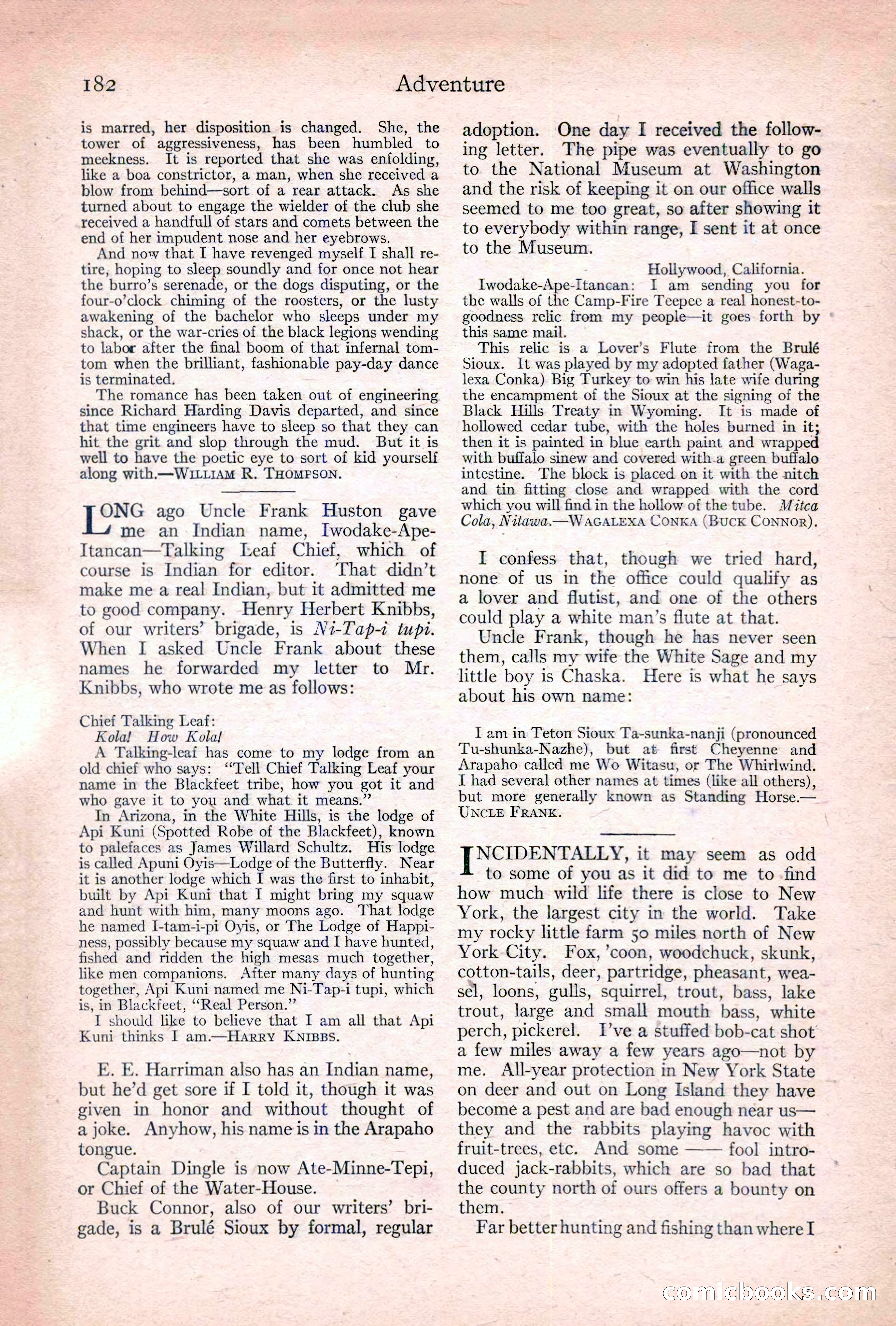
A restored page from Pulp Fiction, 1922. Page through the whole issue in the reader above.
📄 Transcribed text from this page (OCR, searchable)
Machine-transcribed from the original scan — historical spelling and the odd misread are preserved.
182 is marred, her disposition is changed. She, the tower of aggressiveness, has been humbled to meekness. It is reported that she was enfolding, like a boa constrictor, a man, when she received a blow from behind—sort of a rear attack. As she turned about to engage the wielder of the club she received a handfull of stars and comets between the end of her impudent nose and her eyebrows. And now that I have revenged myself I shall re- tire, hoping to sleep soundly and for once not hear the burro’s serenade, or the dogs disputing, or the four-o’clock chiming of the roosters, or the lusty awakening of the bachelor who sleeps under my shack, or the war-cries of the black legions wending to labor after the final boom of that infernal tom- tom when the brilliant, fashionable pay-day dance is terminated. The romance has been taken out of engineering since Richard Harding Davis departed, and since that time engineers have to sleep so that they can hit the grit and slop through the mud. But it is well to have the poetic eye to sort of kid yourself along with.— Wi1i1AM R. THompPson. _ ago Uncle Frank Huston gave me an Indian name, Iwodake-Ape- Itancan—Talking Leaf Chief, which of course is Indian for editor. That didn’t make me a real Indian, but it admitted me to good company. Henry Herbert Knibbs, of our writers’ brigade, is Ni-Tap- tupi. When I asked Uncle Frank about these names he forwarded my letter to Mr. Knibbs, who wrote me as follows: Chief Talking Leaf: Kola! How Kola! A Talking-leaf has come to my lodge from an old chief who says: “Tell Chief Talking Leaf your name in the Blackfeet tribe, how you got it and who gave it to you and what it means.’ In Arizona, in the White Hills, is the lodge of Api Kuni (Spotted Robe of the Blackfeet), known to palefaces as James Willard Schultz. His lodge is called Apuni Oyis—Lodge of the Butterfly. Near it is another lodge which I was the first to inhabit, built by Api Kuni that I might bring my squaw and hunt with him, many moons ago. That lodge he named I-tam-i-pi Oyis, or The Lodge of Happi- ness, possibly because my squaw and I have hunted, fished and ridden the high mesas much together, like men companions. After many days of hunting together, Api Kuni named me Ni-Tap-i tupi, which is, in Blackfeet, ‘‘Real Person.” I should like to believe that I am all that Api Kuni thinks | am.—HAarry KNIBBS. E. E. Harriman also has an Indian name, but he’d get sore if I told it, though it was given in honor and without thought of a joke. Anyhow, his name is in the Arapaho tongue. Captain Dingle is now Ate-Minne-Tepi, or Chief of the Water-House. Buck Connor, also of our writers’ bri- gade, is a Brulé Sioux by formal, regular Adventure adoption. One day I received the follow- ing letter. The pipe was eventually to go to the National Museum at Washington and the risk of keeping it on our office walls seemed to me too great, so after showing it to everybody within range, I sent it at once to the Museum. Hollywood, California. Iwodake-Ape-Itancan: I am sending you for the walls of the Camp-Fire Teepee a real honest-to- goodness relic from my people—it goes forth by ° this same mail. This relic is a Lover’s Flute from the Brulé Sioux. It was played by my adopted father (Waga- lexa Conka) Big Turkey to win his late wife during the encampment of the Sioux at the signing of the Black Hills Treaty in Wyoming. It is made of hollowed cedar tube, with the holes burned in it; then it is painted in ‘blue earth paint and wrapped with buffalo sinew and covered with.a green buffalo intestine. The block is placed on it with the nitch and tin fitting close and wrapped with the cord which you will find in the hollow of the tube. Mitca Cola, Nitawa.—W AGALEXA CONKA (Buck CONNOR). I confess that, though we tried hard, none of us in the office could qualify as a lover and flutist, and one of the others could play a white man’s flute at that. Uncle Frank, though he has never seen them, calls my wife the White Sage and my little boy is Chaska. Here is what he says about his own name: I am in Teton Sioux Ta-sunka-nanji (pronounced Tu-shunka-Nazhe), but at first Cheyenne and Arapaho called me Wo Witasu, or The Whirlwind. I ar several other names at times (like all others), but more generally known as Standing Horse.— UNCLE FRANK. 7 eae, it may seem as odd to some of you as it did to me to find how much wild life there is close to New York, the largest city in the world. Take my rocky little farm 50 miles north of New York City. Fox, coon, woodchuck, skunk, cotton-tails, deer, partridge, pheasant, wea- sel, loons, gulls, ‘squirrel, trout, bass, lake trout, large and small mouth bass, white perch, pickerel. I’ve a stuffed bob-cat shot a few miles away a few years ago—not by me. All-year protection in New York State on deer and out on Long Island they have become a pest and are bad enough near us— they and the rabbits playing havoc with fruit-trees, etc. And some fool intro- duced jack-rabbits, which are so bad that the county north of ours offers a bounty on them. Far better hunting and fishing than where I VTOOKS CONMUC (C@