
Pulp Fiction, 1922 · page 180 of 196
Adventure, January 20, 1922 — page 180: what you’re looking at
A restored page from Pulp Fiction, 1922. Page through the whole issue in the reader above.
📄 Transcribed text from this page (OCR, searchable)
Machine-transcribed from the original scan — historical spelling and the odd misread are preserved.
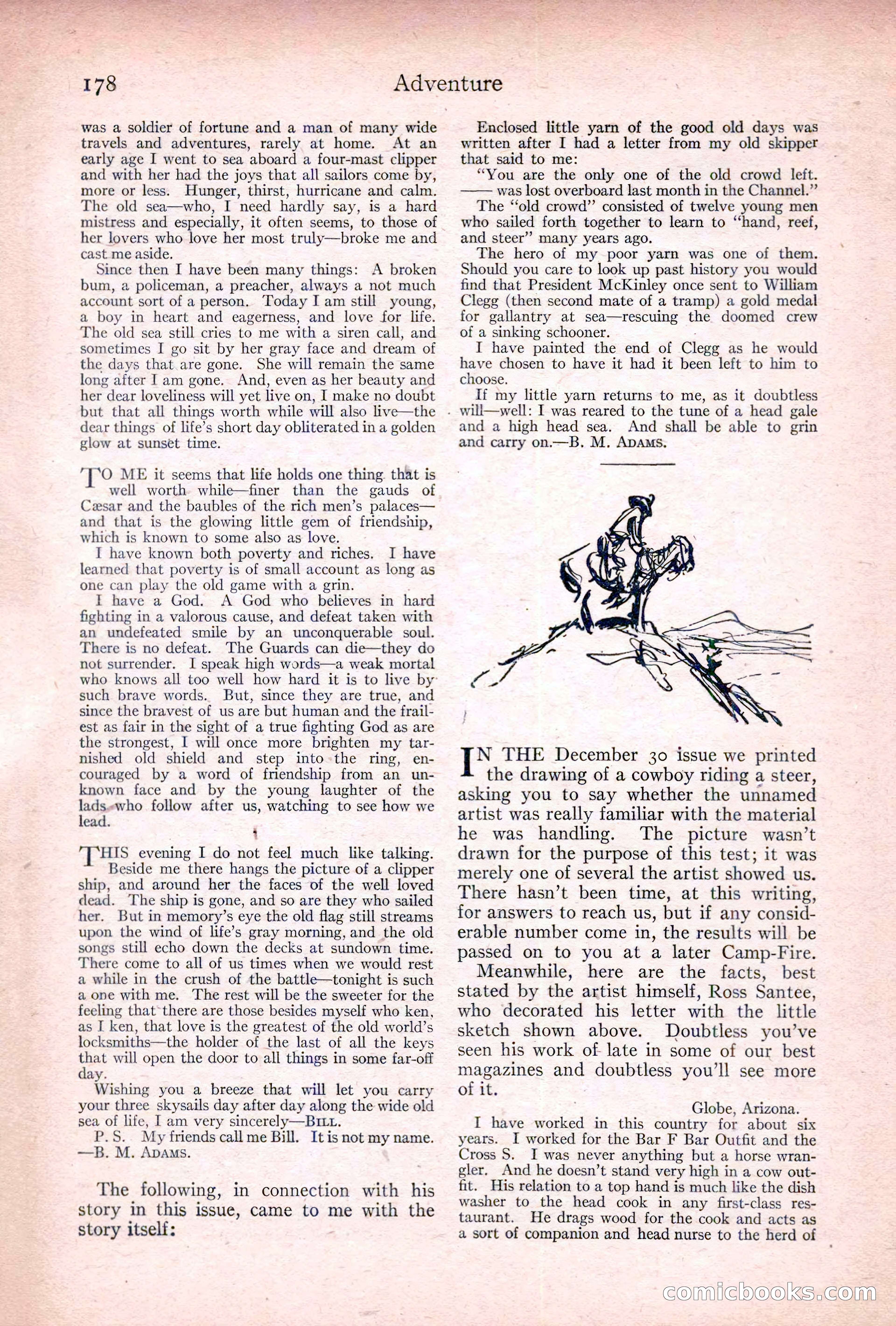
a ES 178 Adventure was a soldier of fortune and a man of many wide travels and adventures, rarely at home. At an early age I went to sea aboard a four-mast clipper and with her had the joys that all sailors come by, more or less. Hunger, thirst, hurricane and calm. The old sea—who, I need hardly say, is a hard mistress and especially, it often seems, to those of her lovers who love her most truly—broke me and cast me aside. Since then I have been many things: A broken bum, a policeman, a preacher, always a not much account sort of a person. Today Iam still young, a boy in heart and eagerness, and love for life. The old sea still cries to me with a siren call, and sometimes I go sit by her gray face and dream of the days that.are gone. She will remain the same long after 1am gone. And, even as her beauty and her dear loveliness will yet live on, I make no doubt but that all things worth while will also live—the dear things of life’s short day obliterated in a golden glow at sunset time. "T’O ME it seems that life holds one thing. that is well worth while—finer than the gauds of Cesar and the baubles of the rich men’s palaces— and that is the glowing little gem of friendship, which is known to some also as love. I have known both poverty and riches. I have learned that poverty is of small account as long as one can play the old game with a grin. I have a God. A God who believes in hard fighting in a valorous cause, and defeat taken with an undefeated smile by an unconquerable soul. There is no defeat. The Guards can die—they do not surrender. I speak high words—a weak mortal who knows all too well how hard it is to live by such brave words. But, since they are true, and since the bravest of us are but human and the frail- est as fair in the sight of a true fighting God as are the strongest, I will once more brighten my tar- nished old shield and step into the ring, en- couraged by a word of friendship from an un- known face and by the young laughter of the lads«who follow after us, watching to see how we lead. ‘ ‘Tas evening I do not feel much like talking. Beside me there hangs the picture of a clipper ship, and around her the faces of the well loved dead. The ship is gone, and so are they who sailed her. But in memory’s eye the old flag still streams upon the wind of life’s gray morning, and the old songs still echo down the decks at sundown time. There come to all of us times when we would rest a while in the crush of the battle—tonight is such a one with me. The rest will be the sweeter for the feeling that there are those besides myself who ken, as I ken, that love is the greatest of the old world’s locksmiths—the holder of the last of all the keys that will open the door to all things in some far-off day. Wishing you a breeze that will let you carry your three skysails day after day along the wide old sea of life, | am very sincerely—BrLt. P.S. My friends call me Bill. It is not my name. —B. M. Apams. The following, in connection with his story in this issue, came to me with the story itself: Enclosed little yarn of the good old days was written after I had a letter from my old skipper that said to me: “You are the only one of the old crowd left. was lost overboard last month in the Channel.” The ‘‘old crowd” consisted of twelve young men who sailed forth together to learn to “hand, reef, and steer” many years ago. The hero of my poor yarn was one of them. Should you care to look up past history you would find that President McKinley once sent to William Clegg (then second mate of a tramp) a gold medal for gallantry at sea—rescuing the doomed crew of a sinking schooner. I have painted the end of Clege as he would have chosen to have it had it been left to him to choose. If my little yarn returns to me, as it doubtless . will—well: I was reared to the tune of a head gale and a high head sea. And shall be able to grin and carry on.—B,. M. ApAms, ies THE December 30 issue we printed the drawing of a cowboy riding a steer, asking you to say whether the unnamed artist was really familiar with the material he was handling. The picture wasn’t drawn for the purpose of this test; it was merely one of several the artist showed us. There hasn’t been time, at this writing, for answers to reach us, but if any consid- erable number come in, the results will be passed on to you at a later Camp-Fire. Meanwhile, here are the facts, best stated by the artist himself, Ross Santee, who decorated his letter with the little sketch shown above. Doubtless you’ve seen his work of late in some of our best magazines and doubtless you’ll see more of it. Globe, Arizona. I have worked in this country for about six years. I worked for the Bar F Bar Outfit and the Cross S$. I was never anything but a horse wran- gler. And he doesn’t stand very high in a cow out- fit. His relation to a top hand is much like the dish washer to the head cook in any first-class res- taurant. He drags wood for the cook and acts as a sort of companion and head nurse to the herd of COmicloooks (C@