
Pulp Fiction, 1922 · page 18 of 196
Adventure, January 20, 1922 — page 18: what you’re looking at
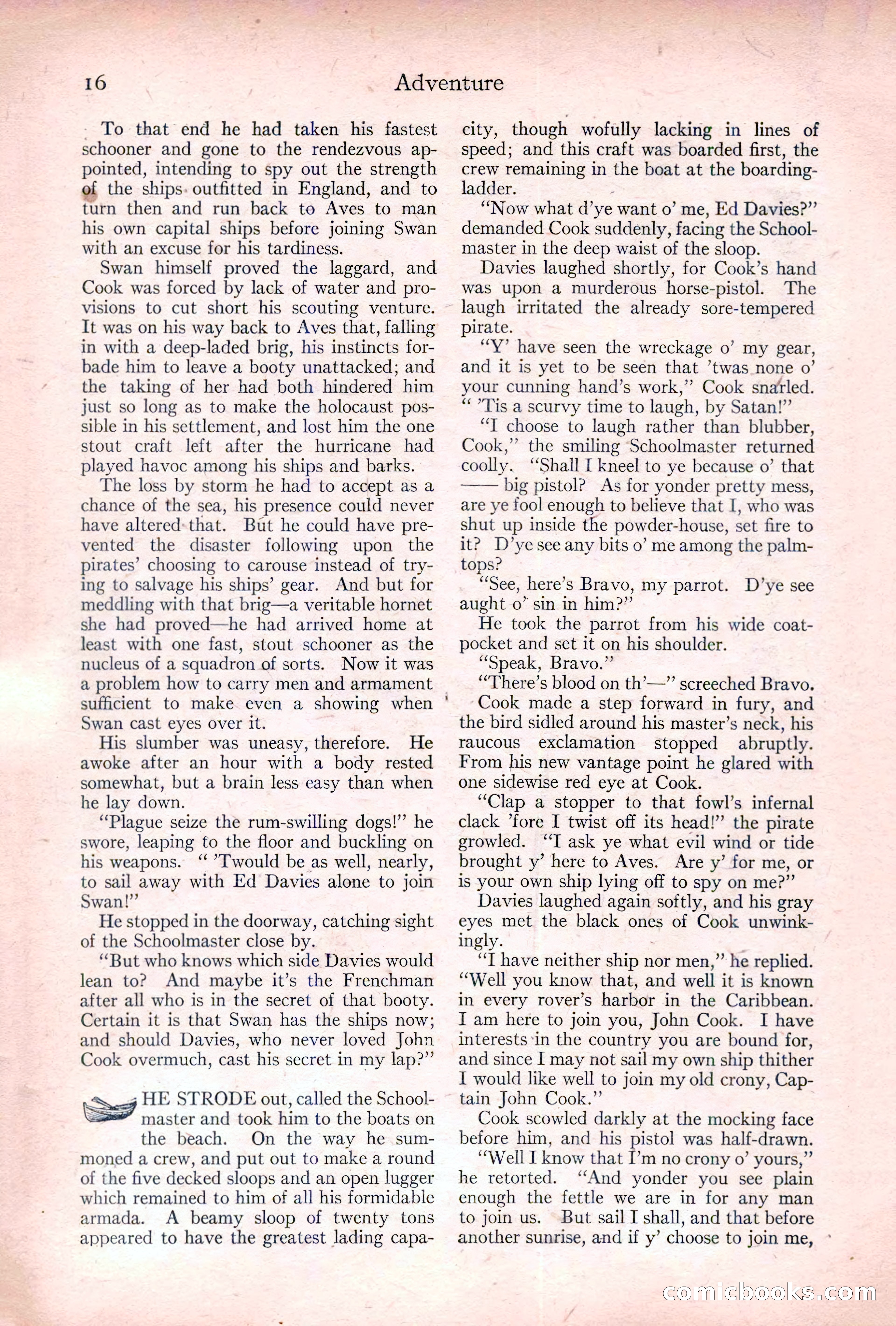
A restored page from Pulp Fiction, 1922. Page through the whole issue in the reader above.
📄 Transcribed text from this page (OCR, searchable)
Machine-transcribed from the original scan — historical spelling and the odd misread are preserved.
16 - To that end he had taken his fastest schooner and gone to the rendezvous ap- pointed, intending to spy out the strength gi the ships: outfitted in England, and to ded then and run back to Aves to man his own capital ships before joining Swan with an excuse for his tardiness. Swan himself proved the laggard, and Cook was forced by lack of water and pro- visions to cut short his scouting venture. It was on his way back to Aves that, falling in with a deep-laded brig, his instincts for- bade him to leave a booty unattacked; and the taking of her had both hindered him just so long as to make the holocaust pos- sible in his settlement, and lost him the one stout craft left after the hurricane had played havoc among his ships and barks. The loss by storm he had to accept as a chance of the sea, his presence could never have altered-that. But he could have pre- vented the disaster following upon the pirates’ choosing to carouse instead of try- ing to salvage his ships’ gear. And but for meddling with that brig—a veritable hornet she had proved—he had arrived home at least with one fast, stout schooner as the nucleus of a squadron of sorts. Now it was a problem how to carry men and armament sufficient to make even a showing when Swan cast eyes over it. His slumber was uneasy, therefore. He awoke after an hour with a body rested somewhat, but a brain less easy than when he lay down. “Plague seize the rum-swilling dogs!’’ he swore, leaping fo the floor and buckling on his weapons. ‘ ’T'would be as well, nearly, to sail away with Ed Davies alone to join Swan!” He stopped in the doorway, catching sight of the Schoolmaster close by. “But who knows which side Davies would lean to? And maybe it’s the Frenchman after all who is in the secret of that booty. Certain it is that Swan has the ships now; and should Davies, who never loved John Cook overmuch, cast his secret in my lap?” sg HE STRODE out, called the School- SS master and took him to the boats on the beach. On the way he sum- moned a crew, and put out to make a round of the five decked sloops and an open lugger which remained to him of all his formidable armada. A beamy sloop of twenty tons appeared to have the greatest lading capa- Adventure city, though wofully lacking in lines of speed; and this craft was boarded first, the crew remaining in the boat at the boarding- ladder. “Now what d’ ye want o’ me, Ed Davies?” demanded Cook suddenly, facing the School- master in the deep waist of the sloop. Davies laughed shortly, for Cook’s hand was upon a murderous horse-pistol. The laugh irritated the already sore-tempered pirate. ““Y’ have seen the wreckage o’ my gear, and it is yet to be seen that ’twas_none 0’ your cunning hand’s work,” Cook snarled. “°Tis a scurvy time to laugh, by Satan!” “T choose to laugh rather than blubber, Cook,” the smiling Schoolmaster returned coolly. “Shall I kneel to ye because o’ that big pistol? As for yonder pretty mess, are ye fool enough to believe that I, who was shut up inside the powder-house, set fire to it? D’ye see any bits o’ me among the palm- tops? “See, here’s Bravo, my parrot. aught o” sin in him?” He took the parrot from his wide coat- pocket and set it on his shoulder. ‘Speak, Bravo.” “‘There’s blood on th’—” screeched Bravo. Cook made a step forward in fury, and the bird sidled around his master’s neck, his raucous exclamation stopped abruptly. From his new vantage point he glared with one sidewise red eye at Cook. “Clap a stopper to that fowl’s infernal clack ‘fore I twist off its head!” the pirate growled. vl ask ye what evil wind or tide brought y’ here to Aves. Are y’ for me, or is your own ship lying off to spy on me?” Davies laughed again softly, and his gray eyes met the black ones of Cook unwink- ingly. “T have neither aoe nor men,” he replied. “Well you know that, and well it is known in every rover’s harbor in the Caribbean. I am here to join you, John Cook. I have interests’in the country you are bound for, and since I may not sail my own ship thither I would like well to join my old crony, Cap- tain John Cook.”’ Cook scowled darkly at the mocking face before him, and his pistol was half-drawn. ‘Well I know that I’m no crony o’ yours,” he retorted. “And yonder you see plain enough the fettle we are in for any man to join us. But sail I shall, and that before D’ye see another sunrise, and if y’ choose to join me, ° COmicloooks C (C@