
Pulp Fiction, 1922 · page 163 of 196
Adventure, January 20, 1922 — page 163: what you’re looking at
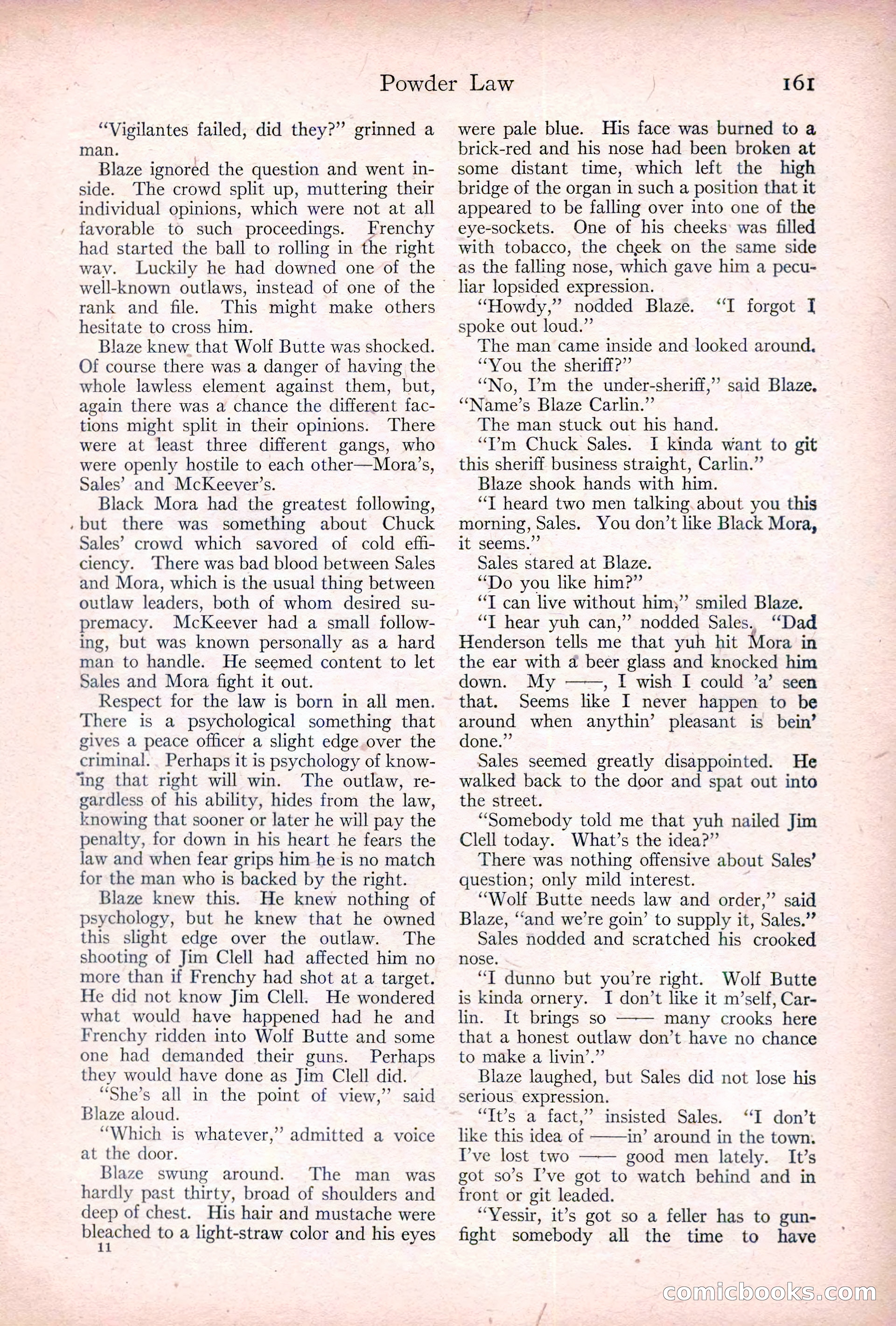
A restored page from Pulp Fiction, 1922. Page through the whole issue in the reader above.
📄 Transcribed text from this page (OCR, searchable)
Machine-transcribed from the original scan — historical spelling and the odd misread are preserved.
Powder Law “Vigilantes failed, did they?” grinned a man. : Blaze ignored the question and went in- side. The crowd split up, muttering their individual opinions, which were not at all favorable to such proceedings. Frenchy had started the ball to rolling in the right wav. Luckily he had downed one of the well-known outlaws, instead of one of the > rank and file. This might make others hesitate to cross him. Blaze knew that Wolf Butte was shocked. Of course there was a danger of having the whole lawless element against them, but, again there was a chance the different fac- tions might split in their opinions. There were at least three different gangs, who were openly hostile to each other—Mora’s, Sales’ and McKeever’s. Black Mora had the greatest following, but there was something about Chuck Sales’ crowd which savored of cold eff- ciency. ‘There was bad blood between Sales and Mora, which is the usual thing between outlaw leaders, both of whom desired su- premacy. McKeever had a small follow- ing, but was known personally as a hard man to handle. He seemed content to let Sales and Mora fight it out. Respect for the law is born in all men. There is a psychological something that gives a peace officer a slight edge over the criminal. Perhaps it is psychology of know- ‘Ing that right will win. The outlaw, re- gardless of his ability, hides from the law, knowing that sooner or later he will pay the penalty, for down in his heart he fears the law and when fear grips him he is no match for the man who is backed by the right. Blaze knew this. He knew nothing of psychology, but he knew that he owned this slight edge over the outlaw. The shooting of Jim Clell had affected him no more than if Frenchy had shot at a target. He did not know Jim Clell. He wondered what would have happened had he and Frenchy ridden into Wolf Butte and some one had demanded their guns. Perhaps they would have done as Jim Clell did. ‘She’s all in the point of view,’ said Blaze aloud. “Which is whatever,’ admitted a voice at the door. Blaze swung around. The man was hardly past thirty, broad of shoulders and deep of chest. His hair and mustache were bleached to a light-straw color and his eyes 16I were pale blue. His face was burned to a brick-red and his nose had been broken at some distant time, which left the high bridge of the organ in such a position that it appeared to be falling over into one of the eye-sockets. One of his cheeks was filled with tobacco, the cheek on the same side as the falling nose, which gave him a pecu- liar lopsided expression. “Howdy,” nodded Blaze. spoke out loud.” The man came inside and looked around, “You the sheriff?” “No, I’m the under-sheriff,” said Blaze, “‘Name’s Blaze Carlin.” The man stuck out his hand. “T’m Chuck Sales. I kinda want to git this sheriff business straight, Carlin.”’ Blaze shook hands with him. “T heard two men talking. about you this morning, Sales. You don’t like Black Mora, it seems.”’ Sales stared at Blaze. “Do you like him?” “T can live without him,” smiled Blaze. “T hear yuh can,” nodded Sales. “Dad Henderson tells me that yuh hit Mora in the ear with @ beer glass and knocked him down. My , | wish I could ’a’ seen that. Seems like I never happen to be around when anythin’ pleasant is bein’ done.” Sales seemed greatly disappointed. He walked back to the door and spat out into the street. “Somebody told me that yuh nailed Jim Clell today. What’s the idea?” There was nothing offensive about Sales’ question; only mild interest. “Wolf Butte needs law and order,” said Blaze, ‘“‘and we’re goin’ to supply it, Sales.’’ Sales nodded and scratched his crooked nose. “Tt dunno but you’re right. Wolf Butte is kinda ornery. I don’t like it m’self, Car- lin. It brings so many crooks here that a honest outlaw don’t have no chance to make a livin’.” Blaze laughed, but Sales did not lose his serlous expression. “It’s a fact,” insisted Sales. like this idea of in’ around in the town. I’ve lost two good men lately. It’s got so’s I’ve got to watch behind and in front or git leaded. “Yessir, it’s got so a feller has to gun- fight somebody all the time to have “TI forgot J “T don’t Gomichdoo S (C@