
Pulp Fiction, 1922 · page 123 of 196
Adventure, January 20, 1922 — page 123: what you’re looking at
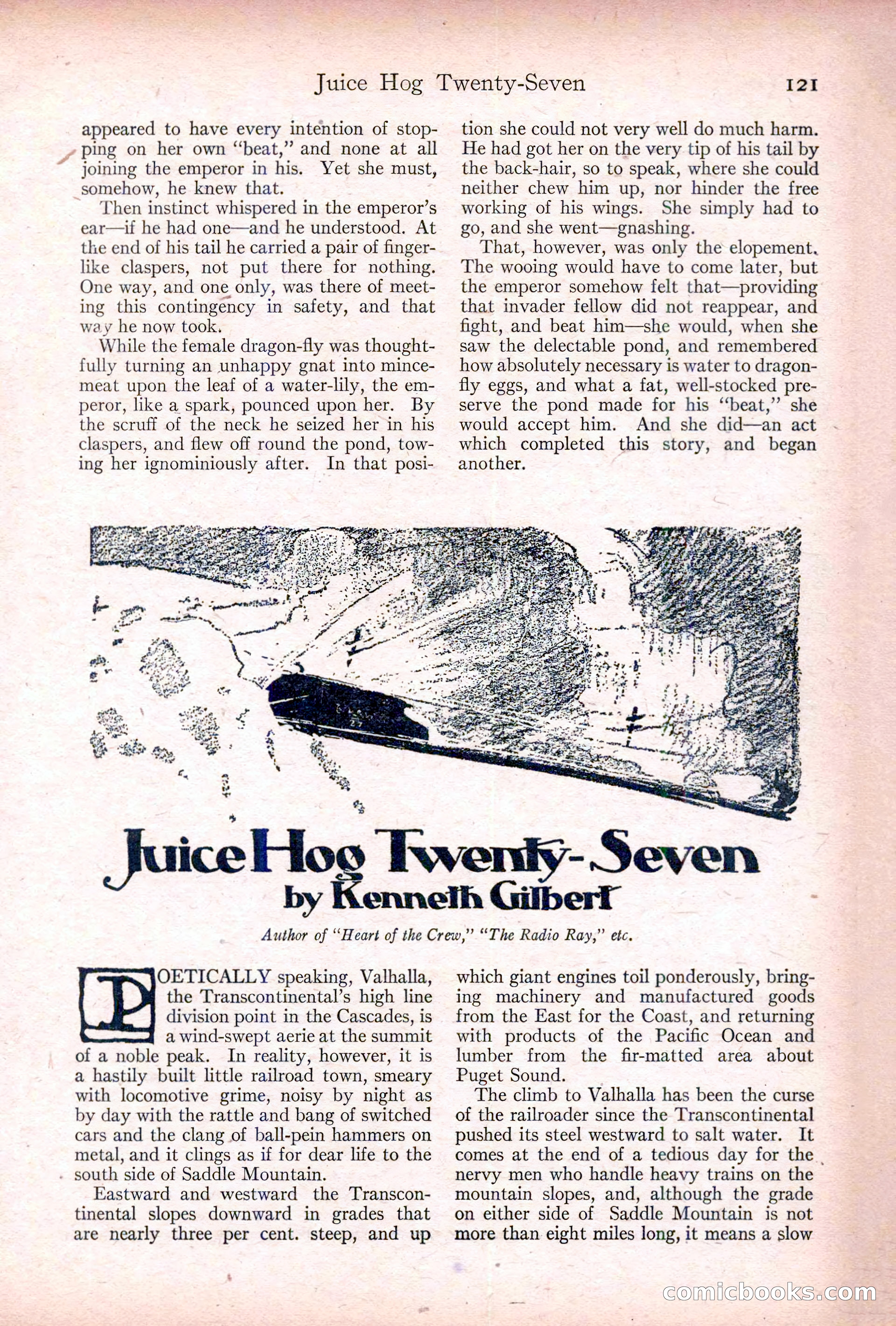
A restored page from Pulp Fiction, 1922. Page through the whole issue in the reader above.
📄 Transcribed text from this page (OCR, searchable)
Machine-transcribed from the original scan — historical spelling and the odd misread are preserved.
Juice Hog Twenty-Seven appeared to have every intention of stop- » ping on her own “beat,” and none at all joining the emperor in his. Yet she must, somehow, he knew that. Then instinct whispered in the emperor’s ear—if he had one—and he understood. At the end of his tail he carried a pair of finger- like claspers, not put there for nothing. One way, and one only, was there of meet- ing this contingency in safety, and that way he now took. While the female dragon-fly was thought- fully turning an unhappy gnat into mince- meat upon the leaf of a water-lily, the em- peror, like a spark, pounced upon her. By the scruff of the neck he seized her in his claspers, and flew off round the pond, tow- ing her ignominiously after. In that posi- $ Juice Hog Fwenty: ennelh Gilberf by I2I tion she could not very well do much harm. He had got her on the very tip of his tail by the back-hair, so to speak, where she could neither chew him up, nor hinder the free working of his wings. She simply had to go, and she went—gnashing. That, however, was only the elopement, The wooing would have to come later, but the emperor somehow felt that—providing that invader fellow did not reappear, and fight, and beat him—she would, when she saw the delectable pond, and remembered how absolutely necessary is water to dragon- fly eggs, and what a fat, well-stocked pre- serve the pond made for his “beat,” she would accept him. And she did—an act which completed this story, and began another. ~~. - te - Seven Author of ‘Heart of the Crew,” “The Radio Ray,” etc. OETICALLY speaking, Valhalla, 2 the Transcontinental’s high line | division point in the Cascades, is bend 2 Wind-swept aerie at the summit of a noble peak. In reality, however, it is a hastily built little railroad town, smeary with locomotive grime, noisy by night as by day with the rattle and bang of switched cars and the clang of ball-pein hammers on metal, and it clings as if for dear life to the south side of Saddle Mountain. Eastward and westward the Transcon- tinental slopes downward in grades that are nearly three per cent. steep, and up which giant engines toil ponderously, bring- ing machinery and manufactured goods from the East for the Coast, and returning with products of the Pacific Ocean and lumber from the fir-matted area about Puget Sound. , The climb to Valhalla has been the curse of the railroader since the Transcontinental pushed its steel westward to salt water. It comes at the end of a tedious day for the . nervy men who handle heavy trains on the mountain slopes, and, although the grade on either side of Saddle Mountain is not more than eight miles long, it means a slow COMmMicCloooks (C@