
Pulp Fiction, 1922 · page 106 of 196
Adventure, January 20, 1922 — page 106: what you’re looking at
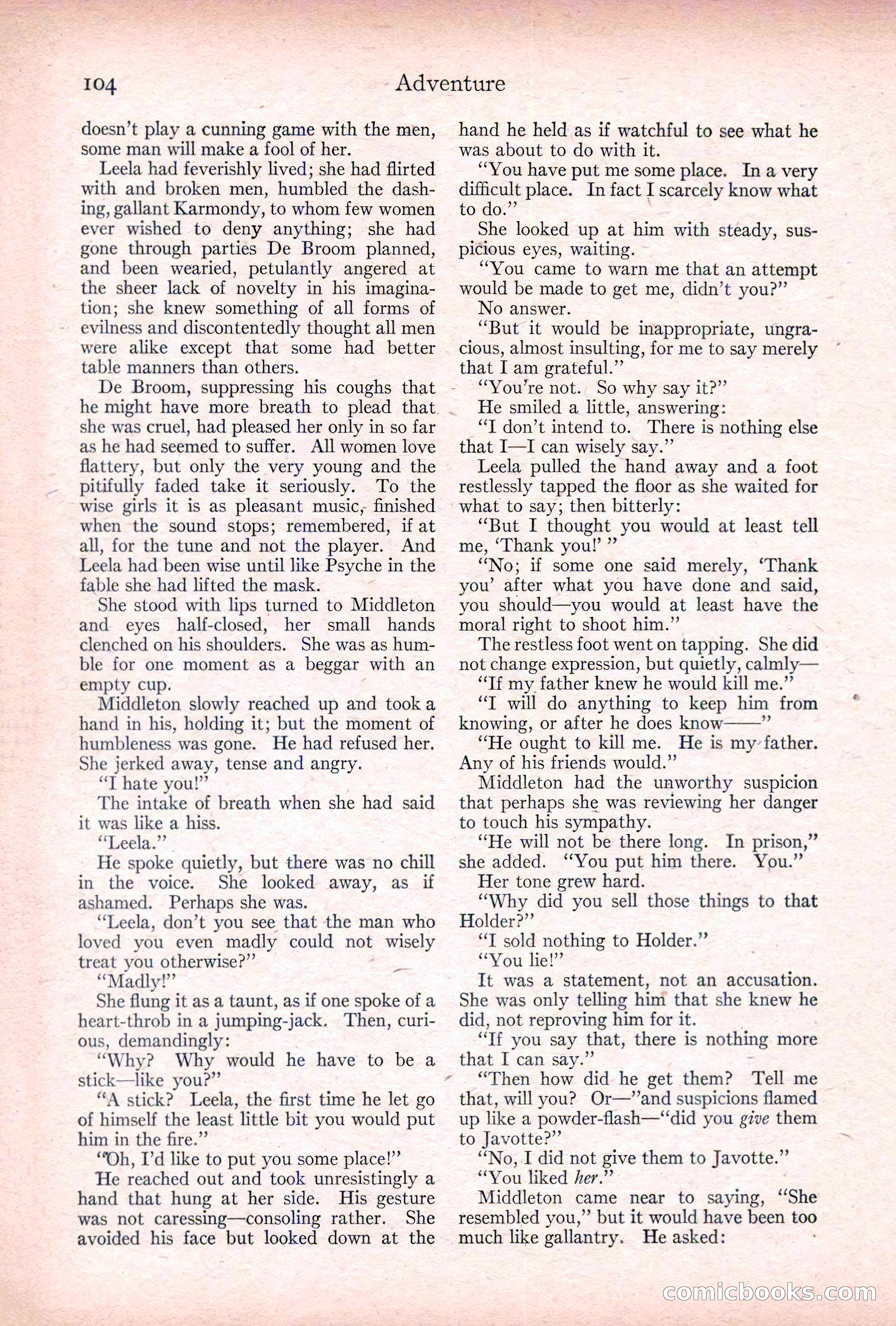
A restored page from Pulp Fiction, 1922. Page through the whole issue in the reader above.
📄 Transcribed text from this page (OCR, searchable)
Machine-transcribed from the original scan — historical spelling and the odd misread are preserved.
104 doesn’t play a cunning game with the men, some man will make a fool of her. Leela had feverishly lived; she had flirted with and broken men, humbled the dash- ing, gallant Karmondy, to whom few women ever wished to deny anything; she had gone through parties De Broom planned, and been wearied, petulantly angered at the sheer lack of novelty in his imagina- tion; she knew something of all forms of evilness and discontentedly thought all men were alike except that some had better table manners than others. De Broom, suppressing his coughs that - he might have more breath to plead that she was cruel, had pleased her only in so far as he had seemed to suffer. All women love flattery, but only the very young and the pitifully faded take it seriously. To the wise girls it is as pleasant music, finished when the sound stops; remembered, if at all, for the tune and not the player. And Leela had been wise until like Psyche in the fable she had lifted the mask. She stood with lips turned to Middleton and eyes half-closed, her small hands clenched on his shoulders. She was as hum- ble for one moment as a beggar with an empty cup. Middleton slowly reached up and took a hand in his, holding it; but the moment of humbleness was gone. He had refused her. She jerked away, tense and angry. “T hate you!” The intake of breath when she had said it was like a hiss. “Leela.” He spoke quietly, but there was no chill in the voice. She looked away, as if ashamed. Perhaps she was. “Leela, don’t you see that the man who loved you even madly could not wisely treat you otherwise?” “Madly?’’ She flung it as a taunt, as if one spoke of a heart-throb in a jumping-jack. Then, curi- ous, demandingly: “Why? Why would he have to be a stick—like you?” “A stick? Leela, the first time he let go of himself the least little bit you would put him in the fire.” “Oh, I'd like to put you some place!” He reached out and took unresistingly a hand that hung at her side. His gesture was not caressing—consoling rather. She avoided his face but looked down at the -_ Adventure hand he held as if watchful to see what he was about to do with it. “You have put me some place. In a very difficult place. In fact I scarcely know what to do.” She looked up at him with steady, sus- picious eyes, waiting. “You came to warn me that an attempt would be made to get me, didn’t you?” No answer. “But it would be inappropriate, ungra- cious, almost insulting, for me to say merely that I am grateful.” “You’re not. So why say it?” He smiled a little, answering: “YT don’t intend to. There is nothing else that I—I can wisely say.” Leela pulled the hand away and a foot restlessly tapped the floor as she waited for what to say; then bitterly: “But I thought you would at least tell me, ‘Thank you! ” “No; if some one said merely, ‘Thank you’ after what you have done and said, you should—you would at least have the moral right to shoot him.” The restless foot went on tapping. She did not change expression, but quietly, calmly— “Tf my father knew he would kill me.” “T will do anything to keep him from knowing, or after he does know “ “He ought to kill me. He is my’ father. Any of his friends would.” Middleton had the unworthy suspicion that perhaps she was reviewing her danger to touch his sympathy. “He will not be there long. In prison,” she added. ‘‘You put him there. You.” Her tone grew hard. “Why did you sell those things to that Holder?” “T sold nothing to Holder.” “You be!” It was a statement, not an accusation. She was only telling him that she knew he did, not reproving him for it. “Tf you say that, there is nothing more that I can say.” : “Then how did he get them? Tell me that, will you? Or—’’and suspicions flamed up like a powder-flash—“‘did you give them to Javotte?”’ “No, I did not give them to Javotte.” “Vou liked her.”’ Middleton came near to saying, ‘She resembled you,” but it would have been too much like gallantry. He asked: COmMiCLMOoolks (C@