
Pulp Fiction, 1921 · page 91 of 204
Adventure Magazine Cover — page 91: what you’re looking at
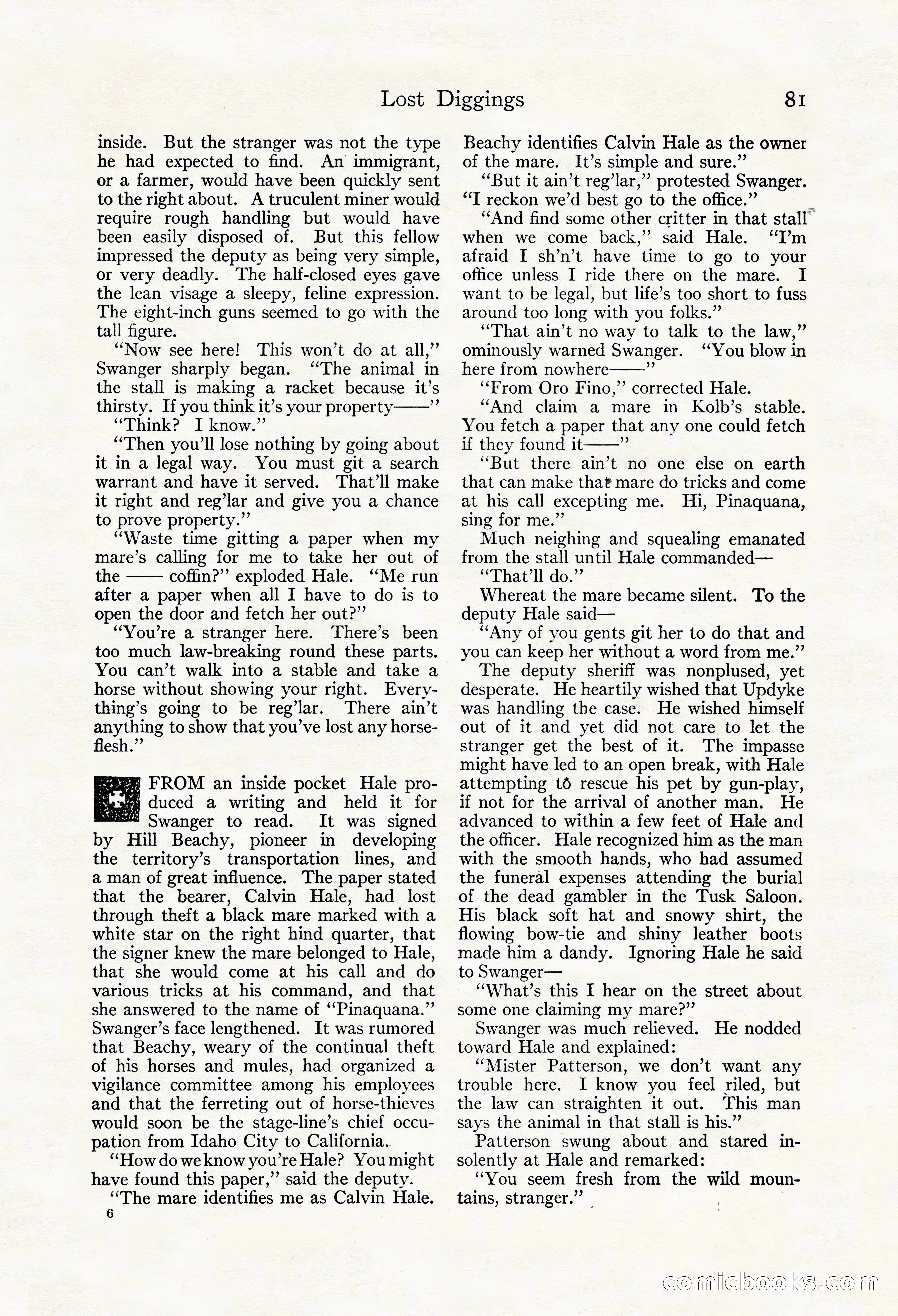
A restored page from Pulp Fiction, 1921. Page through the whole issue in the reader above.
📄 Transcribed text from this page (OCR, searchable)
Machine-transcribed from the original scan — historical spelling and the odd misread are preserved.
Lost Diggings inside. But the stranger was not the type he had expected to find. An immigrant, or a farmer, would have been quickly sent to the right about. A truculent miner would require rough handling but would have been easily disposed of. But this fellow impressed the deputy as being very simple, or very deadly. The half-closed eyes gave the lean visage a sleepy, feline expression. The eight-inch guns seemed to go with the tall figure. ‘“‘Now see here! This won’t do at all,” Swanger sharply began. “The animal in the stall is making a racket because it’s thirsty. If you think it’s your property “Think? I know.” “Then you'll lose nothing by going about it in a legal way. You must git a search warrant and have it served. That’ll make it right and reg’lar and give you a chance to prove property.” “Waste time gitting a paper when my mare’s calling for me to take her out of the coffin?” exploded Hale. ‘Me run after a paper when all I have to do is to open the door and fetch her out?”’ “You're a stranger here. There’s been too much law-breaking round these parts. You can’t walk into a stable and take a horse without showing your right. Every- thing’s going to be reg’lar. There ain’t anything to show that you’ve lost any horse- flesh.” ore FROM an inside pocket Hale pro- a duced a writing and held it for al Swanger to read. It was signed by Hill Beachy, pioneer in developing the territory’s transportation lines, and a man of great influence. The paper stated that the bearer, Calvin Hale, had lost through theft a black mare marked with a white star on the right hind quarter, that the signer knew the mare belonged to Hale, that she would come at his call and do various tricks at his command, and that she answered to the name of “‘Pinaquana.”’ Swanger’s face lengthened. It was rumored that Beachy, weary of the continual theft of his horses and mules, had organized a vigilance committee among his employees and that the ferreting out of horse-thieves would soon be the stage-line’s chief occu- pation from Idaho City to California. “How do we know you’re Hale? You might have found this paper,” said the deputy. “The mare identifies me as Calvin Hale. 6 81 Beachy identifies Calvin Hale as the owner of the mare. It’s simple and sure.” “But it ain’t reg’lar,” protested Swanger. “T reckon we’d best go to the office.”’ ‘And find some other critter in that stall” when we come back,” said Hale. “I’m afraid I sh’n’t have time to go to your office unless I ride there on the mare. I want to be legal, but life’s too short to fuss around too long with you folks.” “That ain’t no way to talk to the law,” ominously warned Swanger. ‘You blow in here from nowhere “ ‘‘From Oro Fino,” corrected Hale. “And claim a mare in Kolb’s stable. You fetch a paper that any one could fetch if they found it “But there ain’t no one else on earth that can make that mare do tricks and come at his call excepting me. Hi, Pinaquana, sing for me.” Much neighing and squealing emanated from the stall until Hale commanded— “That'll do.” Whereat the mare became silent. To the deputy Hale said— ‘“‘Any of you gents git her to do that and you can keep her without a word from me.” The deputy sheriff was nonplused, yet desperate. He heartily wished that Updyke was handling the case. He wished himself out of it and yet did not care to let the stranger get the best of it. The impasse might have led to an open break, with Hale attempting td rescue his pet by gun-play, if not for the arrival of another man. He advanced to within a few feet of Hale and the officer. Hale recognized him as the man with the smooth hands, who had assumed the funeral expenses attending the burial of the dead gambler in the Tusk Saloon. His black soft hat and snowy shirt, the flowing bow-tie and shiny leather boots made him a dandy. Ignoring Hale he said to Swanger— ‘“What’s this I hear on the street about some one claiming my mare?” Swanger was much relieved. He nodded toward Hale and explained: “Mister Patterson, we don’t want any trouble here. I know you feel riled, but the law can straighten it out. This man says the animal in that stall is his.” Patterson swung about and stared in- solently at Hale and remarked: “You seem fresh from the wild moun- tains, stranger.”’ Coin DOOKS co iin