
Pulp Fiction, 1921 · page 85 of 204
Adventure Magazine Cover — page 85: what you’re looking at
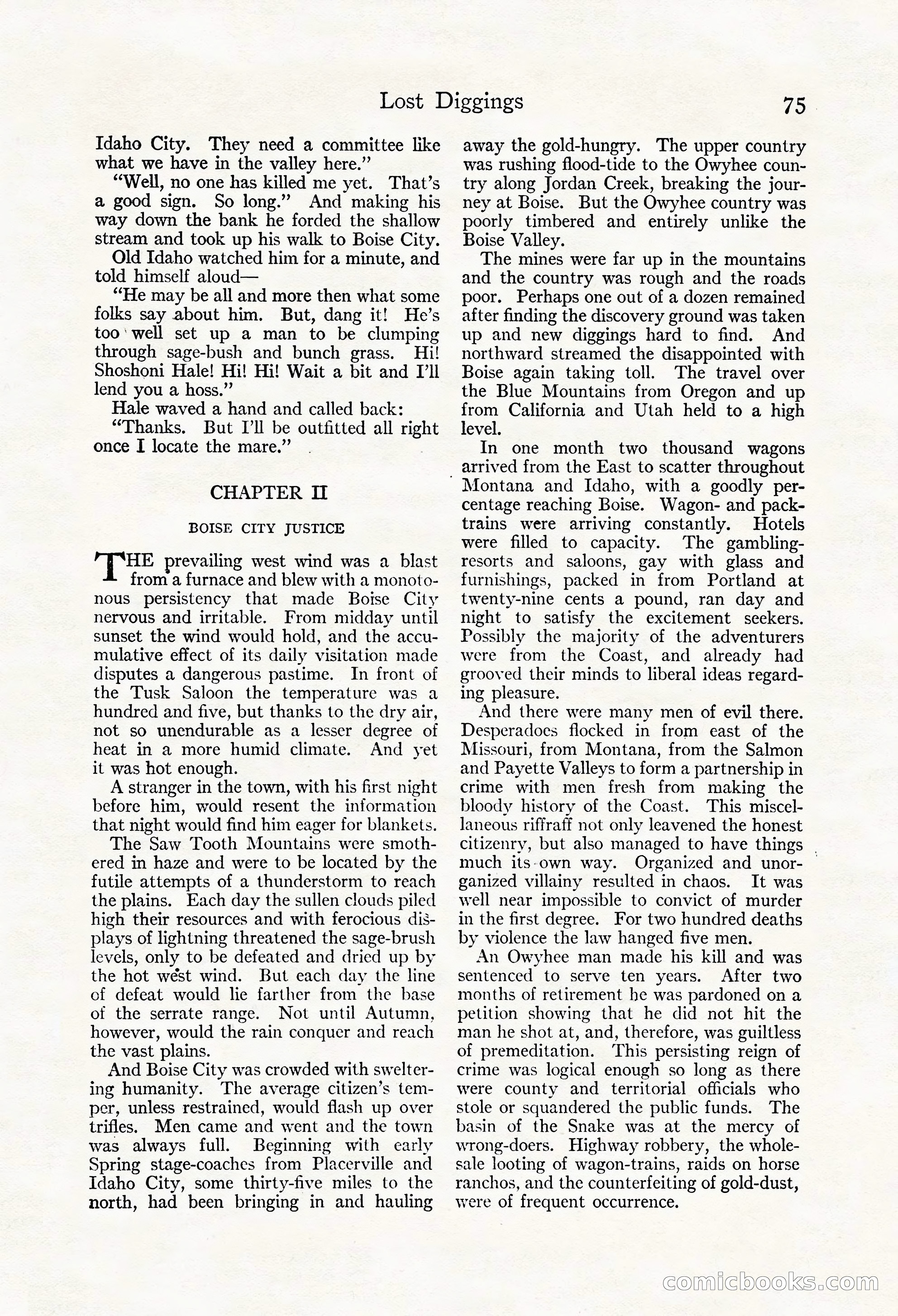
A restored page from Pulp Fiction, 1921. Page through the whole issue in the reader above.
📄 Transcribed text from this page (OCR, searchable)
Machine-transcribed from the original scan — historical spelling and the odd misread are preserved.
Lost Diggings Idaho City. They need a committee like what we have in the valley here.” “Well, no one has killed me yet. That’s a good sign. So long.” And making his way down the bank he forded the shallow stream and took up his walk to Boise City. Old Idaho watched him for a minute, and told himself aloud— ““He may be all and more then what some folks say about him. But, dang it! He’s too' well set up a man to be clumping through sage-bush and bunch grass. Hi! Shoshoni Hale! Hi! Hi! Wait a bit and I'll lend you a hoss.” Hale waved a hand and called back: “Thanks. But Dll be outfitted all right once I locate the mare.” CHAPTER II BOISE CITY JUSTICE HE prevailing west wind was a blast from a furnace and blew with a monoto- nous persistency that made Boise City nervous and irritable. From midday until sunset the wind would hold, and the accu- mulative effect of its daily visitation made disputes a dangerous pastime. In front of the Tusk Saloon the temperature was a hundred and five, but thanks to the dry air, not so unendurable as a lesser degree of heat in a more humid climate. And yet it was hot enough. A stranger in the town, with his first night before him, would resent the information that night would find him eager for blankets. The Saw Tooth Mountains were smoth- ered in haze and were to be located by the futile attempts of a thunderstorm to reach the plains. Each day the sullen clouds piled high their resources and with ferocious dis- plays of lightning threatened the sage-brush levels, only to be defeated and dried up by the hot wést wind. But each day the line of defeat would le farther from the base of the serrate range. Not until Autumn, however, would the rain conquer and reach the vast plains. And Boise City was crowded with swelter- ing humanity. The average citizen’s tem- per, unless restrained, would flash up over trifles. Men came and went and the town was always full. Beginning with early Spring stage-coaches from Placerville and Idaho City, some thirty-five miles to the north, had been bringing in and hauling away the gold-hungry. The upper country was rushing flood-tide to the Owyhee coun- try along Jordan Creek, breaking the jour- ney at Boise. But the Owyhee country was poorly timbered and entirely unlike the Boise Valley. The mines were far up in the mountains and the country was rough and the roads poor. Perhaps one out of a dozen remained after finding the discovery ground was taken up and new diggings hard to find. And northward streamed the disappointed with Boise again taking toll. The travel over the Blue Mountains from Oregon and up from California and Utah held to a high level. In one month two thousand wagons arrived from the East to scatter throughout - Montana and Idaho, with a goodly per- centage reaching Boise. Wagon- and pack- trains were arriving constantly. Hotels were filled to capacity. The gambling- resorts and saloons, gay with glass and furnishings, packed in from Portland at twenty-nine cents a pound, ran day and night to satisfy the excitement seekers. Possibly the majority of the adventurers were from the Coast, and already had grooved their minds to liberal ideas regard- ing pleasure. And there were many men of evil there. Desperadoes flocked in from east of the Missouri, from Montana, from the Salmon and Payette Valleys to form a partnership in crime with men fresh from making the bloody history of the Coast. This miscel- laneous riffraff not only leavened the honest 73. citizenry, but also managed to have things | much its-own way. Organized and unor- ganized villainy resulted in chaos. It was well near impossible to convict of murder in the first degree. For two hundred deaths by violence the law hanged five men. An Owyhee man made his kill and was sentenced to serve ten years. After two months of retirement he was pardoned on a petition showing that he did not hit the man he shot at, and, therefore, was guiltless of premeditation. This persisting reign of crime was logical enough so long as there were county and territorial officials who stole or squandered the public funds. The basin of the Snake was at the mercy of wrong-doers. Highway robbery, the whole- sale looting of wagon-trains, raids on horse ranchos, and the counterfeiting of gold-dust, vere of frequent occurrence. COIN DOOKS © inn