
Pulp Fiction, 1921 · page 83 of 204
Adventure Magazine Cover — page 83: what you’re looking at
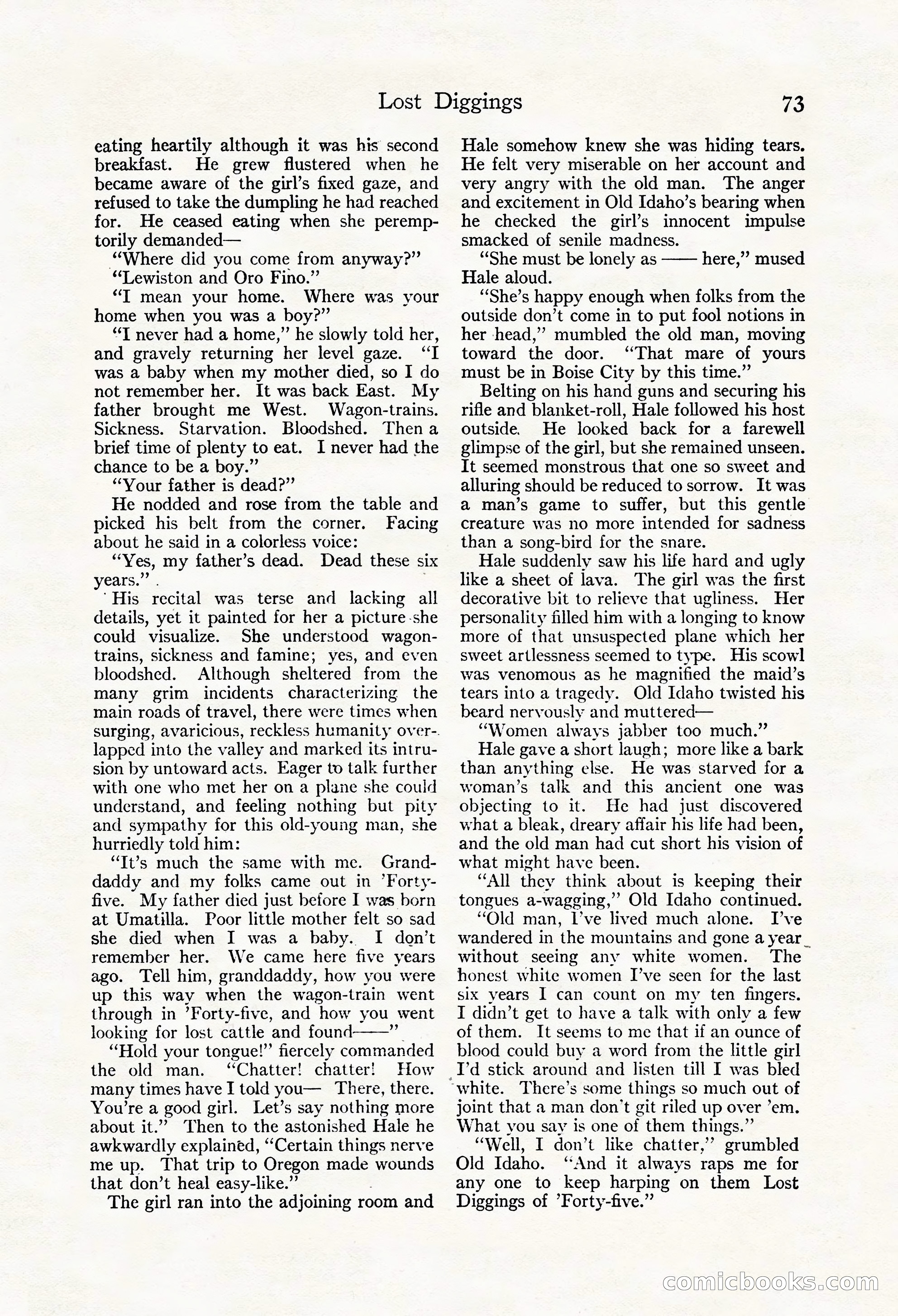
A restored page from Pulp Fiction, 1921. Page through the whole issue in the reader above.
📄 Transcribed text from this page (OCR, searchable)
Machine-transcribed from the original scan — historical spelling and the odd misread are preserved.
Lost Diggings eating heartily although it was hts second breakfast. He grew flustered when he became aware of the girl’s fixed gaze, and refused to take the dumpling he had reached for. He ceased eating when she peremp- torily demanded— “Where did you come from anyway?” “Lewiston and Oro Fino.” “T mean your home. Where was your home when you was a boy?” “T never had a home,” he slowly told her, and gravely returning her level gaze. “I was a baby when my mother died, so I do not remember her. It was back East. My father brought me West. Wagon-trains. Sickness. Starvation. Bloodshed. Then a brief time of plenty to eat. I never had the chance to be a boy.” “Your father is dead?”’ He nodded and rose from the table and picked his belt from the corner. Facing about he said in a colorless voice: “Yes, my father’s dead. Dead these six years.” His recital was terse and lacking all details, yet it painted for her a picture-she could visualize. She understood wagon- trains, sickness and famine; yes, and even bloodshed. Although sheltered from the many grim incidents characterizing the main roads of travel, there were times when surging, avaricious, reckless humanity over-. lapped into the valley and marked its intru- sion by untoward acts. Eager to talk further with one who met her on a plane she could understand, and feeling nothing but pity and sympathy for this old-young man, she hurriedly told him: “Tt’s much the same with me. Grand- daddy and my folks came out in ’Forty- five. My father died just before I was born at Umatilla. Poor little mother felt so sad she died when I was a baby. I don’t remember her. We came here five years ago. Tell him, granddaddy, how you were up this way when the wagon-train went through in ’Forty-five, and how you went looking for lost cattle and found “Hold your tongue!” fiercely commanded the old man. “Chatter! chatter! How many times have I told you— There, there. You’re a good girl. Let’s say nothing more about it.” Then to the astonished Hale he awkwardly explained, “Certain things nerve me up. That trip to Oregon made wounds that don’t heal easy-like.”’ The girl ran into the adjoining room and “white. 73 Hale somehow knew she was hiding tears. He felt very miserable on her account and very angry with the old man. The anger and excitement in Old Idaho’s bearing when he checked the girl’s innocent impulse smacked of senile madness. ‘She must be lonely as Hale aloud. ‘‘She’s happy enough when folks from the outside don’t come in to put fool notions in her head,” mumbled the old man, moving toward the door. ‘That mare of yours must be in Boise City by this time.” Belting on his hand guns and securing his rifle and blanket-roll, Hale followed his host outside. He looked back for a farewell glimpse of the girl, but she remained unseen. It seemed monstrous that one so sweet and alluring should be reduced to sorrow. It was a man’s game to suffer, but this gentle creature was no more intended for sadness than a song-bird for the snare. Hale suddenly saw his life hard and ugly like a sheet of lava. The girl was the first decorative bit to relieve that ugliness. Her personality filled him with a longing to know more of that unsuspected plane which her sweet artlessness seemed to type. His scowl was venomous as he magnified the maid’s tears into a tragedy. Old Idaho twisted his beard nervously and muttered— “Women always jabber too much.” Hale gave a short laugh; more like a bark than anything else. He was starved for a woman’s talk and this ancient one was objecting to it. He had just discovered what a bleak, dreary affair his life had been, and the old man had cut short his vision of what might have been. “All they think about is keeping their tongues a-wagging,’’ Old Idaho continued. “Old man, L’ve lived much alone. I’ve here,” mused wandered in the mountains and gone a year_ without seeing any white women. The honest white women I’ve seen for the last six years I can count on my ten fingers. I didn’t get to have a talk with only a few of them. It seems to me that if an ounce of blood could buy a word from the little girl I’d stick around and listen till I was bled There’s some things so much out of joint that a man don’t git riled up over ’em. What vou say is one of them things.” “Well, I don’t like chatter,’ grumbled Old Idaho. ‘And it always raps me for any one to keep harping on them Lost Diggings of ’Forty-five.” GO NOOLK S (© inn