
Pulp Fiction, 1921 · page 72 of 204
Adventure Magazine Cover — page 72: what you’re looking at
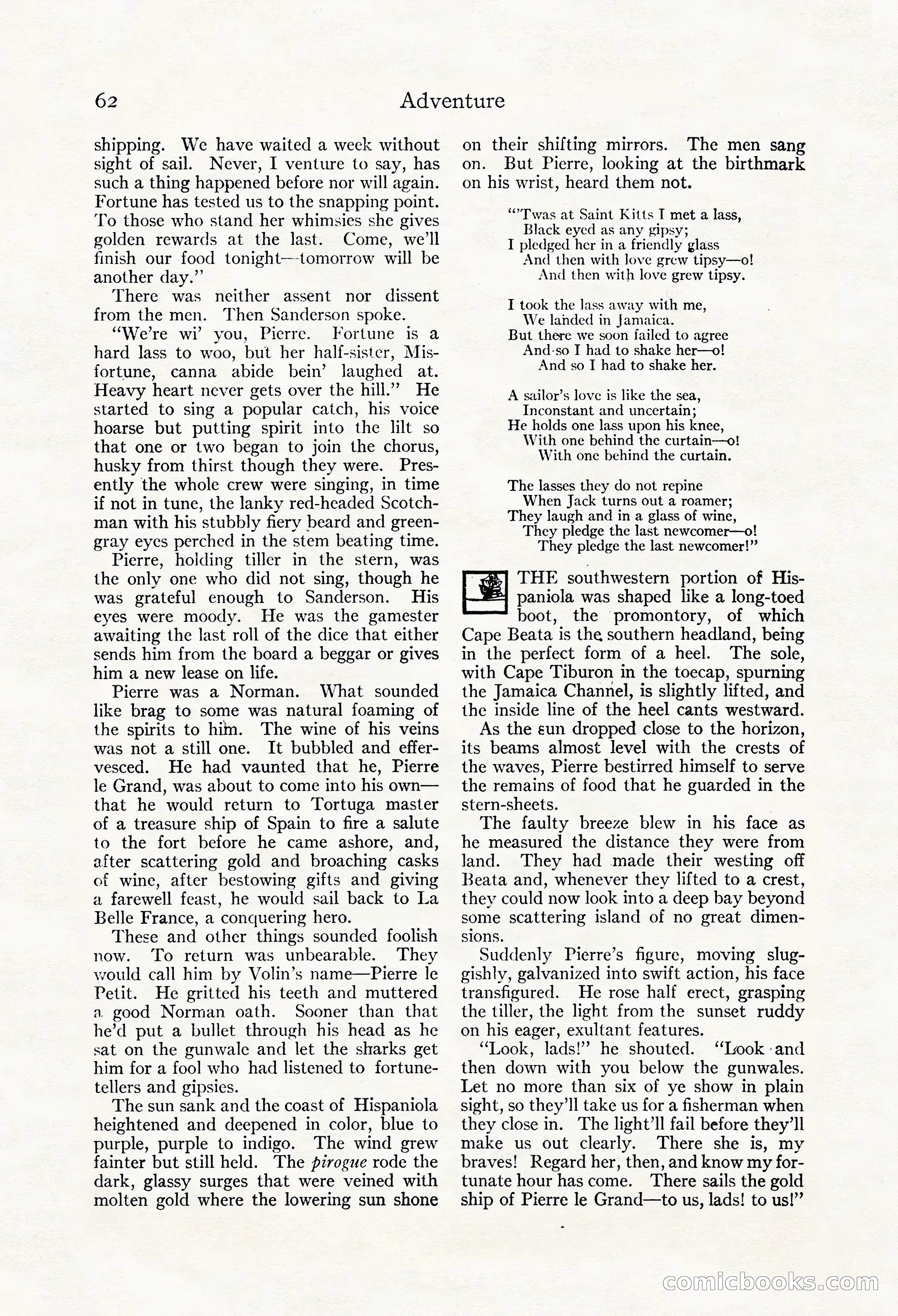
A restored page from Pulp Fiction, 1921. Page through the whole issue in the reader above.
📄 Transcribed text from this page (OCR, searchable)
Machine-transcribed from the original scan — historical spelling and the odd misread are preserved.
62 shipping. We have waited a week without sight of sail. Never, I venture to say, has such a thing happened before nor will again. Fortune has tested us to the snapping point. To those who stand her whimsies she gives golden rewards at the last. Come, we'll finish our food tonight—-tomorrow will be another day.”’ There was neither assent nor dissent from the men. Then Sanderson spoke. “We're wi’ you, Pierre. Fortune is a hard lass to woo, but her half-sister, Mis- fortune, canna abide bein’ laughed at. Heavy heart never gets over the hill.” He started to sing a popular catch, his voice hoarse but putting spirit into the lilt so that one or two began to join the chorus, husky from thirst though they were. Pres- ently the whole crew were singing, in time if not in tune, the lanky red-headed Scotch- man with his stubbly fiery beard and green- gray eyes perched in the stem beating time. Pierre, hoiding tiller in the stern, was the only one who did not sing, though he was grateful enough to Sanderson. His eyes were moody. He was the gamester awaiting the last roll of the dice that either sends him from the board a beggar or gives him a new lease on life. Pierre was a Norman. What sounded like brag to some was natural foaming of the spirits to him. The wine of his veins was not a still one. It bubbled and effer- vesced. He had vaunted that he, Pierre le Grand, was about to come into his own— that he would return to Tortuga master of a treasure ship of Spain to fire a salute to the fort before he came ashore, and, after scattering gold and broaching casks of wine, after bestowing gifts and giving a farewell feast, he would sail back to La Belle France, a conquering hero. These and other things sounded foolish now. To return was unbearable. They would call him by Volin’s name—Pierre le Petit. He gritted his teeth and muttered a. good Norman oath. Sooner than that he’d put a bullet through his head as he sat on the gunwale and let the sharks get him for a fool who had listened to fortune- tellers and gipsies. The sun sank and the coast of Hispaniola heightened and deepened in color, blue to purple, purple to indigo. The wind grew fainter but still held. The pirogue rode the dark, glassy surges that were veined with molten gold where the lowering sun shone Adventure on their shifting mirrors. The men sang on. But Pierre, looking at the birthmark on his wrist, heard them not. “°“Twas at Saint Kitts T met a lass, Black eyed as any gipsy; I pledged her in a friendly glass And then with love grew tipsy—o! And then with love grew tipsy. I took the Jass away with me, We landed in Jamaica. But there we soon failed to agree And:so I had to shake her—o! And so I had to shake her. A sailor’s love is like the sea, Inconstant and uncertain; He holds one lass upon his knee, With one behind the curtain—o! With one behind the curtain. The lasses they do not repine When Jack turns out a roamer; They laugh and in a glass of wine, They pledge the last newcomer—o! They pledge the last newcomer!”’ Ee THE southwestern portion of His- —#=} paniola was shaped like a long-toed boot, the promontory, of which Cape Beata is the southern headland, being in the perfect form of a heel. The sole, with Cape Tiburon in the toecap, spurning the Jamaica Channel, is slightly lifted, and the inside line of the heel cants westward. As the gun dropped close to the horizon, its beams almost level with the crests of the waves, Pierre bestirred himself to serve the remains of food that he guarded in the stern-sheets. | The faulty breeze blew in his face as he measured the distance they were from land. They had made their westing off Beata and, whenever they lifted to a crest, they could now look into a deep bay beyond some scattering island of no great dimen- sions. Suddenly Pierre’s figure, moving slug- gishly, galvanized into swift action, his face transfigured. He rose half erect, grasping the tiller, the light from the sunset ruddy on his eager, exultant features. “Look, lads!” he shouted. ‘Look -and then down with you below the gunwales. Let no more than six of ye show in plain sight, so they’ll take us for a fisherman when they close in. The light’ll fail before they’ll make us out clearly. There she is, my braves! Regard her, then, and know my for- tunate hour has come. There sails the gold ship of Pierre le Grand—to us, lads! to us!” GOmiGoooks ©