
Pulp Fiction, 1921 · page 20 of 204
Adventure Magazine Cover — page 20: what you’re looking at
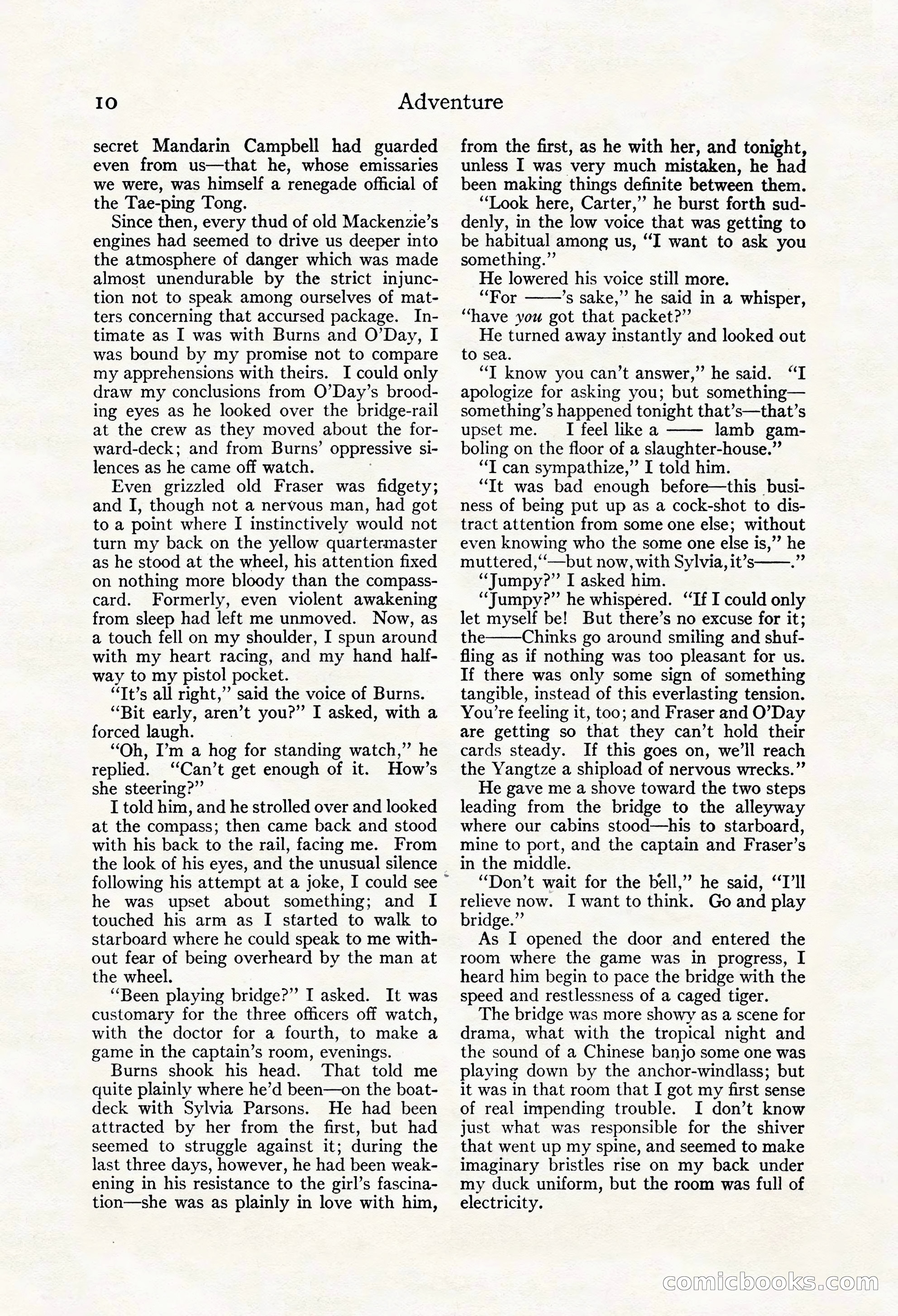
A restored page from Pulp Fiction, 1921. Page through the whole issue in the reader above.
📄 Transcribed text from this page (OCR, searchable)
Machine-transcribed from the original scan — historical spelling and the odd misread are preserved.
IO secret Mandarin Campbell had guarded even from us—that he, whose emissaries we were, was himself a renegade official of the Tae-ping Tong. Since then, every thud of old Mackenzie’s engines had seemed to drive us deeper into the atmosphere of danger which was made almost unendurable by the strict injunc- tion not to speak among ourselves of mat- ters concerning that accursed package. In- timate as I was with Burns and O’Day, I was bound by my promise not to compare my apprehensions with theirs. I could only draw my conclusions from O’Day’s brood- ing eyes as he looked over the bridge-rail at the crew as they moved about the for- ward-deck; and from Burns’ oppressive si- lences as he came off watch. Even grizzled old Fraser was fidgety; and I, though not a nervous man, had got to a point where I instinctively would not turn my back on the yellow quartermaster as he stood at the wheel, his attention fixed on nothing more bloody than the compass- card. Formerly, even violent awakening from sleep had left me unmoved. Now, as a touch fell on my shoulder, I spun around with my heart racing, and my hand half- way to my pistol pocket. “Tt’s all right,” said the voice of Burns. “Bit early, aren’t you?” I asked, with a forced laugh. . “Oh, I’m a hog for standing watch,’ he replied. ‘‘Can’t get enough of it. How’s she steering?” I told him, and he strolled over and looked at the compass; then came back and stood with his back to the rail, facing me. From the look of his eyes, and the unusual silence following his attempt at a joke, I could see © he was upset about something; and I touched his arm as I started to walk to starboard where he could speak to me with- out fear of being overheard by the man at the wheel. “Been playing bridge?” I asked. It was customary for the three officers off watch, with the doctor for a fourth, to make a game in the captain’s room, evenings. Burns shook his head. That told me quite plainly where he’d been—on the boat- deck with Sylvia Parsons. He had been attracted by her from the first, but had seemed to struggle against it; during the last three days, however, he had been weak- ening in his resistance to the girl’s fascina- tion—she was as plainly in love with him, Adventure from the first, as he with her, and tonight, unless I was very much mistaken, he had been making things definite between them. “Look here, Carter,’’ he burst forth sud- denly, in the low voice that was getting to be habitual among us, “I want to ask you something.” He lowered his voice still more. | “For ’s sake,” he said in a whisper, “have you got that packet?” He turned away instantly and looked out to sea. “T know you can’t answer,” he said. “I apologize for asking you; but something— something’s happened tonight that’s—that’s upset me. I feel like a lamb gam- boling on the floor of a slaughter-house.”’ “T can sympathize,” I told him. “It was bad enough before—this busi- ness of being put up as a cock-shot to dis- tract attention from some one else; without even knowing who the some one else is,” he muttered,‘‘—but now, with Sylvia, it’s——.” “Jumpy?” I asked him. ‘“Jumpy?” he whispered. “If I could only let myself be! But there’s no excuse for it; the Chinks go around smiling and shuf- fling as if nothing was too pleasant for us. If there was only some sign of something tangible, instead of this everlasting tension. You’re feeling it, too; and Fraser and O’Day are getting so that they can’t hold their cards steady. If this goes on, we'll reach the Yangtze a shipload of nervous wrecks.”’ He gave me a shove toward the two steps leading from the bridge to the alleyway where our cabins stood—his to starboard, mine to port, and the captain and Fraser’s in the middle. “Don’t wait for the bell,’”’ he said, “TI’ll relieve now. I want to think. Go and play bridge.”’ As I opened the door and entered the room where the game was in progress, I heard him begin to pace the bridge with the speed and restlessness of a caged tiger. The bridge was more showy as a scene for drama, what with the tropical night and the sound of a Chinese banjo some one was playing down by the anchor-windlass; but it was in that room that I got my first sense of real impending trouble. I don’t know just what was responsible for the shiver that went up my spine, and seemed to make imaginary bristles rise on my back under my duck uniform, but the room was full of electricity. GOMIIGoOO S (©) iin