
Pulp Fiction, 1921 · page 198 of 204
Adventure Magazine Cover — page 198: what you’re looking at
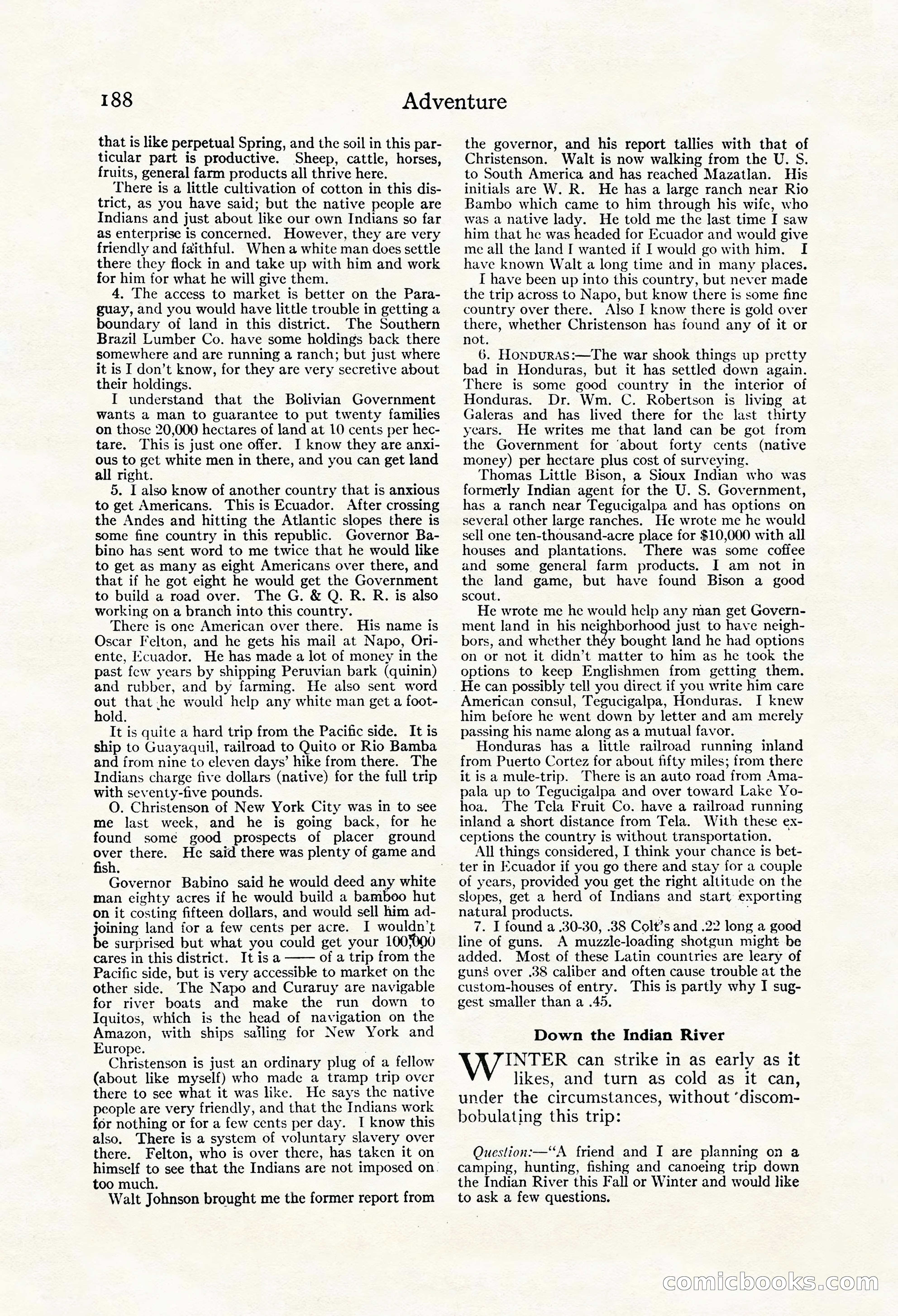
A restored page from Pulp Fiction, 1921. Page through the whole issue in the reader above.
📄 Transcribed text from this page (OCR, searchable)
Machine-transcribed from the original scan — historical spelling and the odd misread are preserved.
188 that is like perpetual Spring, and the soil in this par- ticular part is productive. Sheep, cattle, horses, fruits, general farm products all thrive here. There is a little cultivation of cotton in this dis- trict, as you have said; but the native people are Indians and just about like our own Indians so far as enterprise is concerned. However, they are very friendly and faithful. When a white man does settle there they flock in and take up with him and work for him for what he will give them. 4. The access to market is better on the Para- guay, and you would have little trouble in getting a boundary of land in this district. The Southern Brazil Lumber Co. have some holdings back there somewhere and are running a ranch; but just where it is I don’t know, for they are very secretive about their holdings. I understand that the Bolivian Government wants a man to guarantee to put twenty families on those 20,000 hectares of land at 10 cents per hec- tare. This is just one offer. I know they are anxi- ous to get white men in there, and you can get land all right. 5. I also know of another country that is anxious to get Americans. This is Ecuador. After crossing the Andes and hitting the Atlantic slopes there is some fine country in this republic. Governor Ba- bino has sent word to me twice that he would like to get as many as eight Americans over there, and that if he got eight he would get the Government to build a road over. The G. & Q. R. R. is also working on a branch into this country. There is one American over there. His name is Oscar Felton, and he gets his mail at Napo, Ori- ente, IXcuador. He has made a lot of money in the past few years by shipping Peruvian bark (quinin) and rubber, and by farming. He also sent word out that he would help any white man get a foot- old. It is quite a hard trip from the Pacific side. It is ship to Guayaquil, railroad to Quito or Rio Bamba and from nine to eleven days’ hike from there. The Indians charge five dollars (native) for the full trip with seventy-five pounds. O. Christenson of New York City was in to see me last week, and he is going back, for he found some good prospects of placer ground over there. fish. Governor Babino said he would deed any white man eighty acres if he would build a bamboo hut on it costing fifteen dollars, and would sell him ad- joining land for a few cents per acre. I wouldn't be surprised but what you could get your 100000 cares in this district. Itisa of a trip from the Pacific side, but is very accessible to market on the other side. The Napo and Curaruy are navigable for river boats and make the run down to Iquitos, which is the head of navigation on the Amazon, with ships sailing for New York and Europe. : Christenson is just an ordinary plug of a fellow (about like myself) who made a tramp trip over there to see what it was like. He says the native people are very friendly, and that the Indians work for nothing or for a few cents per day. I know this also. There is a system of voluntary slavery over there. Felton, who is over there, has taken it on himself to see that the Indians are not imposed on. too much. Walt Johnson brought me the former report from He said there was plenty of game and Adventure the governor, and his report tallies with that of Christenson. Walt is now walking from the U. 5S. to South America and has reached Mazatlan. His Initials are W. R. He has a large ranch near Rio Bambo which came to him through his wife, who was a native lady. He told me the last time I saw him that he was headed for Ecuador and would give me all the land I wanted if I would go with him. I have known Walt a long time and in many places. I have been up into this country, but never made the trip across to Napo, but know there is some fine country over there. Also I know there is gold over there, whether Christenson has found any of it or not. 6. HonpurAs:—The war shook things up pretty bad in Honduras, but it has settled down again. There is some good country in the interior of Honduras. Dr. Wm. C. Robertson is living at Galeras and has lived there for the last thirty years. He writes me that land can be got from the Government for ‘about forty cents (native money) per hectare plus cost of surveying. Thomas Little Bison, a Sioux Indian who was formerly Indian agent for the U. S. Government, has a ranch near Tegucigalpa and has options on several other large ranches. He wrote me he would sell one ten-thousand-acre place for $10,000 with all houses and plantations. There was some coffee and some general farm products. I am not in the land game, but have found Bison a good scout. He wrote me he would help any man get Govern- ment land in his neighborhood just to have neigh- bors, and whether théy bought land he had options on or not it didn’t matter to him as he took the options to keep Englishmen from getting them. He can possibly tell you direct if you write him care American consul, Tegucigalpa, Honduras. I knew him before he went down by letter and am merely passing his name along as a mutual favor. Honduras has a little railroad running inland from Puerto Cortez for about fifty miles; from there it is a mule-trip. There is an auto road from Ama- pala up to Tegucigalpa and over toward Lake Yo- hoa. The Tela Fruit Co. have a railroad running inland a short distance from Tela. With these ex- ceptions the country is without transportation. All things considered, I think your chance is bet- ter in Ecuador if you go there and stay for a couple of years, provided you get the right altitude on the slopes, get a herd of Indians and start exporting natural products. 7. I found a .30-30, .38 Colt’s and .22 long a good line of guns. A muzzle-loading shotgun might be added. Most of these Latin countries are leary of guns over .38 caliber and often cause trouble at the custom-houses of entry. This is partly why I sug- gest smaller than a .45. Down the Indian River INTER can strike in as early as it likes, and turn as cold as it can, under the circumstances, without ’discom- bobulating this trip: Question: —“A friend and I are planning on a camping, hunting, fishing and canoeing trip down the Indian River this Fall or Winter and would like to ask a few questions. CONMUG re) DOOKS (© iin