
Pulp Fiction, 1921 · page 113 of 204
Adventure Magazine Cover — page 113: what you’re looking at
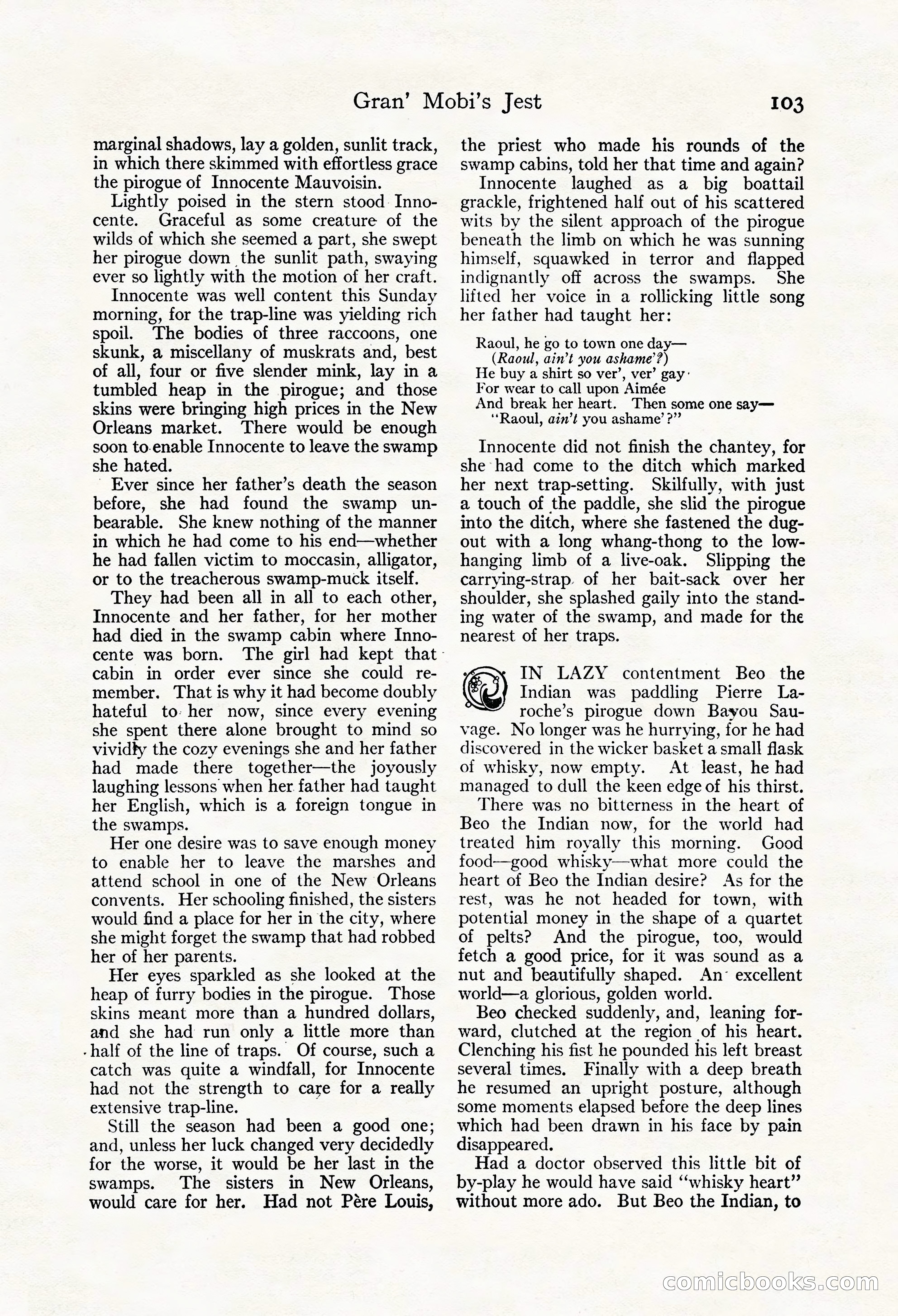
A restored page from Pulp Fiction, 1921. Page through the whole issue in the reader above.
📄 Transcribed text from this page (OCR, searchable)
Machine-transcribed from the original scan — historical spelling and the odd misread are preserved.
Gran’ Mobi’s Jest marginal shadows, lay a golden, sunlit track, in which there skimmed with effortless grace the pirogue of Innocente Mauvoisin. Lightly poised in the stern stood. Inno- cente. Graceful as some creature of the wilds of which she seemed a part, she swept her pirogue down the sunlit path, swaying ever so lightly with the motion of her craft. Innocente was well content this Sunday morning, for the trap-line was yielding rich spoil. The bodies of three raccoons, one skunk, a miscellany of muskrats and, best of all, four or five slender mink, lay in a tumbled heap in the pirogue; and those skins were bringing high prices in the New Orleans market. There would be enough soon to.enable Innocente to leave the swamp she hated. _ Ever since her father’s death the season before, she had found the swamp un- bearable. She knew nothing of the manner in which he had come to his end—whether he had fallen victim to moccasin, alligator, or to the treacherous swamp-muck itself. They had been all in all to each other, Innocente and her father, for her mother had died in the swamp cabin where Inno- cente was born. cabin in order ever since she could re- member. That is why it had become doubly hateful to: her now, since every evening she spent there alone brought to mind so vividty the cozy evenings she and her father had made there together—the joyously laughing lessons when her father had taught her English, which is a foreign tongue in the swamps. Her one desire was to save enough money to enable her to leave the marshes and attend school in one of the New Orleans convents. Her schooling finished, the sisters would find a place for her in the city, where she might forget the swamp that had robbed her of her parents. Her eyes sparkled as she looked at the heap of furry bodies in the pirogue. Those skins meant more than a hundred dollars, and she had run only a little more than -half of the line of traps. Of course, such a catch was quite a windfall, for Innocente had not the strength to care for a really extensive trap-line. Still the season had been a good one; and, unless her luck changed very decidedly for the worse, it would be her last in the swamps. The sisters in New Orleans, would care for her. Had not Pére Louis, The girl had kept that: 103 the priest who made his rounds of the swamp cabins, told her that time and again? Innocente laughed as a big boattail grackle, frightened half out of his scattered wits by the silent approach of the pirogue beneath the limb on which he was sunning himself, squawked in terror and flapped indignantly off across the swamps. She lifted her voice in a rollicking little song her father had taught her: Raoul, he go to town one day— (Raoul, ain't you ashame’?) He buy a shirt so ver’, ver’ gay: For wear to call upon Aimée And break her heart. Then some one say— “Raoul, ain’t you ashame’ 2?” Innocente did not finish the chantey, for she had come to the ditch which marked her next trap-setting. Skilfully, with just a touch of the paddle, she slid the pirogue into the ditch, where she fastened the dug- out with a long whang-thong to the low- hanging limb of a live-oak. Slipping the carrying-strap. of her bait-sack over her shoulder, she splashed gaily into the stand- ing water of the swamp, and made for the nearest of her traps. &) Indian was paddling Pierre La- roche’s pirogue down Bayou Sau- vage. No longer was he hurrying, for he had discovered in the wicker basket a small flask of whisky, now empty. At least, he had managed to dull the keen edge of his thirst. There was no bitterness in the heart of Beo the Indian now, for the world had treated him royally this morning. Good food—good whisky—what more could the heart of Beo the Indian desire? As for the rest, was he not headed for town, with potential money in the shape of a quartet of pelts? And the pirogue, too, would fetch a good price, for it was sound as a nut and beautifully shaped. An- excellent world—a glorious, golden world. Beo checked suddenly, and, leaning for- ward, clutched at the region of his heart. Clenching his fist he pounded his left breast several times. Finally with a deep breath he resumed an upright posture, although some moments elapsed before the deep lines which had been drawn in his face by pain disappeared. Had a doctor observed this little bit of by-play he would have said ‘‘whisky heart” without more ado. But Beo the Indian, to IN LAZY contentment Beo the GOMIIGHOO S (© iin