
Pulp Fiction, 1921 · page 99 of 204
Adventure Magazine Cover, October 10, 1921 — page 99: what you’re looking at
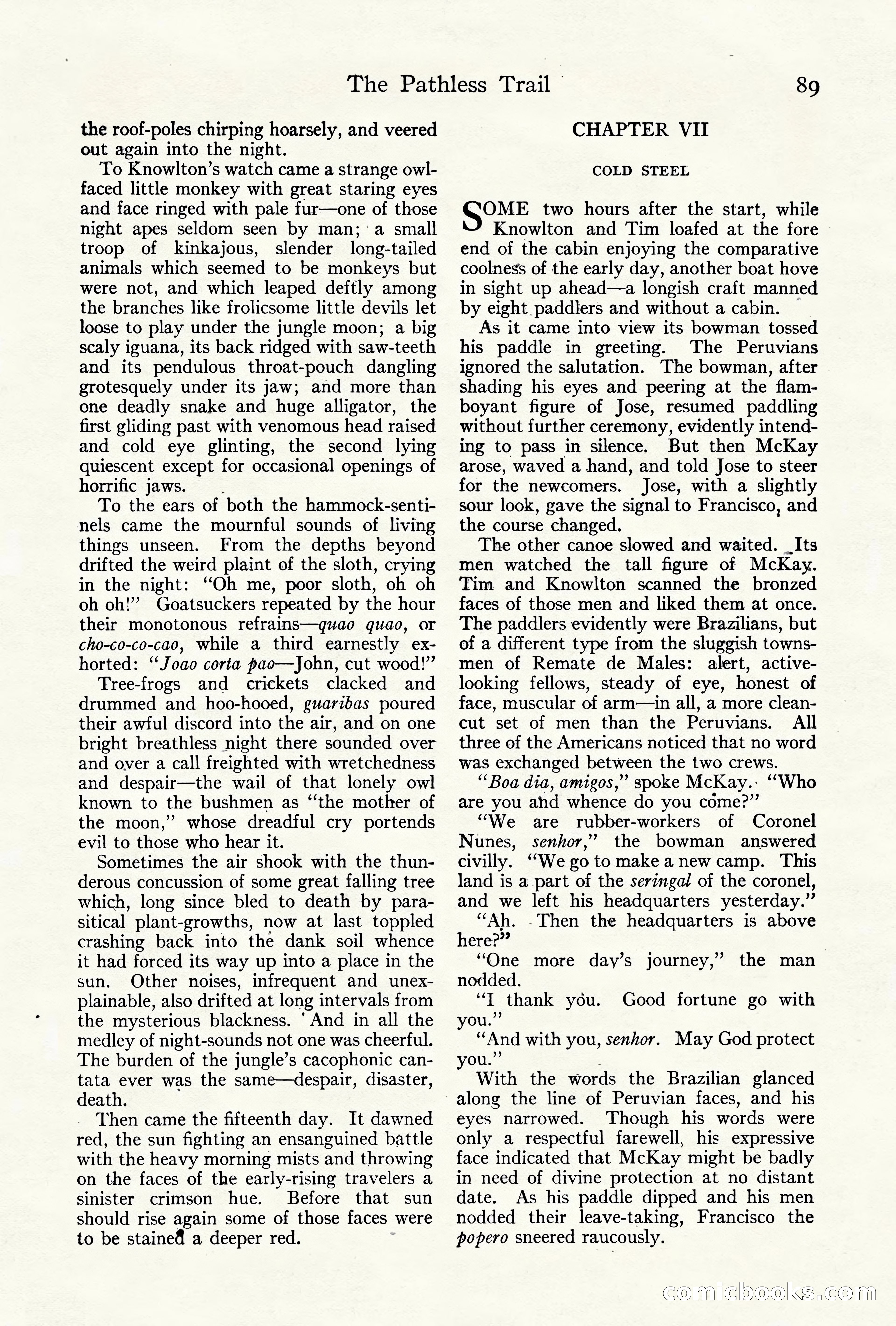
A restored page from Pulp Fiction, 1921. Page through the whole issue in the reader above.
📄 Transcribed text from this page (OCR, searchable)
Machine-transcribed from the original scan — historical spelling and the odd misread are preserved.
The Pathless Trail the roof-poles chirping hoarsely, and veered out again into the night. To Knowlton’s watch came a strange owl- faced little monkey with great staring eyes and face ringed with pale fur—one of those night apes seldom seen by man; ‘a small troop of kinkajous, slender long-tailed animals which seemed to be monkeys but were not, and which leaped deftly among the branches like frolicsome little devils let loose to play under the jungle moon; a big scaly iguana, its back ridged with saw-teeth and its pendulous throat-pouch dangling grotesquely under its jaw; and more than one deadly snake and huge alligator, the first gliding past with venomous head raised and cold eye glinting, the second lying quiescent except for occasional openings of horrific jaws. To the ears of both the hammock-senti- nels came the mournful sounds of living things unseen. From the depths beyond drifted the weird plaint of the sloth, crying in the night: ‘Oh me, poor sloth, oh oh oh oh!” Goatsuckers repeated by the hour their monotonous refrains—quao quao, or cho-co-co-cao, while a third earnestly ex- horted: “Joao corta pao—John, cut wood!” Tree-frogs and crickets clacked and drummed and hoo-hooed, guaribas poured their awful discord into the air, and on one bright breathless night there sounded over and over a call freighted with wretchedness and despair—the wail of that lonely owl known to the bushmen as “‘the mother of the moon,” whose dreadful cry portends evil to those who hear it. Sometimes the air shook with the thun- derous concussion of some great falling tree which, long since bled to death by para- sitical plant-growths, now at last toppled crashing back into the dank soil whence it had forced its way up into a place in the sun. Other noises, infrequent and unex- plainable, also drifted at long intervals from the mysterious blackness. ‘And in all the medley of night-sounds not one was cheerful. The burden of the jungle’s cacophonic can- tata ever was the same—despair, disaster, death. _ Then came the fifteenth day. It dawned red, the sun fighting an ensanguined battle with the heavy morning mists and throwing on the faces of the early-rising travelers a sinister crimson hue. Before that sun should rise again some of those faces were to be stainef a deeper red. 89 CHAPTER VII COLD STEEL OME two hours after the start, while Knowlton and Tim loafed at the fore end of the cabin enjoying the comparative coolness of the early day, another boat hove in sight up ahead—a longish craft manned by eight paddlers and without a cabin. As it came into view its bowman tossed his paddle in greeting. The Peruvians ignored the salutation. The bowman, after . shading his eyes and peering at the flam- boyant figure of Jose, resumed paddling without further ceremony, evidently intend- ing to pass in silence. But then McKay arose, waved a hand, and told Jose to steer for the newcomers. Jose, with a slightly sour look, gave the signal to Francisco, and the course changed. The other canoe slowed and waited. Its men watched the tall figure of McKay. Tim and Knowlton scanned the bronzed faces of those men and liked them at once. The paddlers evidently were Brazilians, but of a different type from the sluggish towns- men of Remate de Males: alert, active- looking fellows, steady of eye, honest of face, muscular of arm—in all, a more clean- cut set of men than the Peruvians. All three of the Americans noticed that no word was exchanged between the two crews. “Boa dia, amigos,” spoke McKay.: “‘Who are you ahd whence do you come?”’ “We are rubber-workers of Coronel Nunes, senhor,” the bowman answered civilly. “Wegotomakeanewcamp. This land is a part of the seringal of the coronel, and we left his headquarters yesterday.” ‘“‘Ah. -Then the headquarters is above here?” “One more day’s journey,” the man nodded. “T thank you. Good fortune go with you.” “And with you, senhor. May God protect you.” With the words the Brazilian glanced along the line of Peruvian faces, and his eyes narrowed. Though his words were only a respectful farewell, his expressive face indicated that McKay might be badly in need of divine protection at no distant date. As his paddle dipped and his men nodded their leave-taking, Francisco the popero sneered raucously. Co NOOK C@