
Pulp Fiction, 1921 · page 92 of 204
Adventure Magazine Cover, October 10, 1921 — page 92: what you’re looking at
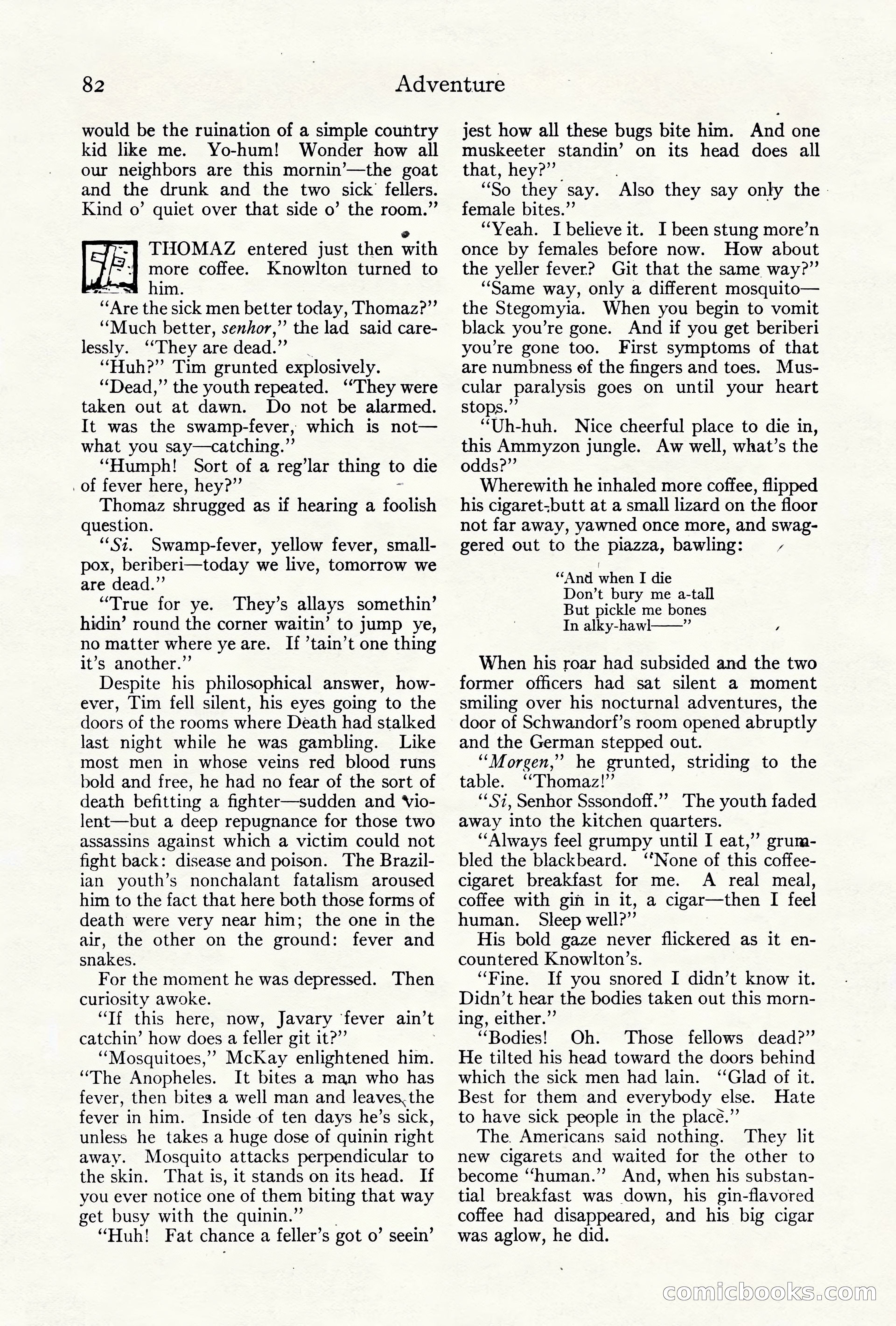
A restored page from Pulp Fiction, 1921. Page through the whole issue in the reader above.
📄 Transcribed text from this page (OCR, searchable)
Machine-transcribed from the original scan — historical spelling and the odd misread are preserved.
82 would be the ruination of a simple country kid like me. Yo-hum! Wonder how all our neighbors are this mornin’—the goat and the drunk and the two sick’ fellers. Kind o’ quiet over that side o’ the room.” more coffee. Knowlton turned to Se him. “Are the sick men better today, Thomaz?”’ ‘Much better, senhor,” the lad said care- lessly. ‘““They are dead.” ‘ “Huh?” Tim grunted explosively. “Dead,” the youth repeated. ‘“They were taken out at dawn. Do not be alarmed. It was the swamp-fever, which is not— what you say—catching.”’ “Humph! Sort of a reg’lar thing to die _of fever here, hey?” Thomaz shrugged as if hearing a foolish question. ‘Si. Swamp-fever, yellow fever, small- pox, beriberi—today we live, tomorrow we are dead.” “True for ye. They’s allays somethin’ hidin’ round the corner waitin’ to jump ye, no matter where ye are. If ’tain’t one thing it’s another.”’ Despite his philosophical answer, how- ever, Tim fell silent, his eyes going to the doors of the rooms where Death had stalked last night while he was gambling. Like most men in whose veins red blood runs bold and free, he had no fear of the sort of death befitting a fighter—sudden and ‘Vio- lent—but a deep repugnance for those two assassins against which a victim could not fight back: disease and poison. The Brazil- ian youth’s nonchalant fatalism aroused him to the fact that here both those forms of death were very near him; the one in the air, the other on the ground: fever and snakes. For the moment he was depressed. Then curiosity awoke. “If this here, now, Javary fever ain’t catchin’ how does a feller git it?” “Mosquitoes,” McKay enlightened him. “The Anopheles. It bites a man who has fever, then bites a well man and leaves.the fever in him. Inside of ten days he’s sick, unless he takes a huge dose of quinin right away. Mosquito attacks perpendicular to the skin. That is, it stands on its head. If you ever notice one of them biting that way get busy with the quinin.”’ “Huh! Fat chance a feller’s got 0’ seein’ THOMAZ entered just then vith Adventure jest how all these bugs bite him. And one muskeeter standin’ on its head does all that, hey?” “So they say. Also they say only the. female bites.” “Yeah. I believe it. I been stung more’n once by females before now. How about the yeller fever? Git that the same way?” “Same way, only a different mosquito— the Stegomyia. When you begin to vomit black you’re gone. And if you get beriberi you're gone too. First symptoms of that are numbness of the fingers and toes. Mus- cular paralysis goes on until your heart stops.” “Uh-huh. Nice cheerful place to die in, this Ammyzon jungle. Aw well, what’s the odds?” Wherewith he inhaled more coffee, flipped his cigaret-butt at a small lizard on the floor not far away, yawned once more, and swag- gered out to the piazza, bawling: ‘‘And when I die Don’t bury me a-tall But pickle me bones In alky-hawl 4 When his roar had subsided and the two former officers had sat silent a moment smiling over his nocturnal adventures, the door of Schwandorf’s room opened abruptly and the German stepped out. “Morgen,” he grunted, striding to the table. ‘“Thomaz!”’ ‘Sz, Senhor Sssondoff.”’ The youth faded away into the kitchen quarters. ‘“‘Always feel grumpy until I eat,” grum- bled the blackbeard. ‘None of this coffee- cigaret breakfast for me. A real meal, coffee with gin in it, a cigar—then I feel human. Sleep well?” His bold gaze never flickered as it en- countered Knowlton’s. “Fine. If you snored I didn’t know it. Didn’t hear the bodies taken out this morn- ing, either.” “Bodies! Oh. ‘Those fellows dead?” He tilted his head toward the doors behind which the sick men had lain. “Glad of it. Best for them and everybody else. Hate to have sick people in the place.” The. Americans said nothing. They lit new cigarets and waited for the other to become “‘human.’”’ And, when his substan- tial breakfast was down, his gin-flavored coffee had disappeared, and his big cigar was aglow, he did. DOOLK C©